June theme: Celtic Iron Age
Introduction
June's theme is linguistic influence early Iron Age Celtic. The rest of the month will focus on words that were borrowed from Gaulish into Latin (more things like the aside in today's families that the very iconic Latin word gladius being borrowed from Gaulish), but I'm going to start out with exploring some of the names of Celtic peoples. This was originally going to be a compare and contrast of two different families, but it ballooned into 3-4.
First, there's the fairly ridiculous fact that Latin word Gallus/Gallia is unrelated to the French Gaule/Gaulois (whence English Gaul) of the same meaning. The regular descendant in French of Gallia would be Jaille, which does in fact appear in a handful of place names in western France, e.g. La Jaille-Yvon, Saint-Mars-la-Jaille. Gaule is from Frankish instead, and is cognate to English Wales.
Celt/Κελτοί/Celtae may be from the same origin as Gallus, but might not. I present Celt and Gallus from two different sources here, but both are uncertain, being only attested in borrowings and not in any native forms. Either could actually be from the source shown for the other.
The Irish Gael is from another source again: Proto-Celtic *wēdelos: "woodsy, woodsman".
Nota Bene: Even just within English words, descendants of *walhaz refer to foreigners of at least three different branches of Indo-European: Celtic (the Welsh), Italic (the Walloons and Wallachians), and Indo-Iranian (the Vlax Romani).
Nota Bene 2: In Irish Gael means "Irish", gall means "not Irish". Gall-Ghàidheal (English Galloway) is a compound of the two meaning "Foreign-Irish"—that is, the Gaelic-speaking descendants of Norse settlers in south-west Scotland.
Teaser
Galatians,
Donegal,
Galloway,
Portugal,
Wallachia,
Vlach,
Wales,
Gaul,
walnut,
Celt,
Zelda,
gladiator,
claymore,
coup,
hilt,
Gael,
Galloway,
divide,
wide,
widow,
guy,
guy
Full Text
-
Proto-Indo-European *kelh₂- to beat, to break, to fight
-
Proto-Indo-European *kelh₂ti primary verb form
-
Balto-Slavic
- Lithuanian kálti to hammer
-
Celtic *kelto to fight, to war
-
Celtic *kellāko fight, war
-
Old Irish
- Irish cellach battle, strife, contention
-
Gaulish ? tribe name meaning "warriors"?
-
Classical Greek Κελτοί Keltoí Celts, Gauls
-
Latin Celtae
-
English Celt
- Japanese ケルト人 kerutojin Celt
-
Latin Celtiberi Celtiberian
-
English Celtiberian
- Translingual xce ISO 639 code for Celtiberian with x for "extinct"
-
Hellenic
- Classical Greek κλάω kláō I break
-
Italic *kellezi to beat
-
Italic *perkellezi to thoroughly beat
- Latin percellere to beat down, to overthrow, to smite
-
Proto-Indo-European *kelh₂tís
-
Germanic *hildiz battle
-
East Germanic
-
North Germanic
-
Old Norse hildr battle
-
Old Norse Gunnhildr personal name: Battle-Maiden lit. "battle-battle but in naming context, "battle maiden"
-
Middle English Gunilda
-
Middle English Domina Gunilda a huge ballista mounted at Windsor Castle in the 14th C
-
English gun or from another such nicknamed weapon
- Icelandic hildur
-
West Germanic
-
Germanic *Grīsahildiz personal name: Grey-Battle
-
Germanic *Hildirīks personal name: Battle-King
-
East Germanic
-
Vandalic *Hildireiks
-
Latin Hildericus Vandal king, c. 530
-
Central Romance
- English Hilderic
-
West Germanic
-
Frankish *Hildirīk
-
Latin Childericus Frankish king c. 450
- Dutch Hilderik
-
Germanic *Albihildiz personal name: Elf-Battle
-
Germanic *Mahtihildiz personal name: Strength-Battle
-
Italic
- Latin clādes a breaking, destruction
-
Proto-Indo-European *kl̥h₂dos
-
Hellenic
-
Classical Greek κλάδος kládos branch, twig, arm
- Greek κλάδος kládos branch, bough, clade
- English clade
-
Celtic *kladiwos
-
Brythonic *klėðɨβ̃
- Breton klezeñv sword
- Cornish kledha sword
- Welsh cleddyf sword, blade
-
Gaulish *kladyos
-
Latin gladius sword
-
Central Romance
-
Western Romance
-
French glaive gladius, short sword
- English gladius
- Italian gladio sword, rapier
-
Latin gladiātor swordsman, gladiator
-
Latin gladiolus little sword, knife, sword lily, gladiolus
-
Old Irish claideb sword
-
Brythonic *klėðɨβ̃
- Breton klezeñv sword
- Cornish kledha sword
- Welsh cleddyf sword, blade
- Irish claíom sword
- Manx cliwe sword
-
Scottish Gaelic claidheamh sword
-
Scottish Gaelic claidheamh mòr great sword
-
Proto-Indo-European *kelh₂do
-
Germanic *heltą handle, hilt
-
North Germanic
-
Old Norse hjalt hilt
-
Old East Norse
-
Old West Norse
-
West Germanic *helt
-
Old English hilt
- Old High German helza
-
Proto-Indo-European *kolh₂do
-
Germanic *hultą wood, timber, grove
-
North Germanic
-
Old Norse holt
- Danish holt
- Icelandic holt hillock, wood
-
West Germanic *holt
-
Old English holt wood, timber, grove
-
Frankish holt
-
Old High German holz wood
-
Middle High German holz
- German Holz wood, a piece of wood, grove
- Yiddish האָלץ holts a piece of wood, wooden block
-
Proto-Indo-European *kl̥h₂yo-?
-
Celtic *kallī-
-
Brythonic
- Cornish kelli grove
- Welsh celli copse, grove, woodland
-
Old Irish caill forest, woodland
- Irish coill forest, woodland
- Manx keyll forest, woodland
-
Scottish Gaelic coille forest
-
Scottish Gaelic capall-coille capercaillie lit. "horse of the forest"
-
Scots capercailȝie / capercailzie
-
Proto-Indo-European *kolh₂ti
-
Balto-Slavic
- Lithuanian kùlti to hit
-
Slavic *kòlti to stab, to sting
-
East Slavic
- Russian колоть kolotʹ to stab, to break, to split, to prick
-
South Slavic
- Serbo-Croatian клати klati to chop, to cut, to butcher
-
West Slavic
- Polish kłuć to prick, to prickle
-
Proto-Indo-European *kolh₂-p?-yos
-
Hellenic
-
Classical Greek κολάπτω koláptō I knock, I peck, I hew
-
Classical Greek δρυοκολάπτης druokoláptis woodpecker
- Greek δρυοκολάπτης dryokoláptis woodpecker
-
Classical Greek κόλαφος kólaphos a buffet, a blow, a peck
- Greek κόλαφος kólafos a slap
-
Latin colaphus a blow, a cuff
-
Central Romance
- Italian colpo blow, shock, shot
-
Western Romance
-
French coup blow, hit, strike, any fast action
- English coup
-
French coupé cut, shortened
-
French coup d'État coup d'état
-
English coup d'état
- Japanese クーデター kūdetā coup d'état
- Spanish golpe blow, knock, bump, beat, rhythm, surprise
-
Vulgar Latin *colpāre to strike, to cut
-
Vulgar Latin *colpaticium having been cut
-
Proto-Indo-European *kelh₂d- *kelh₂-dʰh₁-
-
Celtic *kladeti stabs, digs
-
Brythonic *klėðɨd
-
Old Irish claidid to dig
- Irish claidh to dig
-
Old Irish clad ditch, trench, earthwork
-
Irish claí dry-stone wall, ditch, dike
- Irish Claí Mór na Réaltaí the Milky Way, the Great Dike of Stars
-
Proto-Indo-European *gelH-
-
Celtic *galā valor, ability
-
Brythonic
- Welsh gallu ability, might, power
-
Old Irish gal valor, fighting spirit
-
Irish gal valor, fury, steam
- Irish láth gaile warrior
- Irish tuirbín gaile steam turbine
-
Celtic *Wirogalos personal name: Man-Valor
-
Brythonic *Gwɨroɣal
- Old Breton Uurgual
- Middle Welsh Gurgal
-
Old Irish Fergal
-
Celtic
-
Brythonic
- Welsh gâl enemy, adversary, wrath, enmity
-
Old Irish gall foreigner, Gaul, Norseman
-
Old Irish Dún inna nGall place name: Fort of the Norsemen, Donegal
-
Irish Dún na nGall Donegal
-
Middle Irish
- Irish gall foreigner, Gaul, Norman, Englishman, Anglified Irish person
-
Scottish Gaelic gall / Gall foreigner, Lowland Scottish
- Scottish Gaelic gall-chnò walnut
-
Old Irish gall óglaigh foreign/norse warrior, gallowglass
-
Irish gallóglaigh gallowglass
- Old Irish Gall-Goídel Norse-Irish, foreign-Irish Gaelic speaking descendants of Norse settlers
-
Old Irish
-
Irish Dubhghall personal name: Dark-(haired)-Norseman/Foreigner
- English Dougal
-
Irish Ó Dubhghaill surname: descendant of Dubhghall
-
Gaulish ? tribe name meaning "valorous"?
-
Classical Greek Γαλάτης Galátēs Galatian, Gaul
-
Classical Greek Γαλατία Galatíā Galatia, Gaul
-
Latin Galatia Galatia place in Asia Minor settled by Celtic peoples around 4th C BCE
-
English Galatia
-
English Galatian
- Translingual xga ISO 639 code for Galatian with x for "extinct"
- English Galatians
-
Latin Gallia tribe name meaning "valorous"?
- Latin Gallia Lugdūnēnsis
-
Old Irish gall foreigner, Gaul, Norseman
-
Old Irish Dún inna nGall place name: Fort of the Norsemen, Donegal
-
Irish Dún na nGall Donegal
-
Middle Irish
- Irish gall foreigner, Gaul, Norman, Englishman, Anglified Irish person
-
Scottish Gaelic gall / Gall foreigner, Lowland Scottish
- Scottish Gaelic gall-chnò walnut
-
Old Irish gall óglaigh foreign/norse warrior, gallowglass
-
Irish gallóglaigh gallowglass
- Old Irish Gall-Goídel Norse-Irish, foreign-Irish Gaelic speaking descendants of Norse settlers
-
Old Irish
-
Irish Dubhghall personal name: Dark-(haired)-Norseman/Foreigner
- English Dougal
-
Irish Ó Dubhghaill surname: descendant of Dubhghall
-
Western Romance
-
French Jaille
- French Saint-Mars-la-Jaille place name: Holy Mars the Gaul
- French La Jaille-Yvon place name: the Gaul Yvon
-
Classical Greek Γαλλία Gallíā Gaul
- Greek Γαλλία Gallía France
- Welsh Gâl Gaul
-
New Latin gallium
- Translingual Ga
- English gallium
-
Latin gallicus Gallic, Gaulish
- English Gallic
-
Latin gallicula
-
Western Romance
-
Old French galoche
-
Middle French
-
Middle English galoche
- English galosh / galoshes
-
Latin gallaecus
-
Western Romance
-
Galician galego Galician
- Translingual glg ISO 639 code for Galician
-
Latin Gallaeci
-
Latin Gallaecia land of the Gallaeci
-
Latin Callus a city in Gallaecia
-
Latin Portus Callus Port of Callus
-
Western Romance
-
Portuguese Porto
-
Portuguese Portugal
-
Gaulish ? tribe name meaning "valorous"?
-
Classical Greek Γαλάτης Galátēs Galatian, Gaul
-
Classical Greek Γαλατία Galatíā Galatia, Gaul
-
Latin Galatia Galatia place in Asia Minor settled by Celtic peoples around 4th C BCE
-
English Galatia
-
English Galatian
- Translingual xga ISO 639 code for Galatian with x for "extinct"
- English Galatians
-
Latin Gallia tribe name meaning "valorous"?
- Latin Gallia Lugdūnēnsis
-
Old Irish gall foreigner, Gaul, Norseman
-
Old Irish Dún inna nGall place name: Fort of the Norsemen, Donegal
-
Irish Dún na nGall Donegal
-
Middle Irish
- Irish gall foreigner, Gaul, Norman, Englishman, Anglified Irish person
-
Scottish Gaelic gall / Gall foreigner, Lowland Scottish
- Scottish Gaelic gall-chnò walnut
-
Old Irish gall óglaigh foreign/norse warrior, gallowglass
-
Irish gallóglaigh gallowglass
- Old Irish Gall-Goídel Norse-Irish, foreign-Irish Gaelic speaking descendants of Norse settlers
-
Old Irish
-
Irish Dubhghall personal name: Dark-(haired)-Norseman/Foreigner
- English Dougal
-
Irish Ó Dubhghaill surname: descendant of Dubhghall
-
Western Romance
-
French Jaille
- French Saint-Mars-la-Jaille place name: Holy Mars the Gaul
- French La Jaille-Yvon place name: the Gaul Yvon
-
Classical Greek Γαλλία Gallíā Gaul
- Greek Γαλλία Gallía France
- Welsh Gâl Gaul
-
New Latin gallium
- Translingual Ga
- English gallium
-
Latin gallicus Gallic, Gaulish
- English Gallic
-
Latin gallicula
-
Western Romance
-
Old French galoche
-
Middle French
-
Middle English galoche
- English galosh / galoshes
-
Latin gallaecus
-
Western Romance
-
Galician galego Galician
- Translingual glg ISO 639 code for Galician
-
Latin Gallaeci
-
Latin Gallaecia land of the Gallaeci
-
Latin Callus a city in Gallaecia
-
Latin Portus Callus Port of Callus
-
Western Romance
-
Portuguese Porto
-
Portuguese Portugal
-
Proto-Indo-European *gʷʰelk- *gʷʰeHlk- hawk?
-
Proto-Indo-European *gʷʰólkos
-
Celtic *wolkos *gʷolkos hawk?
-
Celtic *katuwolkos personal name?, epithet?: Battle-Hawk
-
Brythonic
-
Gaulish *Catuuolcos Battle-Hawk?
-
Brythonic *gwalx hawk, hero?
-
Brythonic *Gwalx-gwɨnn? personal name: White-Hawk?
-
Old Breton
- Old French Gauvain / Galvain Gawain
-
Brythonic *Gwalx-mae? personal name: May-Hawk?
-
Old Breton
- Breton Gwalc'hmoei
-
Old French Gauvain / Galvain
-
Middle French
-
Middle English Gawayne
- Middle Dutch Walewein
- Old West Norse Valven
- Middle Dutch Walewein
- Italian Galvagino
-
Old Welsh
- Breton gwalc'h hawk, falcon
- Welsh gwalch hawk, rogue, rascal
-
Brythonic *Gwalx-haβ̃-öð personal name: Summery-Hawk?
-
Gaulish *Uolk-? tribe name of unknown native form
- Latin Volcae Gaulish tribe
-
Germanic *walhaz foreigner, southerner, speaker of a Celtic or Romance language
-
Germanic *walhahnuts walnut
-
North Germanic
-
Old Norse valhnot walnut
- Danish valnød walnut
- Icelandic valhneta walnut
-
West Germanic
-
Old English walhhnutu walnut
-
Frankish
-
Old High German
- German Walnuss walnut
- Yiddish וועלשענער נוס velshener nus walnut
-
East Germanic
-
Gothic *walhs
-
Slavic *vòlxъ Roman, Romance speaker
-
East Slavic волохъ voloxŭ
- Russian волох volox Romanic person, Italian, Romanian archaic
-
South Slavic
-
Serbo-Croatian Влах / Vlah Vlach/Romanian, an (Eastern) Orthodox Christian (perjorative), Italian (archaic)
-
Old Church Slavonic влахъ vlaxŭ
-
Byzantine Greek Βλάχος Blákhos Eastern Romance speaker, Vlach
- Greek Βλάχος Vláchos Vlach/Romanian
- Turkish Eflak Wallachia
- Hungarian oláh Vlach/Romanian
-
English Vlach
-
West Slavic
-
German Walachei Wallachia
-
North Germanic
-
Old Norse Valir Southerners, Celts, Romans
- Old Norse Valland Land of the Celts/Romans, Gaul
-
West Germanic
-
Old English wealh foreigner, Celt, Welshman, slave, serf
-
Old English Wealas foreigners, the Welsh, Wales
-
Old English Cornwealas the Cornish Welsh, Cornwall
- English Wales
-
Old French Gales Wales
-
Middle French Galles Wales
-
Old French Galois Welsh, Welshman
-
Old French *Gui li Galois Guy the Welshman
-
Middle French Giglan / Guinglain
-
Middle High German Wigalois / Gwigalois
-
Danish Viegoleis
- English Wigalois
-
Middle French Gallois
- French gallois Welsh, Welsh language
- French Gallois Welshman
-
Middle French Galois surname: Welshman
-
French Galois
-
French Évariste Galois
-
French théorie de Galois Galois theory
-
French corps de Galois Galois field
-
Old High German walh
-
German Walen-
- German Walensee place name: Roman Sea
- German Walchwil place name: Romanville
-
Frankish *walh
-
French Gaule Gaul
- Dutch Waal river in Netherlands
-
Walon walon endonym French-speakers in Belgium
-
French wallon French-speakers in Belgium, walloon
-
Germanic *walhiskaz foreign, Celtic, Roman
-
North Germanic
-
Old Norse
- Swedish välsk southern, foreign, esp. French or Italian
-
West Germanic *walhisk
-
Old English wīelisċ foreign, not English, esp. Celtic/British/Welsh
-
English Welsh
-
English Welsh Romani
- Translingual rmw ISO 639 code for Welsh Romani
- English Wallace
-
Frankish *walsk
-
Old High German walahisc
-
German welsch pertaining to Romance-speaking parts of Switzerland, Welsh, foreign
-
German Rotwelsch a cant from southern Germany lit. "red-foreign", where "red" is used to mean "beggar, itinerant"
- English welsh onion generic sense of "foreign", being from China not Wales
-
Proto-Indo-European *gʷʰHlkō
-
Pre-Proto-Indo-European **dV-?
-
Pre-Proto-Indo-European **de-ḱm̥t? two hands?
-
Proto-Indo-European *déḱm̥ ten oblique stem *dḱm̥t-
-
Proto-Indo-European *Hoḱtódḱomt *oḱtódḱomt *oḱtódḱomt eighty
-
Old Armenian ութսուն utʻsun eighty
- Armenian ութսուն utʻsun eighty
-
Celtic *oxtmākonts
-
Old Irish ochtmoga eighty
-
Germanic *ahtōuthundą *ahtōutēhundą eighty
-
East Germanic
- Gothic 𐌰𐌷𐍄𐌰𐌿𐍄𐌴𐌷𐌿𐌽𐌳 ahtautēhund eighty
-
Hellenic *oktṓkontə eighty
-
Classical Greek ὀγδοήκοντα ogdoḗkonta eighty
- Greek ογδόντα ogdónta eighty
-
Indo-Iranian *aštaHtí eighty
-
Indo-Aryan *aśiHtíṣ eighty
-
Sanskrit 𑀅𑀰𑀻𑀢𑀺 aśītí eighty
-
Elu
- Dhivehi އާހި āhi eighty
- Sinhala අසූව asūwa eighty
-
Magadhi
-
Maharashtri
- Marathi ऐंशी aiuśī eighty
-
Sauraseni
-
Iranian *aštaHtí eighty
- Pashto اتیا atyā eighty
-
Western Iranian
-
Northwestern Iranian
-
Old Persian
-
Middle Persian
- Persian هشتاد haštâd eighty
-
Italic *oktōkentā eighty
-
Latin octōgintā eighty
-
Latin octāgintā eighty variant
-
Central Romance
- Dalmatian otuonta eighty
- Italian ottanta eighty
-
Insular Romance
-
Western Romance
-
Old French uitante eighty
- French huitante eighty (regional)
-
Old French octante eighty
- French octante eighty (regional)
- Spanish ochenta eighty
-
Old French octante eighty
- French octante eighty (regional)
-
Tocharian
- Arshian oktuk
- Kushean oktamka
-
Proto-Indo-European *pénkʷedḱomt fifty
-
Old Armenian յիսուն yisun fifty
- Armenian հիսուն hisun fifty
-
Hellenic
-
Classical Greek πεντήκοντα pentḗkonta fifty
- Greek πενήντα penínta fifty
-
Classical Greek πεντηκοστή pentēkostḗ fiftieth, Pentecost
-
Latin Pentēcostē Pentecost
-
Indo-Iranian *pančaHćát
-
Indo-Aryan
-
Sanskrit 𑀧𑀜𑁆𑀘𑀸𑀰𑀢𑁆 pañcāśát fifty
-
Elu
- Dhivehi ފަންސާސް fan̊sās fifty
- Sinhala පනහ panaha fifty
-
Magadhi
- Bengali পঞ্চাশ pôncash fifty
- Pali 𑀧𑀜𑁆𑀜𑀸𑀲 paññāsa fifty
-
Sauraseni
-
Iranian
- Avestan 𐬞𐬀𐬧𐬗𐬁𐬯𐬀𐬙 paṇcāsat fifty
-
Western Iranian
-
Northwestern Iranian
-
Old Persian
- Persian پنجاه panjâh fifty
-
Italic *kʷenkʷekentā
-
Latin quīnquāgintā fifty
-
Vulgar Latin *cīnquāgintā fifty
-
Central Romance
-
Insular Romance
- Sardinian chimbanta fifty
-
Western Romance
-
Old French cinquante / chinquante
- Spanish cincuenta fifty
-
Tocharian
-
Proto-Indo-European *kʷetwr̥dḱomt forty
- Old Armenian քառասուն kʿaṙasun forty
-
Balto-Slavic
- Lithuanian keturiasdešimt forty
-
Hellenic
-
Classical Greek τεσσαράκοντα tessarákonta forty
- Greek σαράντα saránta forty re-bracketed, with the tes- interpreted as a definite article
-
Indo-Iranian *čatwārHćát forty
-
Indo-Aryan *ćatwārHśát forty
-
Sanskrit 𑀘𑀢𑁆𑀯𑀸𑀭𑀺𑀁𑀰𑀢𑁆 catvāriṃśát forty
-
Prakrit *catwaliśá
-
Elu
- Sinhala හතළිහ hataḷiha forty
-
Magadhi
- Bengali চল্লিশ côlliś forty
-
Sauraseni
-
Iranian *čatwārHcát forty
-
Western Iranian
-
Northwestern Iranian
-
Old Persian
-
Italic *kʷatrukentā
-
Latin quadrāgintā forty
-
Central Romance
-
Italian quaranta forty
- Italian quarantina about forty, forty days
-
Venetian quaranta forty
-
Venetian quarantena about forty, forty days
-
Latin quadrāgēsimus fortieth
-
Latin quadrāgēsima Lent, Christian forty day fast
-
Vulgar Latin *quarēsima
-
Central Romance
-
Eastern Romance
-
Insular Romance
-
Western Romance
-
Old French caresme
-
Old Spanish quaraesma
- Albanian kreshmë Lent
-
Old Irish Corgus
- Welsh Grawys Lent
-
Proto-Indo-European *h₁néwn̥dḱomt *h₁néwn̥ḱm̥tom *h₁néwn̥ḱm̥th₂ *h₁nunēḱomth₂ *h₁néwn̥ḱōmt ninety
- Old Armenian իննսուն innsun ninety
- Balto-Slavic *newinśimta ninety
- Celtic *naukontes ninety
-
Germanic *newunhundą *newunthundą *newuntēhundą ninety
-
East Germanic
- Gothic 𐌽𐌹𐌿𐌽𐍄𐌴𐌷𐌿𐌽𐌳 niuntēhund ninety
-
Proto-Indo-European *septḿ̥dḱomt seventy
-
Celtic *sextamākonts seventy
-
Old Irish sechtmoga seventy
-
Italic *septməkentā
- Latin septuāgintā seventy
-
Tocharian
-
Proto-Albanian *detsati
-
Old Armenian տասն tasn ten
-
Balto-Slavic *dešimtis ten
- Lithuanian dešimt ten
-
Slavic *desętь
-
East Slavic десѧть desętĭ ten
- Russian десять desjatʹ ten
-
South Slavic
- Old Church Slavonic десѧть desętĭ ten
- Serbo-Croatian десет / deset ten
-
West Slavic
-
Celtic *dekam ten
-
Brythonic *deg
-
Old Irish deich ten
-
Germanic *tehun ten
-
Germanic *ahtōutehun eight-ten, eighteen
-
North Germanic
-
Old Norse áttján / átján eighteen
-
Old East Norse
-
Danish atten eighteen
-
Danish atto- SI prefix for 10 to the -18
-
West Germanic
-
Old English eahtatīene / eahtatȳne / eahtatēne eighteen
-
Middle English eightetene / ehtetene / auhtene eighteen
- English eighteen
- Yola ayghteen eighteen
-
Germanic *ahtōuthundą *ahtōutēhundą eighty
-
East Germanic
- Gothic 𐌰𐌷𐍄𐌰𐌿𐍄𐌴𐌷𐌿𐌽𐌳 ahtautēhund eighty
-
Germanic *fimftehun five-ten, fifteen
-
East Germanic
- Gothic 𐍆𐌹𐌼𐍆𐍄𐌰𐌹𐌷𐌿𐌽𐌹𐌼 fimftaihunim fifteen attested only dative
-
North Germanic
-
Old Norse fimmtán / fimtán fifteen
-
Old East Norse
-
Danish femten fifteen
-
Danish femto- SI prefix for 10 to the -15
-
West Germanic
-
Old English fīftīene / fīftȳne / fȳftȳne fifteen
-
Middle English fiftene / fiften / fyftene fifteen
- English fifteen
- Yola vifteen fifteen
- Germanic *fedurtehun four-ten, fourteen
- Germanic *newuntehun nine-ten, nineteen
-
Germanic *newunhundą *newunthundą *newuntēhundą ninety
-
East Germanic
- Gothic 𐌽𐌹𐌿𐌽𐍄𐌴𐌷𐌿𐌽𐌳 niuntēhund ninety
- Germanic *sebuntehun seven-ten, seventeen
- Germanic *sebunthundą *sebuntēhundą seventy
- Germanic *sehstehun six-ten, sixteen
-
East Germanic
-
Gothic 𐍄𐌰𐌹𐌷𐌿𐌽 taihun ten
- Gothic 𐍆𐌹𐌼𐍆𐍄𐌰𐍄𐌰𐌹𐌷𐌿𐌽𐌳𐌰 fimftataihunda the fifteenth
-
North Germanic
-
Old Norse tíu ten
- Danish ti ten
- Icelandic tíu ten
-
West Germanic
-
Old English tīen ten
-
Middle English ten / tene ten
- English ten
- Scots tene ten
-
Frankish *tian ten
-
Old High German zehan ten
- German zehn ten
- Yiddish צען tsen ten
-
Old Saxon tehan ten
-
Germanic *tehundô tenth
-
East Germanic
- Gothic 𐍄𐌰𐌹𐌷𐌿𐌽𐌳𐌰 taihunda tenth
-
North Germanic
-
Old Norse tíundi tenth
- Danish tiende tithe
- Icelandic tíundi tenth
-
Old Norse tíund tithe
-
West Germanic
-
Old English tēoþa tenth
-
Middle English tithe / tenthe tenth
- English tithe
- English tenth
- Scots teind tithe
-
Frankish *tiando
-
Old High German zehanto
- German zehnte tenth
- Yiddish צענט tsent tenth
- Germanic *þritehun three-ten, thirteen
-
Germanic *teguz decade, group of ten
-
North Germanic
-
Germanic *tigiwiz decades, -ty plural
-
Germanic *fimf-tigiwiz five group-of-tens, fifty
-
East Germanic
- Gothic 𐍆𐌹𐌼𐍆 𐍄𐌹𐌲𐌾𐌿𐍃 / 𐍆𐌹𐌼 𐍄𐌹𐌲𐌾𐌿𐍃 fimf tigjus fim tigjus fifty
-
North Germanic
-
Old Norse fimm tigir / fimmtigi fifty
-
Old East Norse
-
Old West Norse
- Faroese fimmti fifty
- Icelandic fimmtíu fifty
-
West Germanic *fimftigiwi fifty
-
Old English fīftiġ fifty
-
Middle English fifty / fifftiȝ fifty
- English fifty
- Scots fifty fifty
-
Frankish *fīftig
-
Middle Dutch vijftich fifty
-
Old High German fimfzug fifty
-
Middle High German vünfzic fifty
- German fünfzig fifty
- Yiddish פֿופֿציק fifty
-
Old Saxon fīftich fifty
-
Middle Low German viftig fifty
-
Germanic *fedwōr-tigiwiz four group-of-tens, forty
-
North Germanic
-
Old Norse fjórutigi forty
- Danish fyrre(tyve) forty
- Icelandic fjörutíu forty
-
West Germanic
-
Old English fēowertiġ forty
-
Frankish *fiurtig
-
Old High German fiorzug forty
- German vierzig forty
- Yiddish פֿערציק fertsik forty
- Germanic *sehs-tigiwiz six group-of-tens, sixty
-
East Germanic
-
North Germanic
-
West Germanic
-
Old English -tiġ
-
Old English seofontiġ seventy
-
Middle English -ty
-
Germanic *twai-tigiwiz two group-of-tens, twenty
-
East Germanic
- Gothic 𐍄𐍅𐌰𐌹 𐍄𐌹𐌲𐌾𐌿𐍃 twai tigjus twenty
-
North Germanic
-
Old Norse tuttugu twenty
- Danish tyve twenty
- Icelandic tuttugu twenty
-
West Germanic
-
Old English twēntiġ
-
Middle English twenty / twenti
-
Frankish *twēntig
-
Old High German zweinzug
- German zwanzig twenty
- Yiddish צוואַנציק tsvantsik twenty
- Germanic *þrīz-tigiwiz three group-of-tens, thirty
-
Hellenic *dékə ten
-
Classical Greek δέκα déka ten
- Classical Greek δεκάρχος dekárkhos
- Greek δέκα déka ten
- English deca-
-
Indo-Iranian *dáĉa ten
-
Indo-Aryan *dáśa ten
-
Sanskrit दशरथः Daśarathaḥ name: Ten-Chariots
-
Sanskrit 𑀤𑀰 dáśa ten
-
Elu
-
Magadhi 𑀤𑀰 daśa ten
- Bengali দশ dôś ten
- Rohingya 𐴊𐴡𐴆 doc ten
-
Maharashtri 𑀤𑀳 daha ten
- Pali dasa
-
Sauraseni 𑀤𑀲 dasa ten
-
Madhya Sauraseni
-
Northwestern Sauraseni
- Kashmiri دَہ dah ten
- Nepali दस dasa ten
- Punjabi ਦਸ das ten
-
Western Sauraseni
-
Iranian *dáĉa ten
- Avestan dasā ten
- Pashto لس las ten
-
Scythian
-
Saka *dasa
-
Alanian *δas ten
-
Western Iranian
-
Northwestern Iranian
- Kurdish deh ten
- Parthian 𐫅𐫘 ds ten
-
Old Persian *daθa ten
-
Nuristani *dáĉ
-
Western Iranian *dasa-patiš ten-commander
-
Medean *δasapatiš
- Elamite 𒆪𒐼𒁁𒋾𒆜 / 𒆪𒊓𒁁𒋾𒆜 da-šá-bat-ti-iš da-sa-bat-ti-iš
-
Old Persian *daθapatiš
- Elamite 𒆪𒐼𒁁𒋾𒆜 / 𒆪𒊓𒁁𒋾𒆜 da-šá-bat-ti-iš da-sa-bat-ti-iš
- Classical Greek δεκάρχος dekárkhos
-
Old Persian *pašcadaθapatiš deputy ten-commander
- Elamite bašzadasabattišbe
- Kamviri dúć ten
-
Italic *dekem ten
-
Italic *dekem-mēnzris tenth month
-
Latin *decumo-mēmbris
-
Latin december
-
Latin -ber
-
Latin octōber / Octōber October
- Albanian tetor October
-
Central Romance
-
Western Romance
- Old French oitovre October
-
Old Spanish ochubre October
- Spanish octubre October
-
Koine Greek Ὀκτώβριος Oktṓbrios October
- Greek Οκτώβριος Októvrios October
-
Old Armenian հոկտեմբեր hoktember October
- Armenian հոկտեմբեր hoktember October
-
Old Church Slavonic октѧбрь oktębrĭ October
-
Old East Slavic октѧбрь oktębrĭ October
- Russian октябрь oktjabrʹ October
- Romanian octombrie October
-
Old French octobre October
- French octobre October
-
Middle English October October
-
English October
- Hawaiʻian ʻOkakopa October
- English December
-
Latin decem ten
-
Latin quattuordecim fourteen
-
Latin quārtusdecimus fourteenth
- Latin Pāpa Leō Quārtusdecimus
-
Central Romance
- Dalmatian dic ten
- Italian dieci ten
-
Eastern Romance
-
Insular Romance
-
Western Romance
- French dix ten
- Spanish diez ten
-
Latin decanus leader of a group of ten people, dean
-
Central Romance
- Italian decano dean, doyen
-
Western Romance
-
Old French deien
-
French doyen dean, doyen
- English dean
- Spanish deán dean
- Spanish degano ranch administrator
-
Latin decima
-
Western Romance
-
Latin decimare
- Translingual deci-
-
Latin *decumo-mēnsris of/in the tenth month
-
Latin december
-
Latin -ber
-
Latin octōber / Octōber October
- Albanian tetor October
-
Central Romance
-
Western Romance
- Old French oitovre October
-
Old Spanish ochubre October
- Spanish octubre October
-
Koine Greek Ὀκτώβριος Oktṓbrios October
- Greek Οκτώβριος Októvrios October
-
Old Armenian հոկտեմբեր hoktember October
- Armenian հոկտեմբեր hoktember October
-
Old Church Slavonic октѧбрь oktębrĭ October
-
Old East Slavic октѧбрь oktębrĭ October
- Russian октябрь oktjabrʹ October
- Romanian octombrie October
-
Old French octobre October
- French octobre October
-
Middle English October October
-
English October
- Hawaiʻian ʻOkakopa October
- English December
-
Medieval Latin decimalis
-
Tocharian *śäk ten
- Arshian śäk ten
- Kushean śak ten
-
Proto-Indo-European *dwih₁dḱm̥ti *dwidḱm̥ti twenty
-
Proto-Albanian *wdžáti twenty
-
Albanian -zet twenty (in compounds)
- Albanian njëzet twenty lit. "one-twenty"
-
Old Armenian քսան kʿsan twenty
- Armenian քսան kʿsan twenty
-
Balto-Slavic
- Lithuanian dvidešimt twenty
-
Celtic *wikantī twenty
-
Brythonic *gwɨgėnt twenty
-
Gaulish *uoconti
-
Gaulish *Uocontioi Gaulish ethonym: the Vocontii
- Classical Greek Οὐοκόντιοι Ouokóntioi Gaulish ethonym: the Vocontii
- Latin Vocontii Gaulish ethnonym
-
Old Irish fiche twenty
-
Irish fiche twenty
- Irish daichead forty, two-score
-
Hellenic *ewīkəti
-
Classical Greek εἴκοσι eíkosi twenty
-
Classical Greek εἰκοσάεδρον eikosáedron icosahedron
- Greek είκοσι eíkosi twenty
-
Indo-Iranian *HwiHĉati
-
Indo-Aryan *HwiHśati
-
Sanskrit 𑀯𑀺𑀁𑀰𑀢𑀺 viṃśatí twenty
-
Sanskrit 𑀧𑀜𑁆𑀘𑀯𑀺𑀁𑀰𑀢𑀺 páñcaviṃśati twenty-five
-
Sauraseni
-
Hindustani
- Hindi पच्चीस paccīs twenty-five
-
English pachisi
-
Magadhi
-
Maharashtri 𑀯𑀻𑀲𑀇 vīsaï
- Pali vīsati
-
Sauraseni
-
Madhya Sauraseni
-
Northwestern Sauraseni
- Kashmiri وُہ vuh twenty
- Punjabi ਵੀਹ vīh twenty
-
Western Sauraseni
-
Iranian *HwiHĉati
- Avestan 𐬬𐬍𐬯𐬀𐬌𐬙𐬌 vīsaⁱti twenty
-
Scythian *wisati
-
Alanian *insaǰ
- Ossetian инсӕй / ссӕдз insæj ssæʒ twenty
-
Saka *wisadi
-
Sogdo-Bactrian
- Bactrian οιστο oisto twenty
- Sogdian ܘܝܣܛ wist
-
Western Iranian
-
Northwestern Iranian
- Kurdish بیست / bîst twenty
- Parthian 𐫇𐫏𐫘𐫤 wist
-
Old Persian *wīθati
- Middle Persian 𐫇𐫏𐫘𐫤 wist
- Persian بيست bist twenty
-
Italic
-
Latin vīgintī twenty
-
Central Romance
-
Insular Romance
-
Western Romance
-
French vingt twenty
- Haitian Creole ven twenty
- Spanish veinte twenty
-
Latin vīcēsimu twentieth
-
Tocharian *w'īkän twenty
- Arshian wiki twenty
- Kushean ikam twenty
-
Proto-Indo-European *tridḱómt thirty
- Albanian tridhjetë thirty
-
Old Armenian երեսուն eresun thirty
- Armenian երեսուն eresun thirty
-
Celtic *trīkonts thirty
-
Brythonic *trigunt
- Gaulish tricontis thirty
-
Old Irish trícho thirty
-
Hellenic
-
Classical Greek τριάκοντα triákonta thirty
-
Indo-Iranian *triHćát thirty
-
Indo-Aryan *triHśát thirty
-
Sanskrit 𑀢𑁆𑀭𑀺𑀁𑀰𑀢𑁆 thirty
-
Sanskrit 𑀢𑁆𑀭𑀬𑀲𑁆𑀢𑁆𑀭𑀺𑀁𑀰𑀢𑁆 tráyastriṃśat thirty-three
- Maharashtri 𑀢𑁂𑀢𑁆𑀢𑀻𑀲 tĕttīsa thirty-three
- Pali 𑀢𑁂𑀢𑁆𑀢𑀺𑀁𑀲 tettiṃsa thirty-three
-
? *tāttri-? thirty-three
-
Middle Chinese 忉利 taw lijH
- Middle Chinese 忉利天 taw lijH then Trāyastriṃśa, a heaven in Buddhism
-
Italic
-
Latin trīgintā thirty
-
Central Romance
- Dalmatian tranta thirty
- Italian trenta thirty
-
Insular Romance
-
Western Romance
-
Old French trente thirty
-
Old Spanish treyenta thirty
- Latin duodētrīgintā twenty-eight "two from thirty"
- Latin ūndētrīgintā twenty-nine "one from thirty"
-
Tocharian *täryākā thirty
- Arshian taryāk thirty
- Kushean täryāka thirty
-
Proto-Indo-European *dḱm̥tóm hundred lit. "tenth"?
-
Proto-Indo-European *h₁ḱm̥tóm *ḱm̥tóm hundred *d dropped? or changed to *h₁?
-
Balto-Slavic *śimta- hundred
-
Baltic *šimtas
-
East Baltic
- Latvian simts hundred
- Lithuanian šimtas hundred
-
West Baltic
- Old Prussian simtan hundred
-
Slavic *sъto hundred irregular, **sęto would be expected
-
East Slavic
- Russian сто sto hundred
- Ukrainian сто sto hundred
-
South Slavic
- Old Church Slavonic съто / ⱄⱏⱅⱁ sŭto hundred
- Serbo-Croatian сто / sto hundred
-
Eastern Romance *suta hundred
- Aromanian sutã hundred
- Romanian sută hundred
-
West Slavic
- Czech sto hundred
- Polish sto hundred
-
Celtic *kantom hundred
-
Brythonic *kant
- Breton kant
- Cornish kans
-
Middle Welsh cant hundred
-
Old Irish cét hundred
-
Middle Irish
- Irish céad hundred
- Manx keead hundred
- Scottish Gaelic ceud hundred
-
Dacian
-
Eastern Romance *suta hundred
- Aromanian sutã hundred
- Romanian sută hundred
-
Germanic *hundą hundred
-
East Germanic
-
West Germanic
-
Old English hund hundred
- Middle English hund hundred
-
Frankish *hund
-
Middle Dutch hont old unit of land area, 100 roeden
- Dutch hond / hont old unit of land area, 100 roeden
- Old High German hund hundred
-
Germanic *hundaradą hundred lit. "hundred-count"
-
North Germanic
-
Old Norse hundrað hundred
-
Old East Norse
-
Danish hundred hundred
- Kalaallisut untriti hundred
-
Swedish hundra hundred, certain (100%)
- Finnish huntti hundred euro note, hundred markka note, group of a hundred things
-
Old West Norse
- Faroese hundrað hundred
- Icelandic hundrað hundred
-
West Germanic
-
Old English hundred hundred
-
Middle English hundred hundred
-
English hundred hundred
- Scots hunder hundred
- Yola hindreth / hundreth / hunnert hundred
-
Frankish *hunderat *hundert
-
Middle Dutch hondert hundred
-
Old Saxon hunderod hundred
- Low German hunnert hundred
-
Middle High German hundert hundred
- German Hundert hundred
- Yiddish הונדערט hundert hundred
-
Hellenic *hekətón hundred first syllable from *h₁?, *sm̥-?
-
Classical Greek ἑκατόν hekatón hundred
- Greek εκατό ekató hundred
- English hecato-
- Classical Greek ἑκατόνταρχος hekatóntarkhos commander of a hundred, centurion
-
Classical Greek ἑκατόγχειρος hekatónkheiros hundred-handed
-
Classical Greek ἑκατὸν μὲν χεῖρες hekatòn mèn kheîres *Hekatónkheires
-
Indo-Iranian *ĉatám hundred
-
Indo-Aryan *śatám hundred
-
Sanskrit श॒तम् śatám hundred
-
Elu
- Sinhala සියය siyaya hundred
-
Magadhi 𑀰𑀢 śata hundred
- Bengali শত śôt hundred
- Rohingya 𐴆𐴡𐴤𐴃 cót hundred
-
Maharashtri 𑀲𑀅 saä hundred
- Pali sata
-
Sauraseni 𑀲𑀤 sada hundred
-
Madhya Sauraseni
-
Northwestern Sauraseni
- Kashmiri şath hundred
- Nepali सय saya hundred
- Punjabi ਸੌ sau hundred
-
Western Sauraseni
-
Iranian *catám hundred
-
Avestan 𐬯𐬀𐬙𐬆𐬨 satəm hundred
- Pashto سل sël hundred
-
Scythian
-
Alanian
- Ossetian сӕдӕ sædæ hundred
-
Sogdo-Bactrian
- Bactrian σαδο sado hundred
-
Western Iranian *sata
-
Northwestern Iranian
- Kurdish سەد / sed hundred
-
Old Persian *θata- hundred
-
Middle Persian 𐫘𐫅 / 𐬯𐬛 sd hundred
-
Finno-Ugric *śata hundred
-
Finnic *sata hundred
-
Mordvinic
-
Permic *śod
-
Samic *čuotē
- Northern Sámi čuođi hundred
-
Ugric
-
Hungarian száz hundred
- Hungarian százszorszép daisy lit. "hundred-times-beautiful"
-
Western Iranian *sata-patiš hundred-commander
-
Old Persian *θata-patiš
- Classical Greek ἑκατόνταρχος hekatóntarkhos commander of a hundred, centurion
- Elamite 𒊓𒀜𒆪𒁁𒋾𒆜 sa-ad-da-bat-ti-iš
-
Italic *kentom hundred
-
Latin centum hundred
-
Central Romance
- Dalmatian ciant hundred
- Italian cento hundred
-
Eastern Romance
-
Insular Romance
- Sardinian centu / chentu hundred
-
Western Romance
-
Old French cent hundred
-
Middle French cent hundred
-
Middle English cent
- Spanish ciento hundred
-
Latin centuria century, 100 of anything
-
Old French centurie
-
Middle French centurie
-
Middle English centurie
-
Latin centurio centurion, commander of 100 soldiers
-
Latin centenarius hundredfold, containing hundred
- English centenary
-
Arabic قِنْطَار qinṭār hundredweight, 100 riṭl
-
Medieval Latin quintale hundredweight, 100 pounds
-
French quintal hundredweight, 100 pounds or 100 kilograms
- English quintal hundredweight, 100 pounds or 100 kilograms
-
Latin centipellio third stomach of a ruminant; psalterium, omasum lit. "hundred-skin"
-
Central Romance
-
Eastern Romance
- Romanian cimpoi stomach of a ruminant, bellows, bagpipe
-
French centi-
- English centum
-
Tocharian *känte hundred
- Arshian känt hundred
- Kushean kante hundred
-
Proto-Indo-European *ḱm̥tógʷus possessing 100 cows
-
Celtic *kantobus *bukantos
- Old Irish Buchet name of a mythical cowherd
-
Hellenic *hekətóngʷā
-
Classical Greek ἑκατόμβη hekatómbē animal sacrifice, hecatomb, great sacrifice
-
Indo-Iranian *ćatáguš
-
Indo-Aryan
- Sanskrit शतगुः śataguḥ possessing a hundred cattle, wealthy
-
Iranian *catáguš
-
Western Iranian
-
Northwestern Iranian
-
Medean *Sataguš place name: Possessing a Hundred Cattle, Sattagydia
- Akkadian 𒊓𒀜𒁕𒄖𒅆 / 𒊓𒀜𒀀𒄖𒍑 sa-ad-d-gu-ši sa-at-a-gu-uš Sattagydia
- Elamite 𒊓𒀜𒆪𒆪𒆜 / 𒊓𒆪𒆪 sa-ad-da-ku-iš sa-da-ku Sattagydia
- Egyptian 𓐠𓂧𓎼𓍯𓍒 sꜣ-d-g-wꜣ-ḏꜣ-FOREIGN Sattagydia
-
Classical Greek Σατταγυδαι Sattagudai Sattagydia
-
Old Persian 𐎰𐎫𐎦𐎢𐏁 θ-t-gu-u-š Sattagydia
- Akkadian 𒊓𒀜𒁕𒄖𒅆 / 𒊓𒀜𒀀𒄖𒍑 sa-ad-d-gu-ši sa-at-a-gu-uš Sattagydia
- Elamite 𒊓𒀜𒆪𒆪𒆜 / 𒊓𒆪𒆪 sa-ad-da-ku-iš sa-da-ku Sattagydia
- Egyptian 𓐠𓂧𓎼𓍯𓍒 sꜣ-d-g-wꜣ-ḏꜣ-FOREIGN Sattagydia
-
Classical Greek Σατταγυδαι Sattagudai Sattagydia
-
Proto-Indo-European *tuh₂s-ḱm̥tóm? thousand lit. "strong/swollen/crowded hundred"
-
Balto-Slavic *tūˀsantis thousand
-
Baltic
-
East Baltic
- Lithuanian tūkstantis thousand
-
Slavic *tỳsǫti *tỳsęti thousand
-
East Slavic тꙑсѧча tysęča
- Russian тысяча tysjača thousand
- Ukrainian тисяча tysjača thousand
-
South Slavic
- Old Church Slavonic тꙑсѫщи / тꙑсѧщи / ⱅⱏⰹⱄⱘⱋⰻ / ⱅⱏⰹⱄⱔⱋⰻ tysǫšti tysęšti thousand
- Serbo-Croatian тисућа / tisuća thousand
-
West Slavic
- Czech tisíc thousand
- Polish tysiąc thousand
-
Finnic *tuhat thousand
- Estonian tuhat thousand
- Finnish tuhat thousand
-
Germanic *þūsundī thousand
-
East Germanic
-
Gothic 𐌸𐌿𐍃𐌿𐌽𐌳𐌹 þusundi thousand
- Gothic 𐌸𐌿𐍃𐌿𐌽𐌳𐌹𐍆𐌰𐌸𐍃 þūsundifaþs commander of a thousand, tribune, chiliarch
-
North Germanic
-
Old Norse þúsund thousand
-
Old East Norse
-
Danish tusinde thousand
- Kalaallisut tuusinti thousand
-
Old West Norse
-
Icelandic þúsund thousand
- Icelandic þúsundþjalasmiður jack of all trades lit. "thousand rasp smith"
-
West Germanic *þūsundi
-
Old English þūsend thousand
-
Middle English thusand / thousend thousand
-
English thousand thousand
- Hawaiʻian kaukani thousand
-
Frankish *thūsunt thousand
-
Old High German thūsunt thousand
-
Middle High German
- German tausend thousand
- Yiddish טויזנט toyznt thousand
-
Old Saxon thūsund thousand
-
Middle Low German
- Low German dusend thousand
-
Proto-Indo-European *dwóh₁ two
- Albanian dy two
-
Old Armenian երկու erku two
- Armenian երկու erku two
-
Old Armenian կրկին krkin double, doubled, iterated
- Armenian կրկին krkin double, again, once more
-
Balto-Slavic *duwō two
-
Baltic
-
Slavic *dъva two
-
East Slavic
-
South Slavic
- Old Church Slavonic ⰴⱏⰲⰰ / дъва dŭva two
- Serbo-Croatian два dva two
-
West Slavic
-
Celtic *dwau two
-
Brythonic *dọw two
-
Old Irish dau two
-
Germanic *twai two
-
Germanic *twai-tigiwiz two group-of-tens, twenty
-
East Germanic
- Gothic 𐍄𐍅𐌰𐌹 𐍄𐌹𐌲𐌾𐌿𐍃 twai tigjus twenty
-
North Germanic
-
Old Norse tuttugu twenty
- Danish tyve twenty
- Icelandic tuttugu twenty
-
West Germanic
-
Old English twēntiġ
-
Middle English twenty / twenti
-
Frankish *twēntig
-
Old High German zweinzug
- German zwanzig twenty
- Yiddish צוואַנציק tsvantsik twenty
-
East Germanic
-
North Germanic
-
Old Norse tvau two
- Danish to two
- Icelandic tvö two
-
West Germanic
-
Old English twā two f. and n.
-
Middle English twa / two two
-
Old English twēġen m.
-
Middle English tweyne / tweien / twaine
-
Old English tweowes twice adverb
-
Middle English twies twice
-
Frankish *twē two
-
Old High German zwei two
- German zwei two
- Yiddish צוויי tsvey two
- Germanic *twalif two left over (after ten), twelve
-
Hellenic *dúwō two
-
Classical Greek δύο dúo two
- Greek δύο dúo two
-
Classical Greek δίδυμος dídumos twin, double, twofold, Gemini
- Greek δίδυμος dídymos twin, twinned, matching
-
Classical Greek Δίδυμος Dídumos personal name; Twin
- Greek Δίδυμοι Dídymoi Gemini
-
New Latin didymia one of two oxides isolated from cerium
-
New Latin didymium
-
New Latin neodidymium
-
New Latin neodymium
- Translingual Nd
- English didymium
-
New Latin praseodidymium
-
New Latin praseodymium
- Translingual Pr
-
Indo-Iranian
-
Indo-Aryan *dva two
-
Sanskrit 𑀤𑁆𑀯 dvá two, both
-
Elu
-
Magadhi
-
Pali duwe two
-
Khmer ទោ too
- Khmer ទោចក្រយាន toocakkrɑyiən bicycle
- Thai โท too second
-
Sauraseni 𑀤𑁄 do two
-
Madhya Sauraseni
-
Northwestern Sauraseni
- Kashmiri zɨ two
- Punjabi ਦੋ do two
-
Western Sauraseni
- Telugu ద్వయము dvayamu two, pair
- Malay dwi two
-
Iranian *duu̯a two
- Avestan 𐬛𐬎𐬎𐬀 duua two
- Pashto دوه dwa two
-
Scythian
-
Alanian
- Ossetian дыууӕ / дууӕ dywwæ duwæ two
-
Saka
-
Sogdo-Bactrian
-
Western Iranian
-
Northwestern Iranian
-
Old Persian
-
Persian دو do two
- Persian دوچرخه dočarxe bicycle
-
Italic *duō two
-
Latin duo two
- Latin duodētrīgintā twenty-eight "two from thirty"
-
Latin duovir
-
Central Romance
- Italian duo duo, two (archaic)
-
Insular Romance
-
Eastern Romance
-
Western Romance
-
French deux two
- English duo two
-
Italian due two
- Spanish dos two
- Umbrian 𐌕𐌖𐌚 tuf two
-
Tocharian
- Arshian wu two
- Kushean wi two
-
Proto-Indo-European *dwoyóm acc.?
-
Proto-Indo-European *dwi- *dwis- *dwís two-, double, apart
-
Proto-Indo-European *dwi-dʰh₁- place apart, placed in two
-
Proto-Indo-European *h₁weydʰh₁- to separate, to divide compound and Kortlandt dissimilation
-
Proto-Indo-European *h₁widʰh₁eti separates, divides
-
Italic *wiðezi
-
Italic *dwis-wiðezi re-prefixed with *dwi-
-
Latin dīvidere to divide, to separate, to distribute, to distinguish
-
Proto-Indo-European *h₁weydʰh₁os
-
Germanic *wīdaz wide, broad
-
North Germanic
-
Old Norse víðr wide
- Danish vid wide
- Icelandic víður wide
-
Old Norse Víðarr
-
Samic *vijδēs wide
- Northern Sámi viiddis wide, broad
-
West Germanic
-
Old English wid wide, far
-
Frankish *wīd
-
Old High German wit
- German weit wide, large, far
- Yiddish ווײַט vayt far, distant
-
Germanic *wīdijaną widen
-
North Germanic
-
Old Norse víða widely, far and wide
- Danish vide to widen
- Icelandic víða far and wide
-
West Germanic *wīdijan
-
Old English *wīdan
-
Old High German wīten
- German weiten to widen, to expand
-
Proto-Indo-European *h₁wéydʰh₁us separate
-
Celtic *weidus wild, woodsy
-
Brythonic *guɨðel woodsman, Irishman
- Breton Gouezel Gael
- Welsh Gwyddel Irishman
-
Old Irish Goídel Irishman, Gael
- Irish Gael Gael
-
Scottish Gaelic Gàidheal Gael, highlander
-
Old Irish Gall-Goídel»1 Norse-Irish, foreign-Irish Gaelic speaking descendants of Norse settlers
-
Scottish Gaelic Gall-Ghàidhealaibh
-
Old Irish Goídelc the Old Irish Language
-
Middle Irish Goídelc
-
Irish Gaeilge the Irish language, any Goidelic language
- Translingual gle ISO 639 code for Irish
-
Irish Sean-Ghaeilge Old Irish
- Translingual sga ISO 639 code for Old Irish
-
Manx Gaelg the Manx language, any Goidelic language
- Translingual glv ISO 639 code for Manx
-
Scottish Gaelic Gàidhlig the Scottish Gaelic language, any Goidelic language
- Translingual gla ISO 639 code for Scottish Gaelic
-
Central Romance *Vedunia
-
Italian
-
Old French
- English Vienna
-
German Wien Vienna
-
German Wiener Person or thing from Vienna
-
German Wiener Schnitzel wienerschnitzel lit. "Viennese Cut"
-
German Wienerwurst Viennese sausage
-
West Slavic
- Czech Vídeň Vienna
- Polish Wiedeń Vienna
-
Old Irish fíad wilderness, uncultivated land, wild animals, game
- Irish fia deer, wild, wilderness, land
-
Proto-Indo-European *h₁widʰh₁éwos separated, unmarried, widowed
-
Hellenic *ewítʰewos
- Classical Greek ἠΐθεος ēḯtheos unmarried, bachelor
-
Italic *wiðowos
-
Latin viduus bereaved, widowed, destitute, deprived
-
Latin vidua widow, unmarried woman
-
Western Romance
-
Old French vedve / veve widow
-
Proto-Indo-European *h₁widʰéwh₂ widow
-
Pre-Albanian *widewā
-
Balto-Slavic *widewāˀ
-
West Baltic
-
Old Prussian widdewū widow
- Old Prussian Widewuto personal name: Widow's (son)
-
Slavic *vьdova widow
-
East Slavic въдова vŭdova widow
- Russian вдова vdova widow
- Ukrainian вдова vdova widow
-
South Slavic
- Old Church Slavonic ⰲⱏⰴⱁⰲⰰ vŭdova
- Bulgarian вдовица vdovica
- Serbo-Croatian удова udova
-
West Slavic
-
Celtic *widwā widow
-
Brythonic *gweðw
- Old Irish fedb widow
-
Germanic *widuwǭ widow
-
West Germanic *widuwā widow
-
Old English widuwe / wuduwe / widewe widow
-
Middle English widwe / widewe / widowe widow
-
Indo-Iranian *HwidʰáwaH
-
Indo-Aryan *HwidʰáwaH
-
Sanskrit 𑀯𑀺𑀥𑀯𑀸 vidhávā widow
-
Iranian *HwidáwaH
- Avestan 𐬬𐬌𐬜𐬀𐬎𐬎𐬀 viδauua
-
Scythian *widawa
-
Scythian *widawačī
-
Alanian
- Ossetian идӕдз idæʒ widowed
- Hungarian özvegy widow(er)
-
Western Iranian
-
Northwestern Iranian
-
Old Persian
-
Italic
-
Latin vidua widow, unmarried woman
-
Western Romance
-
Old French vedve / veve widow
-
Proto-Indo-European *h₁weydʰos wood, woods
-
Balto-Slavic *widus backcountry, rural
-
East Baltic
- Lithuanian vidus interior, inward
-
Celtic *widus wood, trees
-
Brythonic *gwɨð wood, trees
-
Germanic *widuz wood, tree, forest
- North Germanic *widuʀ wood, forest
-
West Germanic *widu
-
Old English widu / wudu wood, woods, tree
- Frankish *widu
-
Germanic *Widu name element, and short form of names beginning with it
-
North Germanic *Widu
- North Germanic ᚹᛁᛞᚢᚺᚢᛞᚨᛉ widuhudaʀ personal name: Wood-Hound
- North Germanic ᚹᛁᛞᚢᚷᚨᛊᛏᛁᛉ widugastiʀ personal name: Wood-Guest
-
West Germanic *Widu
-
Old French Gui
-
Middle French Guy
- French Guy
-
Middle English Guy
-
Old French *Gui li Galois Guy the Welshman
-
Middle French Giglan / Guinglain
-
Middle High German Wigalois / Gwigalois
-
Danish Viegoleis
- English Wigalois
-
Italian Guido
-
West Germanic *Widukind personal name: Wood-Child
-
Old High German
- Middle High German Witekint
- Old Saxon Widukind
-
West Germanic *Widuwald *Widuwalþu personal name: Wood-Power? Wood-Forest?
-
Proto-Indo-European *dus- bad
- Old Armenian տ- t- negative prefix
-
Balto-Slavic *dus-?
-
Balto-Slavic *dusdjos? bad weather lit. "bad sky"
- Celtic *dus-
- Germanic *tuz-
-
Hellenic *dus-
-
Classical Greek δυσ- dus-
-
Classical Greek δύσπεπτος dúspeptos difficult to digest, unripe
-
Latin dyspepsia
-
English dyspepsia
- English Pepsi-Cola / Pepsi
-
Classical Greek δυσθυμία dusthumíā despondency, despair, poor spirits
-
Hellenic *dúskʰimos in a bad winter
- Classical Greek δύσχιμος dýskhimos of bad years, stormy, troubled, alarming, dangerous
-
Indo-Iranian *duš-
-
Iranian *duš-
-
Iranian *dušyārah bad year (drought year)
- Avestan 𐬛𐬎𐬲𐬌𐬌𐬁𐬌𐬭𐬌𐬌𐬀 dužiiāyriia bad year, drought year, bad harvest
-
Western Iranian
-
Northwestern Iranian
-
Parthian 𐫅𐫢𐫏𐫀𐫡 dušyār drought
- Parthian dižyārīft famine
- Old Persian 𐎯𐏁𐎹𐎠𐎼𐎶 dušiyāram bad year, drought year, bad harvest
-
Italic *dis-
-
Latin dis- apart, in two, in reverse, completely adverbial prefix
-
Latin digerere to separate, to dissolve, to arrange, to classify
-
Latin discanere
-
Latin diffundere to pour apart
-
Old French
- French diffuser to diffuse, to broadcast
- English diffuse
-
Latin discooperīre / discoperīre
-
Western Romance
-
Old French descovrir
-
Middle French
-
Middle English discoveren
- Latin discludere
-
Latin disputare to estimate, to discuss, to argue, to preach
-
Latin differre to carry apart, to spread out, to scatter, to distract, to differ
-
Old French differer
- French différer to differ, to defer (postpone)
- English differ
- English defer
-
Latin differēns spreading, separating, differing, different
-
Old French different
- French différent different
- English different
- Latin disicere to scatter, to disperse, to rout, to destroy, to thwart
-
Latin dīmidius half, halved ~"into two pieces at the middle"
-
Latin *dimidietās
-
Eastern Romance
- Romanian jumătate half possibly influenced by unrelated Pre-Albanian *jūmatjā: half"
-
Western Romance
- Welsh dimei a halfpenny
-
Latin dirigere to arrange in lines, to guide, to steer, to distribute
-
Western Romance
-
French diriger to steer, to direct, to aim, to oversee
-
French ballon dirigeable / dirigeable steerable balloon, dirigible, blimp
-
Latin directus arranged in lines, straight, direct, steered, distributed
- English direct
-
Vulgar Latin drictus straight, right (side), right (entitlement)
-
Central Romance
- Dalmatian drat straight
- Italian dritto straight, direct, right (side), upright, obverse
-
Sicilian drittu straight, direct, right (side), upright, obverse
- Maltese dritt right (entitlement), right (just)
-
Eastern Romance
- Romanian drept right (side), right (just), straight
- Albanian drejtë direct, straight, right (just), right (correct)
-
Western Romance
-
Old French dreit / droit right (just), right (correct), right (side), correct, justified
-
Middle French
-
French droit right (side), right (entitlement), right (angle), straight, law
- French adroit skilled, apt
- English adroit
-
Latin *dērēctus
-
Central Romance
- Italian diritto straight, direct, right (side), upright, obverse
-
Insular Romance
- Western Romance
-
Spanish derecho straight, right (side), right (correct)
-
Vulgar Latin *dīrēctiāre to guide, to straighten, to put in order
-
Latin *adīrēctiāre
-
Western Romance
-
Old French adrecier to straighten, to correct, to point in the right direction
-
Middle French
- French adresser to direct, to address
-
Middle English adressen
- Spanish aderezar to dress, to adorn, to season
-
Latin *redīrēctiāre
-
Western Romance
-
Old French redrecier to stand back up, to recover
-
Middle French redresser
- French redresser to straighten, to rectify, to restore, to recover, to turn around
-
Middle English redressen
-
Central Romance
- Italian drizzàre to straighten, to erect
-
Western Romance
-
Old French drecier / dresser
-
Middle French
- French dresser to raise, to build, to prepare, to tame, to stand
-
Middle English dressen
- English dress
- Japanese ドレス doresu a dress
-
English dressing
- English ranch dressing / ranch
-
Old French drecëur
-
Middle English dressure / dressour
-
Vulgar Latin *indīrēctiāre
-
Central Romance
- Italian indirizzàre to direct, to guide, to refer, to address
-
Western Romance
- Spanish enderezar to straighten
-
Latin dīruere
- Latin disiungere
-
Latin dispēnsāre
-
Latin dispōnere
-
Proto-Indo-European *dwiploh₁us two-filled, double, ambivalent, doubtful
-
Germanic *twīflaz doubt
-
East Germanic
- Gothic 𐍄𐍅𐌴𐌹𐍆𐌻 tweifl doubt
-
West Germanic
-
Frankish
-
Old High German zwīfal doubt
-
Old Saxon
-
Middle Low German twīvel doubt
-
Hellenic
-
Classical Greek δῐπλόος diplóos two-fold, folded in half, double, compound, doubtful
- Greek διπλός diplós two-fold, double, dual
-
Classical Greek δίπλωμα díplōma doubled thing, folded paper, double pot
-
Latin diplōma letter of recommendation, diploma
- English diploma
-
Latin diplōmaticus related to a letter of recommendation, diplomatic
-
French diplomatique
- English diplomatic
-
French diplomate diplomat back-formed
-
Italic *dwiplos
-
Latin duplus double
-
Central Romance
- Italian doppio double, dual, two-faced
-
Insular Romance
-
Western Romance
-
French double
- English double
-
German doppeln to double
-
German doppel-
-
German Doppelgänger
- English doppelganger
- Japanese ドッペルゲンガー dopperugengā
- Spanish doble
- English duple
-
Proto-Indo-European *dwih₁dḱm̥ti *dwidḱm̥ti twenty
-
Proto-Albanian *wdžáti twenty
-
Albanian -zet twenty (in compounds)
- Albanian njëzet twenty lit. "one-twenty"
-
Old Armenian քսան kʿsan twenty
- Armenian քսան kʿsan twenty
-
Balto-Slavic
- Lithuanian dvidešimt twenty
-
Celtic *wikantī twenty
-
Brythonic *gwɨgėnt twenty
-
Gaulish *uoconti
-
Gaulish *Uocontioi Gaulish ethonym: the Vocontii
- Classical Greek Οὐοκόντιοι Ouokóntioi Gaulish ethonym: the Vocontii
- Latin Vocontii Gaulish ethnonym
-
Old Irish fiche twenty
-
Irish fiche twenty
- Irish daichead forty, two-score
-
Hellenic *ewīkəti
-
Classical Greek εἴκοσι eíkosi twenty
-
Classical Greek εἰκοσάεδρον eikosáedron icosahedron
- Greek είκοσι eíkosi twenty
-
Indo-Iranian *HwiHĉati
-
Indo-Aryan *HwiHśati
-
Sanskrit 𑀯𑀺𑀁𑀰𑀢𑀺 viṃśatí twenty
-
Sanskrit 𑀧𑀜𑁆𑀘𑀯𑀺𑀁𑀰𑀢𑀺 páñcaviṃśati twenty-five
-
Sauraseni
-
Hindustani
- Hindi पच्चीस paccīs twenty-five
-
English pachisi
-
Magadhi
-
Maharashtri 𑀯𑀻𑀲𑀇 vīsaï
- Pali vīsati
-
Sauraseni
-
Madhya Sauraseni
-
Northwestern Sauraseni
- Kashmiri وُہ vuh twenty
- Punjabi ਵੀਹ vīh twenty
-
Western Sauraseni
-
Iranian *HwiHĉati
- Avestan 𐬬𐬍𐬯𐬀𐬌𐬙𐬌 vīsaⁱti twenty
-
Scythian *wisati
-
Alanian *insaǰ
- Ossetian инсӕй / ссӕдз insæj ssæʒ twenty
-
Saka *wisadi
-
Sogdo-Bactrian
- Bactrian οιστο oisto twenty
- Sogdian ܘܝܣܛ wist
-
Western Iranian
-
Northwestern Iranian
- Kurdish بیست / bîst twenty
- Parthian 𐫇𐫏𐫘𐫤 wist
-
Old Persian *wīθati
- Middle Persian 𐫇𐫏𐫘𐫤 wist
- Persian بيست bist twenty
-
Italic
-
Latin vīgintī twenty
-
Central Romance
-
Insular Romance
-
Western Romance
-
French vingt twenty
- Haitian Creole ven twenty
- Spanish veinte twenty
-
Latin vīcēsimu twentieth
-
Tocharian *w'īkän twenty
- Arshian wiki twenty
- Kushean ikam twenty
-
Anatolian
- Luwian *twi- two, double
- Lycian 𐊋𐊂𐊆 kbi- other, another, second
- Albanian dysh double
-
Germanic *twi- two-, double (prefix)
-
Germanic *twigimaz two-year-old
-
West Germanic
-
Frankish *twigim
- Medieval Latin tuigimus two-year-old (of livestock)
-
North Germanic
-
Old Norse tví-
- Icelandic tví- two-, double, binary
-
West Germanic
-
Old English twi- two-, twice, double
-
Old English twīlēoht twilight
- Old English twilic double threaded, twill with translation of bi- to native twi-
-
Old High German
-
German zwei-
-
German Zweihänder two handed sword
-
Germanic *twiz- in two, apart, asunder
-
West Germanic *twiʀ- *tuʀ- *tiʀ- *tō-
- Old English te- / ti- / tō- apart, asunder, intensely
-
West Germanic *tōward toward, coming, approaching, close
-
Old English tōweard toward, coming, impending, future
-
Hellenic *dwis *dwi-
-
Classical Greek δίς / δι- dís di- two-, twice
-
Classical Greek δίδυμος dídumos twin, double, twofold, Gemini
- Greek δίδυμος dídymos twin, twinned, matching
-
Classical Greek Δίδυμος Dídumos personal name; Twin
- Greek Δίδυμοι Dídymoi Gemini
-
New Latin didymia one of two oxides isolated from cerium
-
New Latin didymium
-
New Latin neodidymium
-
New Latin neodymium
- Translingual Nd
- English didymium
-
New Latin praseodidymium
-
New Latin praseodymium
- Translingual Pr
- English di-
-
Classical Greek διαιτάω diaitáō I handle, I live, I arbitrate, I regulate
-
Classical Greek δίαιτα díaita lifestyle, condition, arbitration, inquiry
-
Latin diaeta / dieta lifestyle, diet, assembly
-
Old French diete
-
Middle French
-
Middle English diet / dyet
- Classical Greek δίενος díenos two years old
-
Classical Greek διορίζω diorízo
-
Indo-Iranian *dwíš *dwi-
-
Indo-Iranian *dwiHpás island, peninsula lit. "two-waters", water on both sides
-
Indo-Aryan
-
Sanskrit 𑀤𑁆𑀯𑀻𑀧𑀂 द्वीपः dvīpaḥ island, peninsula, continent
-
Elu 𑀤𑀻𑀯 dīva
-
Dhivehi ދޫ dū island
-
Dhivehi ދިވެހި divehi Dhivehi lit. "Islander"
- English Dhivehi
- Translingual div ISO 639 code for Dhivehi
-
Dhivehi މާލެދިވެހި Malē Dhive Malē Islands, Maldives
-
Elu
-
Sinhala diwa-
- Sinhala දිවයින diwayina island
-
Magadhi 𑀤𑀻𑀯 dīva
- Assamese দীয়া dia shoal, sandbank, island
-
Pali 𑀤𑀻𑀧 dīpa island
- Pali 𑀚𑀫𑁆𑀩𑀼𑀤𑀻𑀧 jambudīpa India, mortal world
- Pali 𑀮𑀗𑁆𑀓𑀸𑀤𑀻𑀧 laṅkādīpa Sri Lanka "Lanka island"
- Thai ทีป tîip island
-
Northwestern Sauraseni
- Kashmiri ज़ुवु zuwu island
- Bengali দ্বীপ dip island
- Hindi द्वीप dvīp island
- Khmer ទ្វីប tviip continent
-
Middle Mongolian ᠲᠢᠢᠪ tiib
- Mongolian тив tiv continent
- Thai ทวีป tá-wîip continent
-
Telugu ద్వీపము dvīpamu continent
- Telugu ద్వీపకల్పము dvīpakalpamu peninsula lit. "island-ish"
-
Indo-Aryan *dwíṣ
- Sanskrit 𑀤𑁆𑀯𑀺𑀲𑁆 dvis twice
-
Iranian *dwíš
-
Italic *dwis *dwis- *dwi-
-
Italic *dwis-wiðezi re-prefixed with *dwi-
-
Latin dīvidere to divide, to separate, to distribute, to distinguish
-
Italic *dis-
-
Latin dis- apart, in two, in reverse, completely adverbial prefix
-
Latin digerere to separate, to dissolve, to arrange, to classify
-
Latin discanere
-
Latin diffundere to pour apart
-
Old French
- French diffuser to diffuse, to broadcast
- English diffuse
-
Latin discooperīre / discoperīre
-
Western Romance
-
Old French descovrir
-
Middle French
-
Middle English discoveren
- Latin discludere
-
Latin disputare to estimate, to discuss, to argue, to preach
-
Latin differre to carry apart, to spread out, to scatter, to distract, to differ
-
Old French differer
- French différer to differ, to defer (postpone)
- English differ
- English defer
-
Latin differēns spreading, separating, differing, different
-
Old French different
- French différent different
- English different
- Latin disicere to scatter, to disperse, to rout, to destroy, to thwart
-
Latin dīmidius half, halved ~"into two pieces at the middle"
-
Latin *dimidietās
-
Eastern Romance
- Romanian jumătate half possibly influenced by unrelated Pre-Albanian *jūmatjā: half"
-
Western Romance
- Welsh dimei a halfpenny
-
Latin dirigere to arrange in lines, to guide, to steer, to distribute
-
Western Romance
-
French diriger to steer, to direct, to aim, to oversee
-
French ballon dirigeable / dirigeable steerable balloon, dirigible, blimp
-
Latin directus arranged in lines, straight, direct, steered, distributed
- English direct
-
Vulgar Latin drictus straight, right (side), right (entitlement)
-
Central Romance
- Dalmatian drat straight
- Italian dritto straight, direct, right (side), upright, obverse
-
Sicilian drittu straight, direct, right (side), upright, obverse
- Maltese dritt right (entitlement), right (just)
-
Eastern Romance
- Romanian drept right (side), right (just), straight
- Albanian drejtë direct, straight, right (just), right (correct)
-
Western Romance
-
Old French dreit / droit right (just), right (correct), right (side), correct, justified
-
Middle French
-
French droit right (side), right (entitlement), right (angle), straight, law
- French adroit skilled, apt
- English adroit
-
Latin *dērēctus
-
Central Romance
- Italian diritto straight, direct, right (side), upright, obverse
-
Insular Romance
- Western Romance
-
Spanish derecho straight, right (side), right (correct)
-
Vulgar Latin *dīrēctiāre to guide, to straighten, to put in order
-
Latin *adīrēctiāre
-
Western Romance
-
Old French adrecier to straighten, to correct, to point in the right direction
-
Middle French
- French adresser to direct, to address
-
Middle English adressen
- Spanish aderezar to dress, to adorn, to season
-
Latin *redīrēctiāre
-
Western Romance
-
Old French redrecier to stand back up, to recover
-
Middle French redresser
- French redresser to straighten, to rectify, to restore, to recover, to turn around
-
Middle English redressen
-
Central Romance
- Italian drizzàre to straighten, to erect
-
Western Romance
-
Old French drecier / dresser
-
Middle French
- French dresser to raise, to build, to prepare, to tame, to stand
-
Middle English dressen
- English dress
- Japanese ドレス doresu a dress
-
English dressing
- English ranch dressing / ranch
-
Old French drecëur
-
Middle English dressure / dressour
-
Vulgar Latin *indīrēctiāre
-
Central Romance
- Italian indirizzàre to direct, to guide, to refer, to address
-
Western Romance
- Spanish enderezar to straighten
-
Latin dīruere
- Latin disiungere
-
Latin dispēnsāre
-
Latin dispōnere
-
Latin bis / bis- / bi- two parts, twice
-
Latin *biaxis skewed, with two axes
-
Western Romance
-
Old Occitan biais
- Occitan biais path, way, manner
-
French biais means, way, angle, skew, bias
-
Latin biceps two-headed, double-edged, in two parts
-
Latin biscoctus twice-cooked
-
Central Romance
-
Italian biscotto biscuit, cookie
- English biscotti from the plural
-
Western Romance
-
Old French bescuit biscuit
-
Middle French bescuit / biscuit / besquit
-
Middle Dutch bescuut
-
Middle English bisquyte / bisquit
- English biscuit
- Yola busk
- Spanish bizcocho
-
Middle French billion billion (long-scale, 10^12)
- French billion billion (long-scale, 10^12)
- English billion
-
Latin bilix double threaded
-
Old English twilic double threaded, twill with translation of bi- to native twi-
-
French bicycle
- Persian دوچرخه dočarxe bicycle
- French bicyclette
- English bicycle
-
Latin bilanx double-pan, balancing scale
-
Central Romance
-
Western Romance
- French bi-
-
Spanish bi- / bis-
- Spanish bisnieta great-grandaughter {Family} (twice-granddaughter)
- English bi-
-
Italic *dwipleks two-fold, double
-
Latin duplex
- English duplex
-
Latin duplicāre to double, to duplicate, to fold in half, to split in half, to enlarge
- English duplicity
-
Proto-Indo-European *dwityon
-
Italic *wition
-
Latin vitium flaw, defect, crime, sin, blemish
-
Old French vice
- French vice vice
- English vice
-
Italic *witil-?
-
Proto-Indo-European *dwisnós paired, doubled
-
Germanic *twiznaz twine, double thread
-
West Germanic
-
Old English twīn
-
Middle English twyn / twyne
-
Old High German zwirn
- German Zwirn thread, string, yarn
-
Proto-Indo-European *dwino-s pair, twin
-
Balto-Slavic
- Lithuanian dvynys twin
-
Slavic
-
East Slavic
- Russian двойня dvojnja twins
-
Germanic *twinaz twin, pair, double
-
North Germanic
-
West Germanic
-
Old English twinn twin
-
Middle English twinne / twynne
-
Germanic *twinlingaz twin children
-
North Germanic
-
West Germanic
-
Frankish *twinling
- Dutch tweeling twin, pair of twins
- Old High German zwinilinc
- German Zwilling twin
-
Italic
-
Latin bīnus double, in pairs
-
French binoculaire
-
Latin combīnāre to combine, to put together a pair
-
Central Romance
- Italian combinàre to combine, to match, to organize, to achieve
-
Western Romance
-
French combiner to combine
- Spanish combinar to combine, to go with
-
Latin bīnārius containing two things
-
Vulgar Latin *bināre to do twice
-
Central Romance
- Italian binare to repeat, to double
-
Western Romance
- French biner to hoe, to attend mass twice in one day
- Spanish binar to plow over
-
Proto-Indo-European *dʰeh₁- to do, to put, to place
-
Proto-Indo-European *h₂eydʰ- ignite, fire place in fire??
-
Proto-Indo-European *h₂éydʰeti burning, igniting primary verb
-
Indo-Iranian *Háydʰati
-
Indo-Aryan
- Sanskrit 𑀏𑀥𑀢𑁂 édhate to spread, to grow, to increase, to prosper
-
Hellenic *áitʰō
-
Classical Greek αἴθω aíthō To kindle, to light, to burn
-
Classical Greek αἴθων a burning, a blaze, lightning, a thing that flashes like burnished metal
-
Classical Greek Αἴθων Aíthōn eagle that eats Prometheus's liver
-
Classical Greek αἰθήρ aithḗr The pure upper air breathed by the gods, clear sky, heaven, aether, ether
- Greek αιθήρ aithír sky, air
- Greek αιθέρας aithéras ether
-
Latin aethēr Pure upper air, daytime sky, brightness surrounding a deity
-
French éther ether
-
English ether
- Japanese エーテル ēteru ether
- German Äther ether
- Italian etere ether
- Spanish éter ether
-
Latin aetherius pertaining to ether, pertaining to the sky, pertaining to heaven; ethereal
- French éthéré ethereal
- Italian etereo ethereal
- English ethereal
- Russian эфир efir ether
-
Hellenic *áitʰ-ókʷs "eye-burning"
- Classical Greek αἶθοψ aîthops gleaming, sparkling, blazing
-
Hellenic *áitʰiókʷs
- Mycenaean Greek 𐀀𐀂𐀴𐀍𐀦 a-i-ti-jo-qo Ethiopian
-
Classical Greek Αἰθίοψ Aithíops Ethiopian
-
Classical Greek Αἰθιοπία Ethiopia
-
Latin Aethiopia Ethiopia
-
English Ethiopia
- Hawaiʻian ʻAikiopa Ethiopia
- Amharic ኢትዮጵያ ʾityop̣p̣ya Ethiopia
-
Proto-Indo-European *h₂éydʰs root noun
-
Italic *aiþs place with a hearth
-
Latin aedis house, room, shrine, temple
-
Latin aedificare to build, to establish
-
Central Romance
- Italian edificare to build, erect, edify
-
Western Romance
-
Old French edifier
-
Middle French edifier
- French édifier to construct, erect, edify
-
Middle English edifier
- Spanish edificar to build, set a good example
-
Latin aedificatio / aedificātiōnem
-
Latin aedificium building, structure
-
Central Romance
- Italian edificio building, organization
-
Western Romance
-
French édifice building, structure
- Spanish edificio building
-
Latin aedicula small building, small temple
-
Central Romance
- Italian edicola newstand, shrine
-
Latin aedilis
-
Proto-Indo-European *h₂éydʰos burning action noun
-
Celtic *aidos
-
Old Irish áed fire
-
Old Irish Áed personal name: Fire
-
Irish Aodh
- English Hugh Anglicization, merger with Hughe/Hugo
-
Irish Ó hAodha surname: descendant of Aodh
- English O'Hea
- English Hayes
-
Old Irish Áedán personal name: Fire(ling) áed + diminutive/substantive
-
Irish Aodhan
- English Aidan
-
Irish Eithne Possibly a feminine form of Aodhan
-
Old Irish Áedócán
-
Irish Aodhagán
- English Egan
-
Irish Mac Aodhagáin patronymic
-
Old Irish Máedóc personal name: My-Little-Fire affectionate + áed + dimunitive
- English Maddoc
- Welsh Madog
-
Irish Mo Aodh Og
-
Old Irish Cináed personal name: Fire-Born
- English Kenneth also used as anglicization of Irish Coinneach
-
Germanic *aidaz fire, pyre
-
West Germanic
- Old English ād fire, pyre
- Old High German eit
-
Hellenic *áitʰos
- Classical Greek αἶθος aîthos heat, fire
-
Indo-Iranian
-
Indo-Aryan
- Sanskrit 𑀏𑀥 édha fuel, firewood
-
Proto-Indo-European *h₂éydʰtus burning action noun
-
Italic *aissus
-
Latin aestus heat, fire, passion, tidal surge
-
Latin aestuarium tidal marsh, estuary
-
Central Romance
-
Western Romance
- French étier channel through a salt marsh
- Spanish estero river delta, lagoon, pond
- English estuary
-
Proto-Indo-European *h₂éydʰlom instrument
-
Germanic *ailą fire
-
Germanic *ailijaną to burn
-
North Germanic *aili-
-
North Germanic *ailisk- *alisk-
-
Old Norse elska / ælska to love
-
Old East Norse
- Danish elske to love
- Swedish älska to love
-
Old West Norse
- Faroese elska / alska to love
- Icelandic elska love, to love
- Scots elsk to love Shetland dialect
-
West Germanic
-
Old English ǣlan to kindle, to burn
-
Old English onǣlan to set fire to, to burn up, to make hot
-
Germanic *ailidaz fire, pyre
-
North Germanic *ailidaʀ
-
Old Norse eldr fire
-
Old East Norse
-
Old West Norse
-
Icelandic eldur fire
- Icelandic eldfjall fire-mountain, volcano
-
Old Norse mǫrueldr phosphorence on the ocean lit. "sea-fire"
-
Old East Norse
-
Old West Norse
-
West Germanic
-
Old English æled fire, conflagration
-
Brythonic
- Welsh aelwyd hearth, fireside, home
-
Proto-Indo-European *h₂éydʰteh₂ts state of being, ~"heat, on-fire-ness"
-
Italic *aissāts
-
Latin aestas summer
-
Central Romance
- Dalmatian instuat summer
-
Italian state summer
- Italian estate summer re-Latinization
-
Insular Romance
-
Sardinian
- Campidanese stadi summer
- Logudorese istade summer
-
Western Romance
-
Latin aestivus summery
-
Latin tempus aestivum summertime
-
Vulgar Latin *aestīvuᵐ summer
-
Western Romance
- Spanish estío summer (poetic)
-
Latin aestivare to summer, to spend the summer (in a place)
- English estivate like hibernate, but in the summer
-
Proto-Indo-European *h₂reh₁-dʰh₁- *h₂reh₁-dʰ- to think, to arrange, to accomplish
-
Proto-Indo-European *h₂réh₁dʰh₁eti primary verb
-
Germanic *rēdaną to decide, to advise
-
West Germanic *rādan
-
Old English rǣdan
-
West Germanic *rādislī
-
Proto-Indo-European *h₂roh₁dʰh₁éyeti causative
-
Balto-Slavic
- Slavic *raditi to care about, to heed
- Germanic *rōdijaną to speak, to talk about
- Indo-Iranian *HraHdʰHáyati
-
Proto-Indo-European *h₂réh₁dʰh₁os resultative noun
-
Germanic *rēdaz
-
West Germanic
-
Germanic *Albirēdaz personal name: Elf-Counsel
-
West Germanic
-
Old English Ælfrēd
-
Middle English
-
English Alfred
-
Italian Alfredo
-
Italian fettuccine Alfredo
- English fettuccine Alfredo
-
Proto-Indo-European *h₂ówi-dʰh₁- sheep-placing
-
Proto-Indo-European *h₂ówi-dʰh₁-yom sheepfold
-
Balto-Slavic
-
Baltic
-
East Baltic
- Lithuanian avidė sheepfold
-
Germanic *awidiją flock of sheep
-
Germanic *awistrą sheepfold
-
East Germanic
- Gothic 𐌰𐍅𐌹𐍃𐍄𐍂𐌹𐍃 awistris of the sheepfold inly attested as gen.
-
West Germanic *awistr
- Old English ēowestre sheepfold
-
Frankish
- Dutch Avest place name: Sheepfold?
-
Old High German ouwist sheepfold
-
Alemmanic Äugst sheepfold
- German Aeugst am Albis place name: Sheepfold? in the Highlands
-
East Germanic
- Gothic 𐌰𐍅𐌴𐌸𐌹 awēþi flock of sheep
-
West Germanic
- Old English ēowede flock of sheep
- Old High German ouwiti
-
Proto-Indo-European *kelh₂d- *kelh₂-dʰh₁-
-
Celtic *kladeti stabs, digs
-
Brythonic *klėðɨd
-
Old Irish claidid to dig
- Irish claidh to dig
-
Old Irish clad ditch, trench, earthwork
-
Irish claí dry-stone wall, ditch, dike
- Irish Claí Mór na Réaltaí the Milky Way, the Great Dike of Stars
-
Proto-Indo-European *gʷh₃u-dʰh₁- cow-placing
-
Proto-Indo-European *gʷh₃u-dʰh₁-yom herd of cows
-
Germanic *kudją (cow) herd
-
West Germanic *kuddi
-
Frankish *kuddi
- Old High German kutti
-
Proto-Indo-European *dʰéh₁t athematic root perfective
- Anatolian *dǣ́di
- Balto-Slavic *dḗˀtei
-
Germanic *dōną to do, to make, to put, to place
-
West Germanic *dōn to do, to put, to place
-
Old English dōn
-
Middle English don to do, to make, to complete, to place
-
Middle English don of / doffen to take off
- English do
-
Middle English don on / don to put on
-
Middle English don up *duppen to take off
- Hellenic *étʰēka
-
Italic *ðazi
-
Italic *addazi
-
Latin addere to add to, to put with, to bring to
-
Middle English adden to add to, to append, to sum
-
Italic *komðazi to put together, to build, to establish, to put away, to store up
-
Latin condēre to put together, to build, to establish, to put away, to store up
-
Latin conditiō / conditiōnem
-
Old French condition / condicion / condicioun
-
Middle English condicioun
-
Latin conditus / condita / conditum
- Latin abscondere
-
Latin recondere to put away, to hoard, to conceal
-
Latin reconditus / recondita / reconditum concealed, hidden
-
Italic *proðazi
-
Latin prōdere
- Latin prōditor traitor, betrayer
-
Italic *wreðazi
-
Latin reddere
-
Vulgar Latin *rendere remodelled by analogy with prēndere from a different root
-
Western Romance
-
Old French rendre
-
Middle French rendre
-
Middle English renderen / rendren
-
Proto-Indo-European *dʰédʰeh₁ti is putting, is doing athematic reduplicative imperfective
- Celtic *didīti
-
Germanic *dedē did past tense of *dōną, from the perfective
-
Hellenic *tetʰēmi
- Classical Greek τίθημι títhēmi
-
Indo-Iranian *dʰádʰaHti
-
Indo-Aryan
-
Sanskrit dádhāti
-
Northwestern Sauraseni
- Kalasha dyek to place, to put
-
Iranian
- Italic *ðeðezi
-
Proto-Indo-European *dʰh₁newti?
- Old Armenian դնեմ dnem
-
Indo-Iranian
-
Proto-Indo-European *dʰéh₁lom
-
Proto-Indo-European *dʰéh₁mn̥
- Celtic
-
Hellenic
-
Classical Greek θέμα théma that which is placed, proposal, prize
-
Latin thema
-
Classical Greek θέμις thémis
- Classical Greek Θέμις Thémis Divinity of Justice
- Indo-Iranian
- Italic
-
Proto-Indo-European *dʰéh₁s god, divinity, sacred place
-
Pre-Armenian *dʰēses plural
-
Old Armenian դիք dikʿ gods, god plurale tantum
-
Proto-Indo-European *dʰeh₁os thematicized
-
Anatolian
-
Hellenic *tʰehós
- Mycenaean Greek 𐀳𐀃 te-o god
-
Classical Greek θεός theós god, divinity
-
Classical Greek ἀπὸ μηχανῆς θεός apò mēkhanês theós
-
Classical Greek Δωροθέα Dōrothéā
-
Classical Greek Θεόδωρος Theódōros personal name: God-Gift
- English Theodore
- Russian Фёдор Fjodor
-
Classical Greek Θεοδώρα Theodóra personal name: God-Gift
- Classical Greek Θεοδόσιος Theodósios personal name: God-Gift
-
Classical Greek θεά theá goddess
- Classical Greek Ἀνθεία Antheia divine epithet: Flower-Goddess (of Aphrodite, Hera)
-
Classical Greek θεολόγος theológos discussion of god
-
Classical Greek Θέσπις Théspis personal name: God-speaking
-
Classical Greek Θεόφραστος Theóphrastos personal name: Divinely Expressed
-
Classical Greek ἔνθεος / ἔνθους éntheos énthous possessed by a god, inspired, divine
-
Classical Greek ἐνθουσιάζω to be possessed, to be inspired, to be in ecstasy
-
Classical Greek ἐνθουσιασμός inspiration, ecstasy
-
Latin enthusiasmus fervour, frenzy
-
Middle French enthousiasme enthusiasm, excitement
- French enthousiasme enthusiasm
- English enthusiasm
- Phrygian deos god
-
Proto-Indo-European *dʰéh₁sis
-
Germanic *dīsiz goddess
-
North Germanic
-
Old Norse dís
-
Old Norse Vanadís Goddess of the Vanir, an epithet of Freyja
-
New Latin vanadium
- English vanadium
- Translingual V
-
Proto-Indo-European *dʰh₁snom
-
Proto-Indo-European *dʰeh₁syos
- Hellenic
-
Italic *fēzjos divine, holy
-
Latin fēriae holiday, festival, vacation
-
Italic *fēzālis of the divine, religious
- Latin fērālis of the dead, funereal
-
Proto-Indo-European *dʰeh₁stos
-
Italic *fēstos related to gods, holy
-
Latin fēstus related to holidays, festival, joyful
- English feast
- English festival
-
Proto-Indo-European *dʰh₁sbʰh₂tós
-
Hellenic *tʰéspʰatos
- Classical Greek θέσφατος thésphatos
-
Proto-Indo-European *dʰeh₁tḗr do-er, placer agentive noun
-
Indo-Iranian *dʰaHtā́ creator, founder, establisher
-
Indo-Aryan
- Sanskrit 𑀥𑀸𑀢𑀾 dhātṛ́ creator, founder, supporter
-
Iranian
- Avestan 𐬛𐬁𐬙𐬀𐬭 dātar creator
-
Proto-Indo-European *dʰéh₁tis a putting, a placement action noun
-
Germanic *dēdiz deed, action
-
Hellenic *tʰétis
-
Classical Greek θέσις thésis a setting, a placement, a position, a thesis, an adoption
-
Latin thesis
- English antithesis
- English epenthetic
- English hypothesis
- English parenthesis
- English synthesis
-
Hellenic *tʰétewus? or some similar derivation from this root
-
Classical Greek Θησεύς Thēseús
- Italic *fētis
- Indo-Iranian *dʰHtíš
-
Balto-Slavic
-
Slavic
-
Slavic *bȏlgъdětь given good, given well-being
-
South Slavic
-
Old Church Slavonic благодѣть blagodětĭ gift, blessing
- Russian благодать blagodatʹ divine grace, boon
-
Proto-Indo-European *ḱóm-dʰeh₁tis a conjunction, a confluence
-
Celtic *kom-dati (at?) a confluence probably in the vocative, locative, or instrumental
-
Gaulish condate confluence
-
Latin Condāte
-
Western Romance
-
Old French
- French Condat
- French Condé
- French Cosne
-
Anglo-Norman
-
Classical Greek Κονδηούικον Kondēoúikon
-
Proto-Indo-European *dʰeh₁tlom tool noun
-
Proto-Indo-European *dʰeh₁tléh₂ collective
- Celtic *datlā meeting, assembly
-
Proto-Indo-European *dʰh₁dʰmós
-
Celtic
-
Hellenic *tetʰmós
- Classical Greek θεσμός thesmós
-
Proto-Indo-European *dʰh₁tós
- Hellenic *tʰetós
- Indo-Iranian *dʰHtás
-
Proto-Indo-European *-dʰe locative particle, where
- Proto-Indo-European *-dʰém
-
Hellenic *-tʰem
-
Classical Greek -θεν -then from
-
Classical Greek πάντοθεν pántothen from every direction, from every side
-
Proto-Indo-European *kúdʰe *kúdʰei where (interogative adverb)
-
Anatolian
-
Luwic
- Lydian 𐤨𐤰𐤣 kud where (relative)
-
Balto-Slavic *kúde where (interogative adverb)
-
Slavic *kúde where (interogative adverb)
-
East Slavic къде / къдѣ / кде / гдѣ kŭde kŭdě kde gdě where
- Russian где / каде / де gde kade de where
- Ukrainian где / де hde de where
-
South Slavic
- Old Church Slavonic ⰽⱏⰴⰵ / къде kŭde where
- Serbo-Croatian где / гдје / gde / gdje where, to where
-
West Slavic
- Czech kde where
- Polish gdzie / dzie where
-
Celtic
-
Indo-Iranian *kúdʰa
-
Indo-Aryan
-
Iranian
-
Avestan 𐬐𐬎𐬛𐬁 kudā where
- Avestan 𐬐𐬎𐬛𐬀𐬝 kudat̰ from where
-
Italic *kuðei *kʷuðei re-labialized by analogy in line leading to Osco-Umbrian?
-
Osco-Umbrian *puβe
- Oscan 𐌐𐌖𐌚 puf
- Umbrian 𐌐𐌖𐌚𐌄 pufe
- Latin cubī / ubī where
-
Proto-Indo-European *uds-dʰh₁os out-placed, protruding
-
Germanic *uzdaz
-
North Germanic
-
West Germanic
-
Old English ord point, tip, beginning, front
-
Middle English ord point, tip, beginning
-
Proto-Indo-European *h₁weh₂-dʰos
-
Hellenic *weûthōs
- Mycenaean Greek 𐀸𐀄𐀵𐀛 we-u-to-ni two caverns attested in dual
-
Classical Greek ἀήθως / ϝᾱήθως / εὖθως aḗthōs waḗthōs eûthōs void, abyss
- Greek αέθος aéthos void
- Latin euthō / euthōnem
-
Proto-Indo-European *dʰeh₁k- root extension
-
Proto-Indo-European *dʰh₁kyéti does, puts ye- imperfective
-
Italic *ðakjezi to make
-
Latin facere
-
Western Romance
-
Old French faire
-
Middle French faire
-
French faire
-
French laissez faire
-
French savoir-faire know-how, savoir-faire
-
Latin benefacere to do good, to benefit, to bless
-
Western Romance
-
Old French bienfaire
- Middle French bienfaire
-
Old French bienfet / bienfait / benfet well-done
-
Middle English benefett / benefytt
- Latin olefacere / olfacere to smell, to scent
-
Latin facilis
- English facile
- English facility
-
Latin factor
-
Latin factum
-
Latin *artefactum
-
Central Romance
-
Italian artefatto artificial
- English fact
- English feat
-
Italic *adðakjezi to make
-
Italic *prōðakjezi to make forward
-
Latin prōficere to advance, to progress, to benefit
-
Latin prōfectus advance, progress, growth, profit
-
Italic *-ðakos -making adjective
-
Latin -ficus
-
Latin magnificus great, noble, splendid, sumptuous
-
Latin magnificāre to praise, to glorify, to magnify
-
Middle French magnifier
- French magnifier to praise, to glorify
-
Middle English magnifien
-
Latin scientificus
-
Italic *-ðakāzi -making, -ify de-adjectival verb
-
Latin -ficāre -ify, forms causative or factive verbs
-
Latin aedificare to build, to establish
-
Central Romance
- Italian edificare to build, erect, edify
-
Western Romance
-
Old French edifier
-
Middle French edifier
- French édifier to construct, erect, edify
-
Middle English edifier
- Spanish edificar to build, set a good example
-
Latin aedificatio / aedificātiōnem
-
Latin ratificare
-
French ratifier to ratify
- Italian ratificare to approve, to ratify
- Spanish ratificar to ratify
-
Latin crucificāre to attach to a cross, to crucify
-
Western Romance
-
Old French crucefier to crucify
-
Middle French
- French crucifier to crucify
-
Middle English crucifien
-
Latin clārificāre
-
Latin efficere
- English effect
- English efficient
-
Latin iūstificāre
- Latin petrificāre to turn to stone, to petrify
-
Latin rāmificāre to branch out, to cause to have branches
-
Latin satisfacere
-
Latin significāre
-
Old French senefier / signefier
-
Middle French senefier / signifier
-
Middle English signifien
-
Latin significāns
-
Latin vērificāre
- English -ify
-
Proto-Indo-European *dʰḗh₁kst?
-
Proto-Indo-European *dʰéh₁ks doer, placer
-
Italic *-ðaks doer, maker
-
Latin -fex
-
Latin artifex
-
Latin opifex
-
Latin opificium
-
Latin officium contraction
-
Latin pontifex high priest, pontiff apparently "bridge-maker"
-
French pontife pontiff
- Italian pontefice pontiff
- Spanish pontífice pontiff
-
Latin pontificatus pontificate, office of the pontifex
-
Proto-Indo-European *dʰéh₁keh₂ placed things collective passive noun
-
Hellenic *tʰḗkā
-
Classical Greek θήκη thḗkē container, box, chest, sheath
- Classical Greek χαρτοθήκη khartothḗkē chest for books or papers
-
Classical Greek ἀποθήκη apothḗkē repository, warehouse
-
Latin apothēca repository, warehouse
-
Western Romance
-
Old Occitan botica
-
Spanish bodega cellar, winery, stockroom
-
Latin apothēcārius
-
Classical Greek βιβλιοθήκη bibliothḗkē bookcase, library, compilation
-
Latin bibliothēca bookcase, library
-
French bibliothèque bookcase, library
-
Greek θήκη thíki case, sheath, holster
- Greek εργαλειοθήκη ergaleiothíki toolbox
-
Finno-Ugric *teke- to do, to put, to place
-
Mordvinic *ťejəms
- Erzya теемс tejems to do
- Moksha тиемс tijems to make, to do
-
Finno-Samic
-
Finnic *tektäk to do, to make
- Estonian tegema to do
- Finnish tehdä to do, to perform, to make
-
Finnic *tekejä doer, maker
- Estonian tegija doer, skilled person
- Finnish tekijä doer, agent, maker, factor
-
Finnic *teko act, deed
- Estonian tegu action, deed, doing
- Finnish teko act, deed, achievement
-
Samic *tëkëtēk to do, to make
- Northern Sámi dahkat to do, to make
-
Ugric
-
Hungarian tesz to do, to place, to put, to cause to be, to ensure that
-
Proto-Indo-European *dwi-dʰh₁- place apart, placed in two
-
Proto-Indo-European *h₁weydʰh₁- to separate, to divide compound and Kortlandt dissimilation
-
Proto-Indo-European *h₁widʰh₁eti separates, divides
-
Italic *wiðezi
-
Italic *dwis-wiðezi re-prefixed with *dwi-
-
Latin dīvidere to divide, to separate, to distribute, to distinguish
-
Proto-Indo-European *h₁weydʰh₁os
-
Germanic *wīdaz wide, broad
-
North Germanic
-
Old Norse víðr wide
- Danish vid wide
- Icelandic víður wide
-
Old Norse Víðarr
-
Samic *vijδēs wide
- Northern Sámi viiddis wide, broad
-
West Germanic
-
Old English wid wide, far
-
Frankish *wīd
-
Old High German wit
- German weit wide, large, far
- Yiddish ווײַט vayt far, distant
-
Germanic *wīdijaną widen
-
North Germanic
-
Old Norse víða widely, far and wide
- Danish vide to widen
- Icelandic víða far and wide
-
West Germanic *wīdijan
-
Old English *wīdan
-
Old High German wīten
- German weiten to widen, to expand
-
Proto-Indo-European *h₁wéydʰh₁us separate
-
Celtic *weidus wild, woodsy
-
Brythonic *guɨðel woodsman, Irishman
- Breton Gouezel Gael
- Welsh Gwyddel Irishman
-
Old Irish Goídel Irishman, Gael
- Irish Gael Gael
-
Scottish Gaelic Gàidheal Gael, highlander
-
Old Irish Gall-Goídel»1 Norse-Irish, foreign-Irish Gaelic speaking descendants of Norse settlers
-
Scottish Gaelic Gall-Ghàidhealaibh
-
Old Irish Goídelc the Old Irish Language
-
Middle Irish Goídelc
-
Irish Gaeilge the Irish language, any Goidelic language
- Translingual gle ISO 639 code for Irish
-
Irish Sean-Ghaeilge Old Irish
- Translingual sga ISO 639 code for Old Irish
-
Manx Gaelg the Manx language, any Goidelic language
- Translingual glv ISO 639 code for Manx
-
Scottish Gaelic Gàidhlig the Scottish Gaelic language, any Goidelic language
- Translingual gla ISO 639 code for Scottish Gaelic
-
Central Romance *Vedunia
-
Italian
-
Old French
- English Vienna
-
German Wien Vienna
-
German Wiener Person or thing from Vienna
-
German Wiener Schnitzel wienerschnitzel lit. "Viennese Cut"
-
German Wienerwurst Viennese sausage
-
West Slavic
- Czech Vídeň Vienna
- Polish Wiedeń Vienna
-
Old Irish fíad wilderness, uncultivated land, wild animals, game
- Irish fia deer, wild, wilderness, land
-
Proto-Indo-European *h₁widʰh₁éwos separated, unmarried, widowed
-
Hellenic *ewítʰewos
- Classical Greek ἠΐθεος ēḯtheos unmarried, bachelor
-
Italic *wiðowos
-
Latin viduus bereaved, widowed, destitute, deprived
-
Latin vidua widow, unmarried woman
-
Western Romance
-
Old French vedve / veve widow
-
Proto-Indo-European *h₁widʰéwh₂ widow
-
Pre-Albanian *widewā
-
Balto-Slavic *widewāˀ
-
West Baltic
-
Old Prussian widdewū widow
- Old Prussian Widewuto personal name: Widow's (son)
-
Slavic *vьdova widow
-
East Slavic въдова vŭdova widow
- Russian вдова vdova widow
- Ukrainian вдова vdova widow
-
South Slavic
- Old Church Slavonic ⰲⱏⰴⱁⰲⰰ vŭdova
- Bulgarian вдовица vdovica
- Serbo-Croatian удова udova
-
West Slavic
-
Celtic *widwā widow
-
Brythonic *gweðw
- Old Irish fedb widow
-
Germanic *widuwǭ widow
-
West Germanic *widuwā widow
-
Old English widuwe / wuduwe / widewe widow
-
Middle English widwe / widewe / widowe widow
-
Indo-Iranian *HwidʰáwaH
-
Indo-Aryan *HwidʰáwaH
-
Sanskrit 𑀯𑀺𑀥𑀯𑀸 vidhávā widow
-
Iranian *HwidáwaH
- Avestan 𐬬𐬌𐬜𐬀𐬎𐬎𐬀 viδauua
-
Scythian *widawa
-
Scythian *widawačī
-
Alanian
- Ossetian идӕдз idæʒ widowed
- Hungarian özvegy widow(er)
-
Western Iranian
-
Northwestern Iranian
-
Old Persian
-
Italic
-
Latin vidua widow, unmarried woman
-
Western Romance
-
Old French vedve / veve widow
-
Proto-Indo-European *h₁weydʰos wood, woods
-
Balto-Slavic *widus backcountry, rural
-
East Baltic
- Lithuanian vidus interior, inward
-
Celtic *widus wood, trees
-
Brythonic *gwɨð wood, trees
-
Germanic *widuz wood, tree, forest
- North Germanic *widuʀ wood, forest
-
West Germanic *widu
-
Old English widu / wudu wood, woods, tree
- Frankish *widu
-
Germanic *Widu name element, and short form of names beginning with it
-
North Germanic *Widu
- North Germanic ᚹᛁᛞᚢᚺᚢᛞᚨᛉ widuhudaʀ personal name: Wood-Hound
- North Germanic ᚹᛁᛞᚢᚷᚨᛊᛏᛁᛉ widugastiʀ personal name: Wood-Guest
-
West Germanic *Widu
-
Old French Gui
-
Middle French Guy
- French Guy
-
Middle English Guy
-
Old French *Gui li Galois Guy the Welshman
-
Middle French Giglan / Guinglain
-
Middle High German Wigalois / Gwigalois
-
Danish Viegoleis
- English Wigalois
-
Italian Guido
-
West Germanic *Widukind personal name: Wood-Child
-
Old High German
- Middle High German Witekint
- Old Saxon Widukind
-
West Germanic *Widuwald *Widuwalþu personal name: Wood-Power? Wood-Forest?
-
Proto-Indo-European *gʰer-dʰ- to enclose, to encircle, enclosure, belt
-
Proto-Indo-European *gʰerdʰeti
-
Germanic *gerdaną
-
East Germanic
-
Gothic *gairdan
- Gothic 𐌱𐌹𐌲𐌰𐌹𐍂𐌳𐌰𐌽 bigairdan to gird
- Gothic 𐌿𐍆𐌲𐌰𐌹𐍂𐌳𐌰𐌽 ufgairdan to gird
-
Proto-Indo-European *gʰr̥dʰyeti
-
Germanic *gurdijaną
-
North Germanic
- Old Norse gyrða to gird, to girth
-
West Germanic *gurdijan
-
Old English gyrdan to gird
-
Germanic *gurdilaz girdle
-
North Germanic
-
West Germanic *gurdil
-
Old English gyrdel
-
Frankish *gurdel
-
Old High German gurtil girtle, girth, band
- German Gürtel belt, strip
- Yiddish גאַרטל gartl belt
-
Proto-Indo-European *gʰordʰs root noun
-
Italic *ɣorðs *ɣorβs
-
Latin urbs / urbem city, walled town, the City (Rome) irregular, *horbs would be expected
-
Italic *ɣorβālis
- Umbrian 𐌖𐌄𐌓𐌚𐌀𐌋𐌄 uerfale temple
-
Proto-Indo-European *gʰórtos enclosure, enclosed pasture? thematicization? with devoicing from previous *dʰs cluster?
- Celtic *gortos
- Hellenic *kʰórtos
-
Italic *hortos
-
Italic *komhortis
-
Latin cohors / cohortem / cōrs / cōrtem court, farmyard, retinue, cohort
-
Latin cōrtīna curtain
-
Central Romance
-
Western Romance
-
Old French cortine / curtine curtain
-
Middle French courtine curtain
- French courtine curtain, curtain wall
-
Middle English curtine curtain
-
Middle Dutch gordine
- Dutch gordijn curtain
- German Gardine a thin, translucent curtain
-
Central Romance
- Italian corte court, courtyard
-
Eastern Romance
- Aromanian curti yard, courtyard
- Romanian curte court, yard, courtyard
- Albanian kurt
-
Insular Romance
- Sardinian colte / corte / corti
-
Western Romance
-
Old French cort / curt court
-
Old French Aisincurt place name: Aizino's farmstead
-
Middle French
-
Middle English
-
Middle French court
-
French cour court, yard, courtyard, courtship
-
Haitian Creole lakou courtyard, yard
-
Middle English court / cort / curt / courte
-
English court
-
Middle Irish cúirt
- Irish cúirt court, courtyard, courthouse, manor house
- Manx cooyrt court
- Scottish Gaelic cùirt court, yard, palace, privilege, circus
- Spanish corte court
- Old Irish cuirt
-
Latin cōrtīna bit of enclosed land late
-
Central Romance
-
Italian cortina hinterland, adjacent territory to a town archaic, dialectal
-
Italian Cortina d'Ampezzo
- Italian Milano Cortina 2026
-
Tocharian
- Tocharian
-
Proto-Indo-European *gʰórdʰos enclosure action/result noun
- Albanian gardh fence
- Balto-Slavic *gárdas enclosure
-
Germanic *gardaz enclosure, court, yard, garden
-
Germanic *midjagardaz the middle enclosure, the world, Midgard
-
East Germanic
- Gothic 𐌼𐌹𐌳𐌾𐌿𐌽𐌲𐌰𐍂𐌳𐍃 midjungards the inhabited world, ecumene
-
North Germanic
-
Old Norse Miðgarðr the Earth, Midgard, the inhabited world
-
Old East Norse
-
Old West Norse
-
West Germanic
-
Old English Middanġeard the world, the inhabited world
-
Old English Middaneard the world, the inhabited world
-
Germanic *urtgardaz garden, orchard
-
East Germanic
- Gothic 𐌰𐌿𐍂𐍄𐌹𐌲𐌰𐍂𐌳𐍃 aurtigards orchard, garden
- Old Church Slavonic врътоградъ vrŭtogradŭ herb garden, kitchen garden
-
North Germanic
-
Old Norse *urtgarðr
- Swedish örtagård herb garden
-
West Germanic *ortgard
-
East Germanic
-
Gothic 𐌲𐌰𐍂𐌳𐍃 gards yard, court, house, household, family
- Gothic 𐌸𐌹𐌿𐌳𐌰𐌽𐌲𐌰𐍂𐌳𐌹 þiudangardi kingdom lit. "~household of a people"
-
North Germanic
-
Old Norse garðr
-
Danish gård
- Danish Kierkegaard surname: Church-Yard pre-1948 orthography retained in proper nouns
- Icelandic garður
- Middle Irish garrda
- Middle Welsh garð
-
Samic *kārtē fenced enclosure, corral
- Northern Sámi gárdi
- Old Norse Útgarðar
-
West Germanic *gard
-
Old English ġeard
-
Frankish *gard
- Dutch gaard
- Old French gart garden
- Old High German gart enclosure, plot of land, circle
-
Germanic *gardô *gardan-
-
West Germanic *gardō
-
Frankish *gardo
- Dutch gaard garden, yard
-
Old French gardin garden
-
Middle French jardin garden
- French jardin garden
- Italian giardino garden
-
Middle English gardyn / garden garden
-
English garden
-
English zoological garden
- Spanish jardín
-
Old High German garto garden, paradise
-
Middle High German garte
-
German Garten garden, yard, orchard
-
German Kindergarten nursery school, kindergarten
- Phrygian -gordum -zordum -city
-
Proto-Indo-European *gʰordʰéh₂
-
Germanic *gerdō
-
East Germanic
- Gothic 𐌲𐌰𐌹𐍂𐌳𐌰 gairda girdle, purse
-
North Germanic
-
Old Norse gjǫrð belt, girdle, saddle girth
- Danish gjord
- Icelandic gjörð
-
Middle English gerth girth, barrel hoop
-
Samic
-
Proto-Indo-European *gʰr̥dʰós enclosure? having enclosures?
-
Proto-Indo-European *gʰórtos enclosure, enclosed pasture? thematicization? with devoicing from previous *dʰs cluster?
- Celtic *gortos
- Hellenic *kʰórtos
-
Italic *hortos
-
Italic *komhortis
-
Latin cohors / cohortem / cōrs / cōrtem court, farmyard, retinue, cohort
-
Latin cōrtīna curtain
-
Central Romance
-
Western Romance
-
Old French cortine / curtine curtain
-
Middle French courtine curtain
- French courtine curtain, curtain wall
-
Middle English curtine curtain
-
Middle Dutch gordine
- Dutch gordijn curtain
- German Gardine a thin, translucent curtain
-
Central Romance
- Italian corte court, courtyard
-
Eastern Romance
- Aromanian curti yard, courtyard
- Romanian curte court, yard, courtyard
- Albanian kurt
-
Insular Romance
- Sardinian colte / corte / corti
-
Western Romance
-
Old French cort / curt court
-
Old French Aisincurt place name: Aizino's farmstead
-
Middle French
-
Middle English
-
Middle French court
-
French cour court, yard, courtyard, courtship
-
Haitian Creole lakou courtyard, yard
-
Middle English court / cort / curt / courte
-
English court
-
Middle Irish cúirt
- Irish cúirt court, courtyard, courthouse, manor house
- Manx cooyrt court
- Scottish Gaelic cùirt court, yard, palace, privilege, circus
- Spanish corte court
- Old Irish cuirt
-
Latin cōrtīna bit of enclosed land late
-
Central Romance
-
Italian cortina hinterland, adjacent territory to a town archaic, dialectal
-
Italian Cortina d'Ampezzo
- Italian Milano Cortina 2026
-
Tocharian
- Tocharian
-
Anatolian
- Hittite 𒄥𒋫𒀸 gurtaš fortress
-
Luwic
-
Luwian
- Cuneiform Luwian 𒄥𒋫 gurta
- Indo-Iranian *gʰr̥dʰás enclosure, house
-
Proto-Indo-European *gʷr̥h₂-dʰh₁-?
-
Proto-Indo-European *gʷerd-?
-
Proto-Indo-European *gʷr̥dús
- Balto-Slavic
- Hellenic *gʷrədús
- Italic *gʷordos
-
Proto-Indo-European *h₂ewís-dʰ- make-obvious
-
Proto-Indo-European *h₂ewísdʰyeti
-
Hellenic *awistʰomai
-
Classical Greek αἰσθάνομαι aisthánomai to perceive, to notice, to learn
-
Classical Greek αἴσθησις aísthēsis perception, sense, discernment
-
English aesthesia / -aesthesia / -esthesia
- English anaesthesia / anesthesia
- English synaesthesia / synesthesia
-
Classical Greek αἰσθητικός aisthētikós related to perception, perceptive, perceptible
-
New Latin aesthēticus
-
French esthétique
- English aesthetic
-
German Ästhetik
-
Classical Greek αἰσθητής aisthētḗs perceiver, noticer
-
Italic *awizdizi to hear
-
Latin audīre to listen, to attend, to obey
-
Central Romance
- Italian udìre to hear, to listen, to attend
-
Eastern Romance
- Aromanian avdu to hear
- Romanian auzi to hear
-
Western Romance
-
Old French oir / odir / ouir to listen, to hear
-
Middle French ouyr / oyr to hear
- Middle English oyes hey, oy from the Old French 2p pl imp oyez
- Spanish oír to hear, to listen
-
Latin audītus / audīta heard, agreed, hearing, rumor
-
Central Romance
-
Eastern Romance
-
Western Romance
- French ouïe hearing, audition, gill
- Spanish oído hearing, inner ear
- English audit
- Latin audientia
- Latin audītiō / audītiōnem
-
Latin audītor
- Latin audītōrius / audītōrium
- Latin audībilis hearable, audible
- English audio- / audio
-
Italic *opawizdijō
-
Latin oboedīre to obey, to serve
-
Central Romance
- Italian ubbidìre / obbedire to obey
-
Western Romance
- Spanish obedecer to obey, to be attributable to
-
Old French obeïr to obey
-
Middle French obeir
-
Middle English obeyen
-
Latin oboediēns obeying, obedient
-
Old French obedient
-
Brythonic *ʉβɨð
-
Proto-Indo-European *Hew-dʰh₁- weave-do
-
Proto-Indo-European *Hewdʰh₁ós
-
Germanic *audaz wealth, riches
-
West Germanic *aud wealth, riches
- Old English ēad happiness, prosperity
- Old High German ōt
-
Germanic *Audamunduz personal name: Wealth-Protection
-
North Germanic
-
West Germanic *Audamundu
-
Old English Ēadmund
-
Middle English Edmund
- English Edmund
-
Middle Irish Eadhmonn
- Old French Edmond
-
Germanic *Audarīks personal name: Wealth-King
-
North Germanic
-
West Germanic *Audarīk
-
Old English Ēadrīc
- Old High German Ōtrich
-
Germanic *Audawakraz personal name: Wealth-Alert
-
East Germanic
-
Gothic *audawakrs?
- Classical Greek Ὀδόακρος Odóakros Odoacer
-
Latin Odoacer
-
West Germanic *Audawakr
- Germanic *Audawarduz personal name: Wealth-Guard
-
Germanic *Audawiniz personal name: Wealth-Friend
-
North Germanic
-
Old Norse Auðunn
-
Old West Norse
- Icelandic Auðunn
- Norwegian Audun
-
West Germanic *Audawini
-
Old English Ēadwine
-
Old High German
- Latin Audoinus
-
Germanic *Audawulfaz personal name: Wealth-Wolf
-
North Germanic
-
Old Norse Auðulfr
-
Old West Norse
- Faroese Eyðolvur
- Icelandic Auðólfur
-
West Germanic
- Old English Ēadwulf
-
Old High German Odolf
-
West Germanic *Auda short form of bithematic names starting with Auda-
-
Old English Ēada personal name
-
Old English Ēading belonging to Ēada, son of Ēada
-
Old English *Ēadingburg place name: Ēada's City or Ēada's Descendants' City
-
Middle English Addyngborough
-
English Attenborough
- Translingual Attenborosaurus a taxonomic genus of Pliosaur
-
Translingual attenboroughi species name: Attenborough's
- Translingual Acisoma attenboroughi species name: Attenborough's pintail (a dragonfly)
- Translingual Blakea attenboroughi species name: Attenborough's blakea (a flower)
- Translingual Ctenocheloides attenboroughi species name: Attenborough's ghost shrimp
- Translingual Electrotettix attenboroughi species name: Attenborough's amber grasshopper
- Translingual Euptychia attenboroughi species name: Attenborough's black-eyed satyr (a butterfly)
- Translingual Materpiscis attenboroughi species name: Attenborough's motherfish (a placoderm fish)
- Translingual Microleo attenboroughi species name: Attenborough's little lion (a thyloacene)
- Translingual Prethopalpus attenboroughi species name: Attenborough's goblin spider
- Translingual Trigonopterus attenboroughi species name: Attenborough's triangle-wing (a weevil)
- Translingual Zaglossus attenboroughi species name: Attenborough's tongue-among (an echidna)
-
Old English *Ēadingtun place name: Ēada's Town or Ēada's Descendants' Town
-
Frankish *Auda
- Old French Odile
- Old French Odette
-
Old High German Ōtto personal name
- German Otto personal name
-
Proto-Indo-European *Hewdʰh₁nós
- Germanic *audanaz granted, given
-
Proto-Indo-European *h₁en-dʰh₁- in-place
-
Proto-Indo-European *h₁endʰh₁us
-
Proto-Indo-European *h₁endʰh₁uh₁tós having had something placed inside
-
Italic *enðūtos
-
Latin imbūtus imbued, moistened
-
Latin imbuere to imbue, to fill, to wet, to infect, to initiate into
-
Proto-Indo-European *ḱel-dʰh₁-? place under cover??
-
Proto-Indo-European *ḱeldʰh₁eti?
-
Germanic *haldaną to hold, to keep
-
East Germanic
- Gothic 𐌷𐌰𐌻𐌳𐌰𐌽 haldan to hold, to tend
-
North Germanic
-
Old Norse halda to hold
- Danish holde to hold, to keep, to stop
- Icelandic halda to hold, to have the opinion that
-
Finnic *haldit'ak to hold, to keep, to control
- Finnish hallita to rule, to govern, to control, to have mastered
-
West Germanic *haldan
-
Old English healdan to keep watch over, to hold, to possess, to keep
-
Frankish *haldan
-
Dutch houden to keep, to preserve, to hold, to like
-
Dutch hou vast hold fast! (imperative)
-
Old High German haltan to hold
-
German halten to hold, to stop, to halt, to keep, to think that
-
Proto-Indo-European *me-dʰh₁- placed with?
-
Proto-Indo-European *médʰyos
-
Pre-Albanian *medza
-
Old Armenian մէջ mēǰ middle, inside, belly, abdomen, loins
- Armenian մեջ meǰ inside, among
- Georgian მიჯნა miǯna boundary, border
-
Romani minʒ
-
Balto-Slavic *medjas boundary, border, no man's land
-
Baltic
-
East Baltic
- Latvian mežs forest
- Lithuanian mẽdis tree, wood
- Lithuanian mẽdžias forest dialectal
-
West Baltic
- Old Prussian median forest
-
Slavic *meďà border, boundary, uncultivated space between fields
-
East Slavic межа meža
- Russian межа meža boundary, margin, abutment
- Ukrainian межа meža boundary, border, limit, frontier
-
South Slavic
- Bulgarian межда mežda boundary between fields
- Serbo-Croatian међа / međa border, boundary, landmark
-
West Slavic
- Czech mez limit
- Polish miedza uncultivated space between fields, border
-
Slavic *meďu between, among from the locative dual of *meďà
-
East Slavic *mežu
- Russian меж mež between, among
- Ukrainian між miž between, among
-
South Slavic
-
Old Church Slavonic междоу / междю meždu meždju between, among
- Russian между meždu between, among
- Bulgarian между meždu between
- Serbo-Croatian међу / među between, among
-
West Slavic
- Czech mezi between, among
- Polish między between
-
Celtic *medyos middle
-
Brythonic
-
Old Irish mide middle, center
-
Gaulish *medyos
-
Gaulish *Medyolānon place name: Central Plain
-
Latin Mediolānum
-
Vulgar Latin *Meiolano
-
Central Romance
-
Italian Milano Milan
-
French Milan Milan
-
English Milan
-
Middle English Milenere person from Milan, someone who sells goods from Milan
- Italian Milano Cortina 2026
-
Old English Mæġelan Milan
-
Middle English Milane / Melan
-
English Milan
-
Middle English Milenere person from Milan, someone who sells goods from Milan
-
Old High German Meilān Milan
-
Middle High German Meilān Milan
-
Germanic *midjaz middle
-
East Germanic
-
Gothic 𐌼𐌹𐌳𐌾𐌹𐍃 midjis middle
- Albanian midis between, among
-
North Germanic
-
Old Norse miðr middle
-
Old East Norse
-
Old West Norse
-
Germanic *midjagardaz the middle enclosure, the world, Midgard
-
East Germanic
- Gothic 𐌼𐌹𐌳𐌾𐌿𐌽𐌲𐌰𐍂𐌳𐍃 midjungards the inhabited world, ecumene
-
North Germanic
-
Old Norse Miðgarðr the Earth, Midgard, the inhabited world
-
Old East Norse
-
Old West Norse
-
West Germanic
-
Old English Middanġeard the world, the inhabited world
-
Old English Middaneard the world, the inhabited world
-
Germanic *midją *midjǭ middle, center noun
-
North Germanic
-
Old Norse miðja center, middle
-
Old East Norse
-
Old West Norse
- Icelandic miðja center, middle
-
West Germanic
-
Old English midd
-
Middle English mid / midde
-
Old High German mitti middle
-
Middle High German mitte
- German Mitte middle, center
- Yiddish מיט mit middle
-
Germanic *midjalą *midlą *medalą middle, means diminutive noun
-
North Germanic
-
Old Norse meðal means, medicine
-
Old West Norse
- Icelandic meðal medicine, drug, means
-
West Germanic
-
Old English middel middle, center
-
Middle English middel
-
English middle
-
English Middle English
- Translingual enm ISO 639 code for Middle English
-
Old English Middelseaxan Middle Saxons
-
Frankish *middil
-
Middle Dutch middel
- Dutch middel means, cure, medicine
-
Old High German mittil
-
Middle High German mittel
- German Mittel agent, appliance, means, remedy, median
- Yiddish מיטל mitl means, resources, middle
- Old Saxon middil
-
Hellenic *métsos
-
Classical Greek μέσος mésos between, half, moderate
-
Classical Greek μεσοποτάμιος mesopotámios between rivers
-
Koine Greek Μεσοποταμία Mesopotamía Land between the rivers (Euphrates and Tigris) calque ultimately of Akkadian birit narim
- English meso-
-
Illyrian metu- between, among
-
Illyrian Metubarbis place name: Among the Swamp
-
Indo-Iranian *mádʰyas middle
-
Indo-Aryan
-
Sanskrit 𑀫𑀥𑁆𑀬𑀂 मध्यः madhyaḥ middle, center
-
Magadhi 𑀫𑀚𑁆𑀛 majjha
- Pali 𑀫𑀚𑁆𑀛 majjha
-
Sauraseni 𑀫𑀀𑀚𑁆𑀛 mãjjha
-
Hindustani
- Hindi में mẽ in, within, into, during, between
-
Northwestern Sauraseni
- Kashmiri مَنٛز manz inside of, among, between
- Nepali मा mā in, at, on
-
Punjabi ਮੰਝ mañjh middle
- Punjabi ਮਾਝਾ Mājjhā place name: Central (Punjab), Majha
- English Majha
-
Western Sauraseni
- Hindi मध्य madhya
-
Javanese ꦩꦢꦾ madya middle, medium, waist
- Punjabi ਮੱਧ maddh
- Telugu మధ్య madhya middle, central
-
Sanskrit 𑀫𑀥𑁆𑀬𑀸𑀳𑁆𑀦𑀂 मध्याह्नः madhyāhnaḥ midday, noon
-
Magadhi
- Bengali মধ্যাহ্ন môdhẏahnô midday, noon
- Telugu మధ్యాహ్నము madhyāhnamu midday, noon
-
Iranian *mádyah middle
- Avestan 𐬨𐬀𐬌𐬜𐬌𐬌𐬁𐬌 maiδiiāi at the center locative
- Pashto ملا mla waist
-
Scythian
-
Iranian *mádyanah middle, waist noun
- Avestan 𐬨𐬀𐬌𐬜𐬌𐬌𐬁𐬥𐬀 maiδiiāna
-
Scythian
-
Western Iranian
-
Northwestern Iranian
-
Parthian 𐫖𐫅𐫏𐫀𐫗 maẟyān
-
Arabic ميدان maydān open space, public square, battlefield, field of study
- Armenian մեյդան meydan public square
-
Persian میدان meydân plaza, public square, field
- Georgian მოედანი moedani arena, plaza, public square
- Hindi मैदान maidān park, lawn, sports field
- Telugu మైదానము maidānamu court, field, meadow
-
Ottoman Turkish میدان meydân
- Armenian մեյդան meydan public square
- Turkish meydan public square, plaza, open space
- Romanian maidan open space
- Serbo-Croatian мејдан mejdan public square, field, public exposition
- Serbo-Croatian мегдан megdan battlefield, dueling ground, duel, battle, competition
-
Kipchak
- Russian майдан majdan public square
-
Ukrainian майдан majdan public square
-
Ukrainian Євромайдан Jevromajdán Euromaidan
-
Old Persian *madyānaʰ
-
Middle Persian 𐭬𐭣𐭩𐭠𐭭 mdjian
- Persian میان miyân middle, center
- Elamite 𒈠𒋾𒂊𒈾 ma-ti-e-na
-
Nuristani *máǰa
-
Italic *meðjos
- Oscan 𐌌𐌄𐌚𐌉𐌞 mefiú
-
Latin medius / medi- middle, half, moderate
-
Latin *medī-diēs mid-day
-
Latin merīdiēs midday, noon, south dissimilation of 'd'
-
Central Romance
-
Eastern Romance
- Romanian meriză palce where cattle rest at noon
-
Latin ante merīdiem before midday
-
Latin post merīdiem after midday
-
Latin merīdiānus relating to midday, southern
-
French méridien relating to midday, meridian
-
English meridian
- English autonomous sensory meridian response / ASMR
-
Latin dīmidius half, halved ~"into two pieces at the middle"
-
Latin *dimidietās
-
Eastern Romance
- Romanian jumătate half possibly influenced by unrelated Pre-Albanian *jūmatjā: half"
-
Western Romance
- Welsh dimei a halfpenny
-
Central Romance
- Dalmatian mesu middle, half with influence from mēnsus: "measured"
-
Italian mezzo half, middle, means, method, vehicle
-
Eastern Romance
- Romanian miez core, heart, pulp
-
Insular Romance
- Sardinian mesu half with influence from mēnsus: "measured"
-
Western Romance
- French mi- half-, mid-
- Portuguese meio half
-
Latin medium middle, center, medium, community, public, publicity neuter substantive
- English medium
-
Latin media neuter plural
-
Latin mediālis of the middle, medial
-
Latin mediocris middling, medium, ordinary, tolerable, mediocre apparently "halfway up the mountain"?
-
French médiocre
- Italian mediocre
- Spanish mediocre
-
Latin medietās / medietātem center, middle part, midpoint, half
-
Central Romance
- Italian metà half, center, mid-
-
Western Romance
-
French moitié half, significant other
- Spanish mitad half
-
Latin *dimidietās
-
Eastern Romance
- Romanian jumătate half possibly influenced by unrelated Pre-Albanian *jūmatjā: half"
-
New Latin medium aevum middle ages
-
New Latin mediaevālis of a middle age, medieval
- English medial
-
Latin mediālia plural substantive
-
Vulgar Latin *medālia a thing in the middle, a half thing, esp. a half-denarius coin
-
Central Romance
-
Italian medaglia medal
-
French médaille medal
- English medal
- Vietnamese mề đay medallion, crest
-
French médaillon medallion
-
Insular Romance
-
Western Romance
- Spanish meaja a small coin
-
Latin mediānus
-
Central Romance
-
Italian mezzano average, mean, medium, middle, mizzen
-
French misaine foresail, mizzen
-
Italian mezzanino mezzanine
-
Western Romance
-
Old Occitan mitjan middle, mizzen
-
French misaine foresail, mizzen
- Catalan mitjana mean, average, mizzen, median strip
-
Old French meien
- French moyen middle, average, medium, way, method, means
- English mean
- English median
-
Old Irish medón middle
- Irish meán mid, central, middle, average, waist
-
Latin mediterrāneus inland, surrounded by land
- French méditerrané inland
-
Latin Mare Mediterrāneum place name: Sea in the Middle of the Land
-
English Mediterranean Sea
-
Italian Mar Mediterraneo
- Italian mediterraneo mediterranean
-
Latin mediāre to halve, to divide in the middle, to be in the middle
-
Latin medulla marrow
-
Central Romance
- Italian midolla pulp, pith, breadcrumbs
-
Eastern Romance
-
Western Romance
- French moelle marrow, spinal cord, pith
- English medulla
-
Messapic *mess-?
-
Messapic *Messapi-? place name: Between the Waters
-
Classical Greek Μεσσάπιος Messápios a Messapian
-
Latin Messapius
-
Latin Messapia
-
English Messapia
-
English Messapian
- Translingual cms ISO 639 code for Messapian
-
Proto-Indo-European *medʰeros more central? comparative
-
Tocharian *mäcǝre- southern
- Arshian mäcriṃ southern
-
Kushean *mutruñ
- Kushean omutruññaiṣṣe southern
-
Proto-Indo-European *m̥ǵh₂-dʰh₁₁- great-do
-
Proto-Indo-European *m̥ǵh₂dʰh₁ós great doings
-
Hellenic *əgatʰós
-
Classical Greek ἀγαθός agathós good, brave, noble, useful, lucky
- Greek αγαθός agathós good, kind, naive, simple
- Coptic ⲁⲅⲁⲑⲟⲥ agathos good
-
Classical Greek Ἀγαθή Agathḗ personal name: Good
-
Proto-Indo-European *men-dʰh₁₁- *mens-dʰh₁₁- mind-do
-
Proto-Indo-European *mn̥ndʰeti
-
Hellenic
-
Classical Greek μανθάνειν to learn, to know, to notice, to perceive, to seek
-
Classical Greek -μηθής -mēthḗs -thinking, -perceiving
- Classical Greek ἀμαθής amathḗs unthinking, unknowing, ignorant, inhuman
-
Classical Greek ἐπιμηθής epimēthḗs after-thinking, prone to afterthought, prone to remorse
-
Classical Greek Ἐπιμηθεύς Epimētheús divine name: After-Thinker
-
Classical Greek προμηθής promēthḗs fore-thinking, anticipating, prudent
-
Classical Greek Προμηθεύς Promētheús divine name: After-Thinker
- Greek προμηθεύω promithévo to provide, to supply
- Proto-Indo-European *stéh₂-dʰh₁-
-
Proto-Indo-European *swe-dʰh₁- self-place
-
Proto-Indo-European *swedʰh₁eti set as one's own, claim, customize "self-put"
-
Hellenic
-
Classical Greek ἔθω éthō I am accustomed
-
Classical Greek ἔθνος éthnos group of people, tribe, family, nation, class, caste
- Greek έθνος éthnos nation, race
- Classical Syriac ܗܬܢܘܣ haṯnōs
-
Old Armenian հեթանոս hetʿanos Hellene, Gentile, foreigner, heathen, pagan
- Armenian հեթանոս hetʿanos heathen, pagan
- Coptic ϩⲉⲑⲛⲟⲥ hethnos people, nation
- French ethnie ethnic group
-
Classical Greek ἐθνῐκός ethnikós national
-
Latin ethnicus national, foreign, heathen
- French ethnique ethnic
-
Middle English ethnik
-
Classical Greek ἦθος êthos custom, habit, character
-
Classical Greek ἠθολογία ēthología representation of a character, mimicry of gestures
- English ethos
-
Classical Greek ἠθικός ēthikós of or for morals, moral, expressing character
- Greek ηθικός ithikós moral, ethical, virtuous
-
Latin ēthicus ethic, ethical
- French ethique
-
Middle English etik
-
Italic *sweðēzi
-
Latin solere to be accustomed, to be used to, to tend to
-
Central Romance
- Italian solere to be in the habit of
-
Western Romance
-
Old French soloir
-
Middle French souloir to do habitually
- Spanish soler to do habitually, to tend to, used to
-
Latin īnsolēns unaccustomed, unusual, arrogant, insolent
-
Proto-Indo-European *swe-dʰh₁sḱeti self-placing durative/iterative
-
Italic *sweðeskezi
-
Latin suēscere to accustom, to train, to habituate
-
Latin cōnsuēscere to accustom, to be accustomed to, to do habitually
-
Latin cōnsuētūdō
-
Central Romance
-
Italian costume
-
French costume
-
English costume
-
Japanese コスチューム kosuchūmu
-
Japanese コスチュームプレイ kosuchūmu purei
-
Western Romance
-
Old French costume / custume / coustume order, tradition, custom
-
Middle French coustume tradition, custom
-
Middle English custume / costom / custoum / custom
-
Latin mānsuēscere to tame lit. "hand-accustom"
-
Latin mansuetus / mansuetinus tamed
-
Central Romance
-
Western Romance
-
Old French mastin guard dog, mastiff
-
Middle French mastin
- French mâtin guard dog, hound, mastiff
-
Middle English mastyf / mastif
- Spanish mastín mastiff
- Spanish manso tame, meek
-
Latin mānsuētūdō / mānsuētūdinem tameness
-
Central Romance
- Italian mansuetudine meekness, docility, gentleness
-
Western Romance
- Spanish mansedumbre meekness, elegance
- French mansuétude indulgence, leniency, calmness, serenity
- Spanish mansuetud
-
Proto-Indo-European *swédʰh₁eh₂
-
Indo-Iranian *swádʰaH
-
Indo-Aryan
-
Sanskrit 𑀲𑁆𑀯𑀥𑀸 svadhā custom, habit, natural state, inherent power
-
Sanskrit 𑀲𑁆𑀯𑀸𑀳𑀸 svāhā
-
Middle Chinese 娑婆訶 / 薩婆訶 sa bwa ha sat bwa ha
- Mandarin 娑婆訶 sàpóhē
- Japanese 娑婆訶 / 薩婆訶 / そわか sowaka
- English Svaha
- Hindi स्वाहा svāhā
- Tibetan སྭཱ་ཧཱ་ swā hā
-
Proto-Indo-European *speh₂-dʰh₁-
-
Proto-Indo-European *speh₂dʰh₁- draw out, draw a weapon, a weapon
-
Anatolian
-
Proto-Indo-European *sph₂dʰh₁éh₂
-
Hellenic *spátʰā
- Classical Greek spáthē blade
-
Greek σπαθί spathí
-
Latin spatha
-
Western Romance *espada
-
Latin spatula diminutive
-
Proto-Indo-European *sph₂dʰeh₁ō *sph₂dʰh₁n-
-
Germanic *spadô *spadan- spade
-
North Germanic
-
Old Norse spaði
-
Old East Norse
- Danish spade
- Swedish spade shovel, spade
-
Old West Norse
- Faroese spaði shovel, spade, spatula
- Icelandic spaði shovel, spade, paddle
-
West Germanic
-
Old English spada
-
Middle English spade
- English spade
- Irish spád spade
-
Frankish *spado
-
Old High German *spato
-
Middle High German spade / spate
-
Old Saxon spado
-
Middle High German spade / spate
-
Middle Low German spāde
-
Proto-Indo-European *ḱwéh₁-dʰh₁- strength-placing?
-
Proto-Indo-European *ḱwéh₁dʰh₁oh₁ dual, apparently
-
Indo-Iranian *ćwáHdʰHaH
-
Iranian *sφáHdHaH army
-
Western Iranian *špaða army
- Northwestern Iranian
-
Old Persian 𐎿𐎱𐎠𐎭 spāda army
-
Old Persian *spādānām of the armies
-
Middle Persian 𐭮𐭯𐭠𐭧𐭠𐭭 Spāhān place name: Of-Armies, Isfahan
- Persian اسپهان / اصفهان espahân esfahân Isfahan
-
Western Iranian *špaða-patiš general, army-commander add more descendants and borrowings
-
Northwestern Iranian
-
Medean *aspāδapatiš
-
Old Armenian ասպարապետ asparapet
- Old Armenian սպարապետ sparapet
- English sparapet
-
Parthian 𐭎𐭐𐭀𐭃𐭐𐭕𐭉 spʾdpty
- Old Armenian սպարապետ sparapet
-
Old Persian
-
Middle Persian 𐭮𐭯𐭠𐭧𐭯𐭲 spʾḥpt
- Persian سپهبد / اسپهبد sepahbod espahbod
-
Old Armenian սպայապետ spayapet
- Old Georgian სპაჲპეტი sṗayṗeṭi
- English spahbed
-
Proto-Indo-European *wes-dʰh₁? clothing-do?
-
Proto-Indo-European *wesdʰēs?
-
Hellenic *westʰēs
-
Classical Greek ἐσθής esthḗs clothes, clothing
- Translingual Erythresthes a taxonomic genus of longhorn beetles
-
Proto-Indo-European *-dʰh₁eti
-
Proto-Indo-European *ḱréddʰh₁eti to believe, to trust lit. "to heart, to make hearted, to place your heart in"
-
Celtic *kreddīti to believe
-
Brythonic *krėdid to believe
- Cornish krysi to believe, to think
- Welsh credu to believe, to trust
-
Old Irish creitid to believe
-
Middle Irish
- Irish creid believe
- Manx creid believe
- Scottish Gaelic creid believe
-
Celtic *kreddīmā believing, belief
-
Old Irish creitem believing, belief, faith, religion, credibility
- Irish creideamh belief, faith, religion, creed
- Manx credjue belief, faith, religion, creed
- Scottish Gaelic creideamh belief, faith, religion, creed
-
Old Irish creitem sí fairy faith
-
Indo-Iranian *ćradᶻdʰádʰaHti
-
Indo-Iranian *ćradᶻdʰáH
-
Indo-Aryan *śraddʰáH
- Sanskrit 𑀰𑁆𑀭𑀤𑁆𑀥𑀸 śraddhā́ faith, trust, loyalty, expectation
-
Iranian *jrazdáH
-
Italic *krezðezi
-
Latin crēdere
-
Latin Credo in unum Deum I believe in one God beginning of the Nicene Creed
-
Old English crēda creed
-
Middle English crede creed
-
Old French credo creed, esp. the Nicene Creed or Apostle's Creed
-
Middle French credo
-
Middle English credo
-
Western Romance
-
Old French croire to believe
-
Middle French
-
Old French mescroire to disbelieve, to doubt
-
Middle French mescroire
-
Old French mescreant doubting, disbelieving
-
Middle French mescreant
- French mécréant unbeliever, infidel
-
Middle English myscreaunt pagan, heretic
- Latin crēditus trusted, confided in, loaned, credited
-
Latin crēdibilis
- Latin incrēdibilis unbelievable, incredible
-
Proto-Indo-European *wérdʰeti say-done perfective; regular deletion of *h₁ in this position
- Hellenic *wértʰō
-
Proto-Indo-European *wr̥dʰh₁os said
-
Proto-Indo-European *wr̥dʰh₁om word neuter substantive, ~"thing that has been said", almost only LNW, except the Nuristani?
-
Balto-Slavic *wirdas *wardas Eastern forms come from *wardas as if o-grade
-
Baltic
-
East Baltic
-
West Baltic
-
Finnic *virti song, poem
- Finnish virsi hymn, chant
-
Germanic *wurdą word, speech
-
East Germanic
-
North Germanic
-
Old Norse orð word, speech, saying
-
Dalecarlian
-
Old East Norse
- Danish ord word
- Swedish ord word
-
Old West Norse
- Faroese orð word, expression
-
Icelandic orð word, message, request, reputation
- Icelandic orðsifjar etymology
-
West Germanic *word
-
Old English word / ƿord / wyrde word
-
Middle English word / weord / wurd / vord word
-
English word
- English Word Family Friday
-
Frankish *wort
-
Old High German wort / uuort / wyrde word, verb
-
Middle High German wort word, verb
- German Wort word, utterance, speech
-
Old Saxon word word
-
Middle Low German wort
- Low German Word / Woort / Woord word
-
Germanic *wurdiją
-
Germanic *andawurdiją an answer, a reply
-
East Germanic
- Gothic 𐌰𐌽𐌳𐌰𐍅𐌰𐌿𐍂𐌳𐌹 andawaurdi an answer, a response
-
North Germanic
-
Old Norse andyrði
-
Old West Norse
- Icelandic andyrði an objection, a contradiction
-
West Germanic *andawurdī an answer, a reply
- Old English andwyrde an answer
-
Frankish *antwurdi
-
Middle Dutch antworde / antwoorde an answer, an affirmation
- Dutch antwoord an answer, a reply
-
Old High German antwurti
-
Middle High German antwurte
- German Antwort an answer
- Yiddish ענטפֿער entfer an answer, a legal plea
-
Indo-Iranian *wr̥Hdʰam
-
Nuristani
- Ashkun veri vīri word, language, topic
-
Kamviri vëri viri language, speech, word
-
Kamviri Kamviri
- English Kamviri
- Translingual xvi ISO 639 code for Kamviri
-
Italic *worðom *werβom word
-
Umbrian *uerfum word?
- Umbrian 𐌖𐌄𐌓𐌚𐌀𐌋𐌄 uerfale temple
-
Latin verbum / verba word
- Latin adverbium adverb
- Latin proverbium proverb, saying
- English univerbation
-
Central Romance
-
Insular Romance
- Sardinian berbu incantation, spell
-
Western Romance
-
Old French verve words, eloquence
-
Middle French
-
French verve eloquence, verve
-
Old French verbe
- Latin verbōsus
-
Proto-Indo-European *werh₁idʰh₁eti
-
Anatolian *werHideti *werideti
- Hittite 𒌑𒂊𒊑𒋾𒄑𒍣 ú-e-ri-ti-iz-zi
-
Proto-Indo-European *h₃erdʰeti
-
Proto-Indo-European *h₃erdʰ- to rise, high, to increase, to grow re-analyzed root
-
Proto-Indo-European *h₃erdʰsḱéti sḱe- imperfective
-
Tocharian
-
Kushean *ārtk- to be make abundant
- Kushean artkiye abundance
-
Proto-Indo-European *h₃r̥dʰnéwti nw- imperfective
-
Indo-Iranian *Hr̥dʰnáwti
-
Indo-Aryan
- Sanskrit 𑀋𑀥𑁆𑀦𑁄𑀢𑀺 ṛdhnóti increases, grows, succeeds
-
Proto-Indo-European *h₃r̥dʰyéti ye- imperfective
-
Indo-Iranian *Hr̥dʰyáti
-
Indo-Aryan
- Sanskrit 𑀋𑀥𑁆𑀬𑀢𑀺 ṛdhyáti increases, grows, succeeds
-
Proto-Indo-European *h₃r̥dʰōs a height, a grown thing
-
Italic *arðōs
-
Latin arbor tree
-
English arbor
- English Arbor Day
- English Ann Arbor
-
Latin arborētum
-
Latin arboreus
- English arboreal 17th C modification of arboreus, possibly influenced by borealis/boreal
-
Proto-Indo-European *h₃ŕ̥dʰtis growth abstract action noun
-
Indo-Iranian *Hŕ̥ddʰiṣ
-
Indo-Aryan
-
Sanskrit 𑀋𑀤𑁆𑀥𑀺 ṛ́ddhi growth, prosperity, greatness, excellence, perfection, magic
-
Hindi ऋद्धि ŕddhi growth, prosperity, divine personification of Prosperity, personal name: Prosperity
-
Pali 𑀇𑀤𑁆𑀥𑀺 iddhi prosperity, magic
- Khmer ឥទ្ធិ ʼətthiʼ power, success, competence
- Thai อิทธิ ìt-tí power, success, competence
-
Proto-Indo-European *h₃r̥dʰwós high, grown, upright adjective
-
Celtic *ardwos high
-
Brythonic *arð
-
Old Irish ard
-
Middle Irish
- Irish ard high, tall, loud, ambitious
- Manx ard high, tall, height
-
Scottish Gaelic àrd high
- Scottish Gaelic àrd-thìr highland
-
Celtic *ardo-windā? place name: Height-Blessed?
-
Brythonic
-
Gaulish Arduenna
-
Latin Arduenna Silva / Arduenna
-
Hellenic *ortʰwós
-
Mycenaean Greek 𐀃𐀵𐀺- o-to-wo-
- Mycenaean Greek 𐀃𐀵𐀺𐀹𐀋 o-to-wo-wi-je probable personal name
-
Classical Greek ὀρθός orthós straight, upright, true, correct, prosperous
- English ortho-
-
Classical Greek ὀρθόδοξος orthódoxos
-
Indo-Iranian *r̥Hdʰwás high, upright metathesis
-
Indo-Aryan
-
Sanskrit 𑀊𑀭𑁆𑀥𑁆𑀯 ūrdhvá high, above, upright, rising, height, after
-
Elu 𑀉𑀟𑁆𑀠 uḍḍha
-
Magadhi 𑀉𑀩𑁆𑀪 ubbha
- Bengali উভ ubhô high, upright
-
Italic *arðwos
-
Latin arduus high, steep, difficult to reach
-
Proto-Indo-European *h₃r̥dʰtós high, grown, upright adjective
-
Indo-Iranian *Hr̥ddʰás
-
Indo-Aryan
- Sanskrit 𑀋𑀤𑁆𑀥 ṛddha increased, abundant, thriving, prosperous
-
Proto-Indo-European *h₃erdʰros risen adjective
-
Hellenic *ortʰros
- Classical Greek ὄρθρος órthros dawn, sunrise, morning twilight
-
Proto-Indo-European *h₃reyHdʰh₁éti resultative
-
Proto-Indo-European *h₃réyHdʰh₁- *h₃réydʰh₁- re-analyzed root
-
Proto-Indo-European *h₃réyHdʰh₁eti *h₃réydʰh₁eti moves imperfective
-
Celtic *rēdeti
- Old Irish réidid to ride, to drive
-
Germanic *rīdaną to ride
-
North Germanic
-
Old Norse ríða to ride
-
Old East Norse
-
Old West Norse
-
West Germanic *rīdan
-
Old English rīdan to ride
-
Old High German rītan to ride
-
Frankish *rīdan to ride
-
Middle Dutch
-
Dutch rijden to ride, to drive
- Dutch rijwiel bicycle "ride-wheel"
-
Finnic *raććas
- Finnish ratsastaa to ride
-
Proto-Indo-European *h₃roydʰh₁éyeti sets in motion, sends causative
-
Proto-Indo-European *h₃reyHdʰh₁éh₁ti *h₃reydʰh₁éh₁ti stative?
-
Balto-Slavic *reidḗˀtei
-
Baltic
-
East Baltic
- Lithuanian riedėti to roll
-
Proto-Indo-European *h₃reyHdʰh₁os *h₃reydʰh₁os action/result noun
-
Celtic *rēdos a ride
-
Celtic *uɸorēdos horse
-
Brythonic *gworuɨð
-
Gaulish *werēdos
-
Latin verēdus fast or light breed of horse
-
Byzantine Greek βέρεδος posthorse
- Arabic بَرِيد barīd mail, postal service
-
Latin verēdārius courier, horse-mounted messenger
-
Latin paraverēdus
-
Western Romance
-
Old French palefreid / palefrei / palefroi small riding horse, palfrey
-
Middle French
-
Middle English palfrey
-
Old Occitan
- Italian palafreno palfrey
- Spanish palafrén palfrey
-
West Germanic *parafred horse
-
Frankish *parifrid horse, knight (chess)
-
Middle Dutch paert / pert horse
-
Old High German pfarifrit horse
-
Middle High German
-
German Pferd horse
- German Flusspferd hippopotamus
- Yiddish פֿערד ferd horse
-
Celtiberian *werēda
-
Western Romance
- Galician verea path, road
- Spanish vereda path, lane, horsepath, sidewalk
- Gaulish reda chariot
- Old Irish ríad journey, ride
-
Proto-Indo-European *h₃royHdʰh₁eh₂ *h₃roydʰh₁eh₂ collective, action, or abstract noun
-
Germanic *raidō ride, journey, the rune ᚱ
-
Germanic *ehwaraidō horse riders
-
North Germanic
- Old Norse jóreið horseriding
-
West Germanic *ehwaraidu
- Old English ēored cavalry
-
East Germanic
- Gothic 𐍂𐌴𐌳𐌰 rēda the letter 𐍂
-
North Germanic *raidu
-
Old Norse reið a ride, riding, vehicle, chariot, the rune ᚱ
-
Old East Norse
-
Old West Norse
-
Icelandic reið ride, chariot
- Icelandic reiðhjól bicycle "ride-wheel"
-
West Germanic *raidu
-
Old English rād journey, ride, expedition, the rune ᚱ
-
Middle English
- English road
-
Scots raid expedition, raid
- Old High German reita
-
Finnic
- Finnish raide track, railroad
-
Samic *rājδō
- Northern Sámi ráidu line of reindeer
- English raido the rune ᚱ
-
Germanic *raidōwarjaz
-
Proto-Indo-European *h₂wélh₁dʰeti
-
Balto-Slavic *walˀdā́ˀtei
-
Slavic *volděti to rule
-
Slavic *voldĭ rulership, power
-
Slavic *Voldiměrъ personal name: Great-Power
-
East Slavic Володимѣръ Volodiměrŭ
- Ukrainian Володимир Volodymyr
-
Danish Valdemar
-
South Slavic
-
Old Church Slavonic Владимѣръ Vladiměrŭ
-
Old Church Slavonic Vladimȋrъ
-
Russian Владимир Vladimir
- Polish Włodzimierz
-
South Slavic
- Old Church Slavonic владь vladĭ
-
Germanic *waldaną to rule
-
Germanic *waldą
-
Germanic *Waldaharjaz personal name: Power-Warrior
-
West Germanic *Waldahari
-
Frankish *Waltheri
-
Middle Dutch
-
Old French Waltier
-
Middle French
- French Gautier / Gauthier
-
Middle English
-
West Germanic *wald
-
West Germanic *Waldburg personal name: Power-Castle
-
Old English Wealdburg
-
Old High German Waltburg / Waltpurc
-
Middle High German
-
German Walburg / Walpurga / Walpurgis
-
German Walpurgisnacht
- English Walpurgis night
- English Walpurgisnacht
-
Old High German Waltburg / Waltpurc
-
Middle High German
-
German Walburg / Walpurga / Walpurgis
-
German Walpurgisnacht
- English Walpurgis night
- English Walpurgisnacht
-
Germanic *waldaz ruler
-
Germanic *Ansuwaldaz personal name: God-Power
-
North Germanic *Asuwaldaʀ
-
West Germanic *Ansuwald
-
Old English Ōsweald
-
Frankish
-
Latin Osvaldus
- Italian Osvaldo
- Spanish Oswaldo
-
Old High German Answalt
-
Middle High German
-
Latin Ānsoaldus
-
Old Norse Ásfríðr pesonal name: God-Beauty
-
Old Norse Ásríðr variant
-
Old Norse Ástríðr variant
-
Old East Norse
- Danish Astrid
- Swedish Astrid
-
Old West Norse
- Faroese Ástrið
- Icelandic Ástríður
- Norwegian Astrid
-
Old Norse Ásta short form
-
Old East Norse
-
Old West Norse
- Faroese Ásta
- Icelandic Ásta
-
Germanic *Harjawaldaz personal name: Warrior-Ruler
-
West Germanic *Hariwald
- Latin Chariovalda
-
Germanic *Raginawaldaz personal name: Advice-Ruler
-
North Germanic
-
Old Norse Rǫgnvaldr
-
Middle English
-
English Ronald
- Italian Ronaldo
- Spanish Ronaldo
-
Old Irish Ragnall
-
Middle Irish
- Irish Raghnall
-
Scottish Gaelic Raghnall
-
English Ronald
- Italian Ronaldo
- Spanish Ronaldo
- English Ranald
- East Slavic Рогъволодъ Rogŭvolodŭ
-
West Germanic
- Old English Ræġnold
-
Old High German Reginwald / Raginoald
-
Latin Reginaldus
-
Western Romance
- English Reginald
-
West Germanic *wald
-
Frankish *-wald
-
Frankish *heriwald war-leader
-
Old French heraut / hiraut
-
Middle French
-
Middle English heraud / herauld / herald
-
Old Spanish haraute
-
Spanish faraute messenger, herald
- English faraud proudly dressed, to dress well
-
Old French -ald / -alt / -ault
-
Old French *marault
-
Middle French maraud
-
French maraud rogue, tomcat
-
French marauder to steal, to prowl
- Old French cucuault cuckold
-
Middle French -aud
-
Proto-Indo-European *dʰeh₁m- root extension
-
Proto-Indo-European *dʰóh₁mos placed, done, final
-
Germanic *dōmaz judgment
-
West Germanic
-
Old English dōm
- Middle English doom / dom
- English doom
-
Germanic *-dōmaz
-
West Germanic
-
Old English -dōm
-
Middle English -dom
-
English -dom
- English boredom
- English fandom
- English kingdom
-
Germanic *dōmijaną
-
Hellenic *tʰōmos
- Classical Greek θωμός thōmós heap
-
Proto-Indo-European *dʰh₁melós agentive noun, diminutive noun, or denominal adjective
-
Hellenic
- Classical Greek θεμέλιος themélios foundational, foundation, basis
-
Italic *ðamelos servant, slave
- Latin famelus / famulus
-
Italic *ðameljā household
-
Latin familia
-
Middle English famylye family
-
English family
- English Word Family Friday
- Yola vamilee family
-
Latin familiāris
-
Proto-Indo-European *dʰeh₁t- root extension
-
Proto-Indo-European *dʰéh₁ts
-
Hellenic
- Classical Greek θής thḗs serf, bondsman, hired laborer "placed person"?
-
Proto-Indo-European *dʰóh₁ts
-
Italic *-dōts
-
Italic *sakrodōts holy-doer
-
Latin sacerdōs priest, cleric
-
Proto-Indo-European *dʰeh₁gʷ?- root extension
-
Hellenic *tʰēgʷā
- Mycenaean Greek *tʰēgʷā Thebes
-
Mycenaean Greek 𐀳𐀣𐀂 te-qa-i at Thebes attested in dative-locative equivalent to Classical Θήβαις Thḗbais, as well as various derived forms
- Egyptian 𓏙𓀠𓇋 di-qa-i a place in Greece during the 18th dynasty, possibly Thebes
-
Attic Greek Θήβη Thḗbē
-
Classical Greek Θῆβαι Thêbai Thebes
Visual
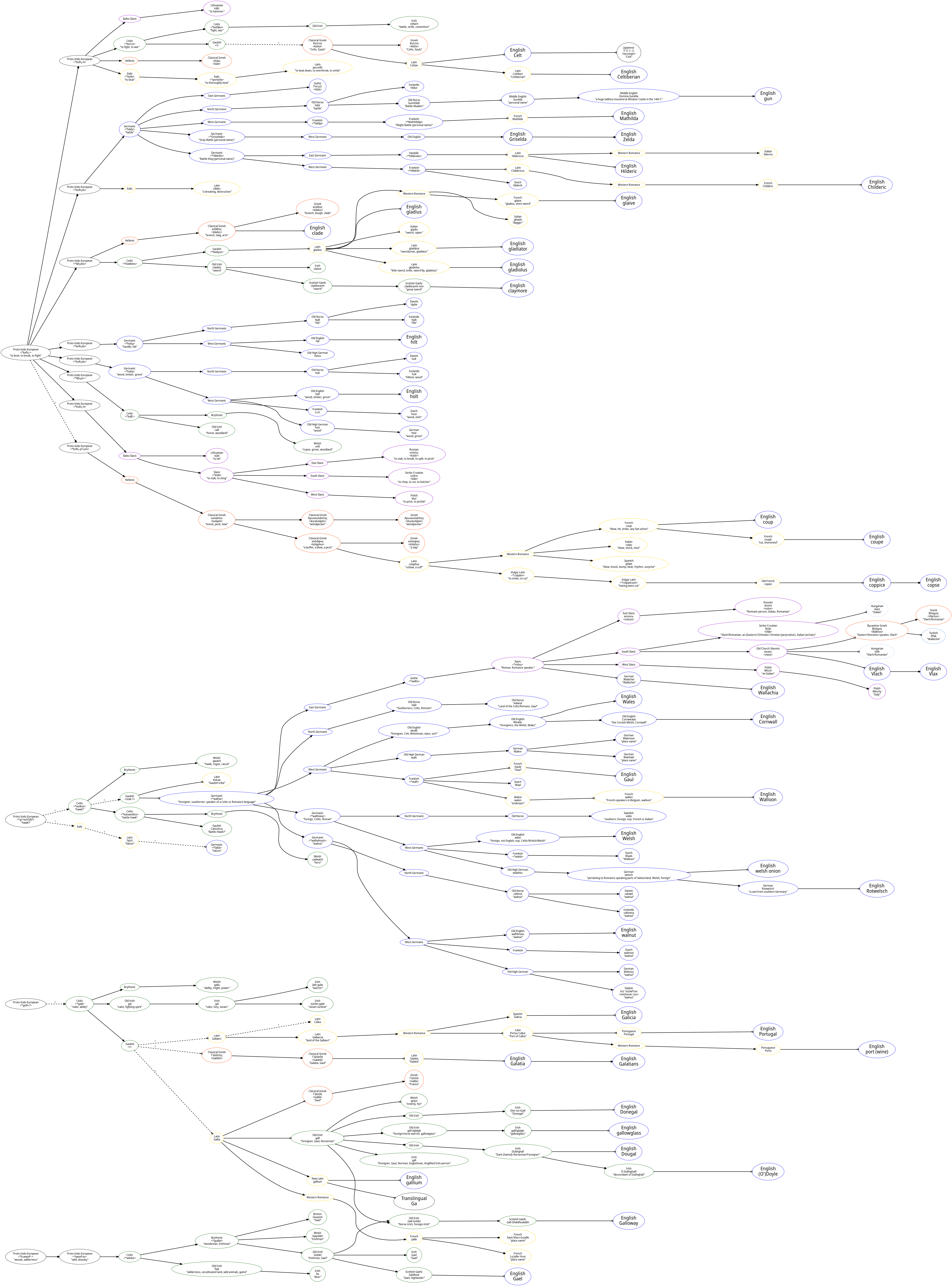
Collected English words
Celt,
Celtiberian,
xce,
Griselda,
Zelda,
Hilderic,
Childeric,
clade,
glaive,
gladius,
gladiator,
gladiolus,
claymore,
hilt,
holt,
coup,
coupe,
coup d'état,
coppice,
copse,
divide,
Vidar,
wide,
widen,
Gael,
Galloway,
gle,
sga,
glv,
gla,
widow,
wood,
redwood,
Guy,
guy,
Gingalain,
Wigalois,
Guido,
Galois field,
Galatia,
Galatian,
xga,
Galatians,
Donegal,
gallowglass,
Dougal,
O'Doyle,
Ga,
gallium,
Gallic,
galosh,
glg,
Galicia,
Galician,
port (wine),
Portugal,
Vienna,
wienerschnitzel,
wiener,
Mathilda,
gun,
gunpowder,
Galahad,
Gawain,
Vlach,
Vlax,
Vlax Romani,
Wallachia,
Wales,
Cornwall,
Galois theory,
Gaul,
Walloon,
Welsh,
Welsh Romani,
rmw,
Wallace,
welsh onion,
Rotwelsch,
walnut,
Farrell,
capercaillie
Footnotes