Introduction
Peculiar fellow, that cyclops.
Teaser
fee, feudal, peculiar, fellow, cyclops, fight, Shadowfax
Full Text
-
Proto-Indo-European *peḱ- wool, livestock, wealth
-
Proto-Indo-European *péḱu
-
Old Armenian ասու asu fleece, wool
- Armenian ասր asr fine fleece
-
Balto-Slavic *péku
-
East Baltic
- Lithuanian pekus
-
West Baltic
- Old Prussian pecku cattle
-
-
Germanic *fehu wealth, cattle, the rune ᚠ
-
East Germanic
- Gothic 𐍆𐌰𐌹𐌷𐌿 faihu property, wealth, money, the letter 𐍆
-
North Germanic *fehu *fēh
-
Old Norse fé livestock, property, money, the rune ᚠ
-
Old East Norse
- Danish fæ cattle, idiot
- Swedish fä creature, cattle
-
Old West Norse
- Faroese fæ cattle, livestock, wealth, money, property
- Icelandic fé livestock, wealth, money, the rune ᚠ
-
Old Norse féhirðir shepherd
-
Old West Norse
- Icelandic féhirðir treasurer
-
-
Old Norse félag partnership, joint business venture, fellowship
-
Old East Norse
- Danish fællig / fælles community, communal, shared
-
Old West Norse
- Icelandic félag society, company, organization
-
Old Norse félagi
-
Old East Norse
- Danish fælle fellow, companion
-
Old West Norse
- Icelandic félagi companion, partner, member
-
Old English fēolaga companion, partner, colleague
-
Middle English felage / felawe companion, partner, colleague
- English fellow
-
-
-
-
-
-
West Germanic
-
Old English feoh money, livestock, property, the rune ᚠ
-
Middle English feh / fe / fee livestock, cattle
- English fee
- Old English fēolaga
-
-
Frankish *feu
-
Middle Dutch vee livestock
- Dutch vee livestock, cattle
- Afrikaans vee
-
Medieval Latin feus
-
Medieval Latin fevum
-
Old French fief
-
Middle French fief
- French fief fief
- English fief
-
-
-
Medieval Latin feudum fief, fee
- Italian feudo fief, domain, stronghold
- Spanish feudo fief, home ground
-
Medieval Latin feudālis
-
Old French feodal feudal
-
Middle French
- French féodal feudal
-
Middle English
- English feudal
-
-
-
-
-
Old High German fihu livestock, cattle
-
Middle High German vich / vehe / vie
- German Vieh livestock, beast
- German Viech animal, beast, vermin
- Yiddish פֿיך fikh livestock, cattle
-
-
- English fehu the rune ᚠ
-
-
Hellenic *péku
-
Hellenic *pᵊkú-klṓps cattle-thief
-
Classical Greek Κύκλωψ Kúklōps cyclops [1]
-
Latin cyclōps
- English cyclops
-
-
-
-
Indo-Iranian *paću livestock
-
Indo-Iranian *paćupaHnáh shepherd, sheep-protector
-
Indo-Aryan
- Sanskrit 𑀧𑀰𑀼𑀧𑀦𑁆 paśupan
-
Iranian *fšupāna
- Pashto شپون špūn shepherd
-
Sogdo-Bactrian
- Bactrian χοβανο khobano shepherd
-
Western Iranian
-
Northwestern Iranian
- Kurdish şivan shepherd
-
Old Persian *fšupāna-
-
Middle Persian šwbʾn
-
Persian چوپان čupân shepherd
-
Hindustani
- Hindi चूपान cūpān shepherd, cowherd
- Urdu چوپان cūpān shepherd, cowherd, caretaker
-
Ottoman Turkish چوبان çoban shepherd, pastor, herdsman, peasant, lout
- Turkish çoban shepherd, herdsman
- Albanian çoban shepherd, Aromanian
- Armenian չոբան čʻoban shepherd, bumpkin
- Greek τσοπάνης shepherd
- Romanian cioban shepherd
- Serbo-Croatian чобан / čoban shepherd, bumpkin
-
-
-
-
-
-
Indo-Aryan *páśu
-
Sanskrit 𑀧𑀰𑀼 पशु paśu cattle, domestic animal
-
Prakrit 𑀧𑀲𑀼 / 𑀧𑀰𑀼 pasu paśu beast
- Gandhari Prakrit 𐨤𐨭𐨂 paśu
-
Magadhi
-
Bengali-Assamese
- Assamese পহু / পশু pohu poxu deer and similar wild herbivores
-
-
Maharashtri 𑀧𑀲𑀼 pasu animal, esp. horned
- Marathi पशू paśū animal
-
Pali 𑀧𑀲𑀼 pasu cattle
- Cebuano pasong manger, trough
-
Sauraseni 𑀧𑀲𑀼 pasu animal, esp. horned
-
Madhya Sauraseni
-
Hindustani
- Hindi पस pas heifer
-
-
Northwestern Sauraseni
- Kashmiri پۆش poś
- Punjabi ਪਸੂ pasū animal, beast, quadruped, cattle
-
- Telugu పశువు paśuvu beast, cattle, domestic ungulate
-
-
-
Iranian *pácu livestock, sheep
- Avestan 𐬞𐬀𐬯𐬎 pasu livestock
- Pashto پسه pəsə́ ram, sheep
-
Scythian
-
Alanian
- Ossetian фыс / фус fys fus sheep
-
Saka
- Khotani pasä
- Wakhi pus sheep
-
-
Sogdo-Bactrian
- Bactrian ποσο poso sheep
-
Sogdic
- Sogdian 𐼾𐼼𐼴 / 𐼾𐼼 / 𐼽𐼾𐼼 / ܦܣܘ / ܦܣ / ܥܦܣ / 𐫛𐫘 psu ps əpas cattle, sheep
-
Western Iranian
-
Northwestern Iranian
- Balochi پس pas sheep, goat
- Kurdish پەز / pez sheep
- Parthian 𐫛𐫘 pas sheep
-
Old Persian
-
Middle Persian 𐭯𐭠𐭮 pah sheep
- Achomi په pah goat
-
-
-
Iranian *fšu-
- Avestan 𐬟𐬱𐬎 fšu
- Iranian *fšupátiš shepherd, sheep-master
-
Ob Ugric *peečəɣ young (semi-domestic) reindeer
- Khanty пеши pješi yearling reindeer
- Mansi пасиг pasig reindeer calf
-
Finno-Samic *počaw (semi-domestic) reindeer
-
Finnic
- Finnish poro (semi-domestic) reindeer
-
Samic *poacōj
- Finnish poro (semi-domestic) reindeer
- Inari Sámi puásui (semi-domestic) reindeer
- Northern Sámi boazu (semi-domestic) reindeer
-
-
-
Italic *peku
-
Latin pecū cattle
-
Latin pecūnia money, wealth
-
Latin pecūniārius financial, related to money, pecuniary
- English pecuniary
-
-
Latin pecūlium private property, livestock
- French pécule savings
- Spanish pegullo herd
-
Latin pecūliāris private, specific
- English peculiar
-
Latin pecūlārī to embezzle, to peculate
- English peculate
-
- Umbrian 𐌐𐌄𐌒𐌏 peqo wealth
-
-
-
Proto-Indo-European *ṓ-pḱu-iyos having livestock
-
Balto-Slavic
-
Baltic
-
East Baltic
- Lithuanian úošvis father-in-law
-
-
-
-
Proto-Indo-European *péḱti
-
Balto-Slavic
-
East Baltic
-
Lithuanian pèšti to pluck, to pull, to tear out
- Lithuanian pašýti to tug, to fight, to brawl iterative
-
-
-
Hellenic
- Classical Greek πέκω pékō I shear, I comb, I pluck
-
-
Proto-Indo-European *peḱteti
-
Germanic *fehtaną to comb, to shear, to detangle, to struggle with
-
West Germanic *fehtan to fight
-
Old English feohtan to fight
-
Middle English fehten / fighten
- English fight
- Scots fecht to fight, to struggle
-
-
Frankish *fehtan
-
Middle Dutch vechten
- Dutch vechten to fight
-
-
Old High German fehtan
-
Middle High German vehten
-
German fechten to fence, to fight
- Russian фехтовать fextovatʹ to fence
- German Fuchtel broadsword
-
-
-
Old Saxon fehtan to fight
-
Middle Low German vechten to fight
- Low German fechten to fence, to fight, to brawl
- Danish fægte to fence, to fight, to brawl
-
-
-
-
Hellenic
- Classical Greek πεκτέω pektéō I shear, I clip
-
Italic *pektezi
- Latin pectere to comb, to card (wool), to weed, to thrash (someone)
-
-
Proto-Indo-European *péḱos
-
Hellenic
- Classical Greek πέκος pékos
-
Italic *pekos
-
Latin pecus cattle, herd
-
Central Romance
- Italian pecora sheep, ewe
-
Latin pecorārius herdsman, shepherd
-
Eastern Romance
- Romanian păcurár shepherd
-
Central Romance
- Italian pecoraio shepherd
-
-
-
-
-
Proto-Indo-European *poḱos
-
Germanic *fahaz sheep
-
North Germanic
-
Old Norse
-
Old East Norse *fáʀ
- Danish får sheep
- Swedish får sheep, mutton
-
Old West Norse fær sheep
-
Old West Norse
- Faroese førilús sheep ked (louse)
- Icelandic færilús sheep ked (louse)
-
Old West Norse Færeyjar Sheep Islands, the Faroe Islands
-
Old East Norse
-
Danish Færøerne Faroe Islands
-
English Faroe
-
English Faroese
- Translingual fao ISO 639 code for Faroese
-
-
- Swedish Färöarna Faroe Islands
-
-
- Faroese Føroyar Faroe Islands
- Icelandic Færeyjar Faroe Islands
-
-
-
-
-
Hellenic
- Classical Greek πόκος pókos wool, fleece
-
-
Proto-Indo-European *péḱleh₂
- Albanian pillë flax comb, hatchel
-
Proto-Indo-European *poḱtis
-
Germanic *fahtiz wool, fleece
-
West Germanic
- Old English feht fleece
-
Frankish *faht
-
Middle Dutch vacht
- Dutch vacht fur, pelt
-
-
-
-
Proto-Indo-European *pǝḱténs
-
Hellenic
-
Classical Greek κτείς / κτεν- kteís kten- comb, rake, scallop, pubic hair
- Greek χτένα chténa comb
-
Classical Greek κτενίζω ktenízō I comb
- Greek χτενίζω chtenízo I comb, I groom, I search
-
New Latin cteno-
- Translingual Ctenophora taxonomic phylum of comb jellies
- English cteno-
-
-
Italic
-
Latin pecten comb, scallop, pubic hair
- English pecten not to be confused with unrelated pectin
-
-
-
Proto-Indo-European *poḱsmn̥
-
Indo-Iranian *páćšma wool, fleece, bristles
-
Indo-Aryan *páṭṣma
-
Sanskrit 𑀧𑀓𑁆𑀱𑁆𑀫𑀦𑁆 pákṣman eyelash, whisker, hair
-
Sauraseni 𑀧𑀫𑁆𑀳 pamha
-
Madhya Sauraseni
- Hindi पपनी papnī eyelash
-
-
-
-
Iranian *pášma
- Avestan 𐬞𐬀𐬱𐬨𐬀 pašma wool
-
Scythian
-
Alanian
- Ossetian фӕсм fæsm wool
-
-
Western Iranian
-
Old Persian *pašma
-
Middle Persian 𐭯𐭱𐭬 pašm
- Persian پشم pašm wool, chest hair, pubic hair
-
-
-
-
-
Proto-Indo-European *poḱsom
-
Germanic *fahsą (head) hair, mane
-
North Germanic
-
Old Norse fax mane
-
Old West Norse
- Icelandic fax mane
- Scots fax sea foam, breakers
- Old Norse Skinfaxi Shining-Mane, horse belonging to Day personified
- Old Norse Hrímfaxi Frost-Mane, horse belonging to Night personified
-
-
-
West Germanic
-
Old English feax mane, (head) hair
-
Middle English fax
-
English fax
- English Fairfax
- English Shadowfax
-
-
-
Frankish *fahs
-
Middle Dutch vas
- Dutch vas
-
-
-
-
-
Visual
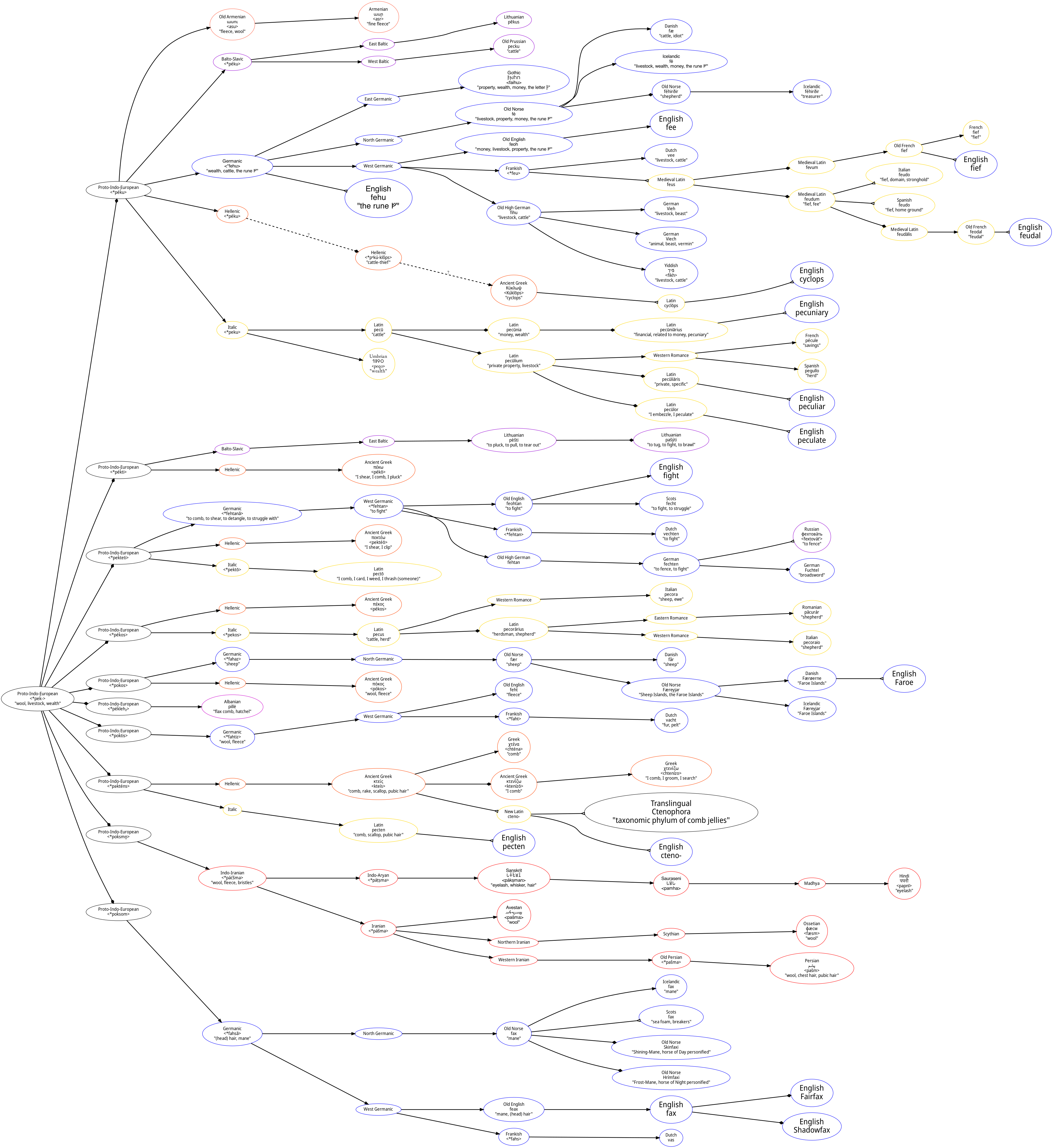
Collected English words
fellow, fee, fief, feudal, fehu, cyclops, pecuniary, peculiar, peculate, fight, Faroe, Faroese, fao, Ctenophora, cteno-, pecten, fax, Fairfax, Shadowfax
Footnotes
-
^
Κύκλωψ Kúklōps: "cyclops" is traditionally understood as "round eye", but this may be an eggcorn of *pḱu-klṓps: "cattle-thief", after Greek lost the word *péḱu. If so, the reinterpretation of the word may have led to a re-envisioning of the creature. (It doesn't take much reconstruction to reach the conclusion that cattle-raids were part of Indo-European culture and mythology.)