Introduction
Bonus word family for Halloween by special request from my 4 year old: witch from *weyk-: "to separate, to choose, to consecrate".
*weyk- looks like an extended root implying *wey-, but I can't find any clear evidence for that root. If it is an extension of *wey-, a zero-grade of that would be the adverb *wi: "apart, asunder" (though that could also be a variant of *dwi-: "in two"). And/or *weyd-: "to see" could be another extension of *wey-; "see", "choose", and "pick out" reasonably forming a semantic group.
Teaser
Full Text
-
Proto-Indo-European *weyḱ- *weyk- settlement, to settle
-
Proto-Indo-European *wiḱpótis head of household, lord, chief
-
Pre-Albanian *dzwāpt
- Albanian zot master, boss, lord, sir, Mr.
-
Balto-Slavic *wiśpatis
-
Baltic
-
East Baltic
- Lithuanian viēšpats lord
-
-
-
Indo-Iranian *wićpátiš
-
Indo-Aryan *wiśpátiṣ
- Sanskrit वि॒श्पतिः viśpátiḥ chief, headman
-
Iranian *wicpátih
- Avestan 𐬬𐬍𐬯𐬞𐬀𐬌𐬙𐬌 vīspaiti chief, master
-
-
Tocharian
- Arshian wikpots chief, master
-
Proto-Indo-European *wiḱpótnih mistress of the settlement, lady
-
Pre-Albanian *dzwāptnjā
-
Albanian zonjë lady, Mrs.
- Albanian zonjë e mirë smallpox
-
-
Balto-Slavic
-
Baltic
-
East Baltic
- Lithuanian viēšpati lady, mistress, queen
-
West Baltic
- Old Prussian waispattin mistress of household
-
-
-
Indo-Iranian *wićpátniH
-
Indo-Aryan *wiśpátniH
- Sanskrit वि॒श्पत्नी॑ viśpátnī mistress of household, lady
-
-
-
-
Proto-Indo-European *wiḱéti settles, joins settlement
-
Balto-Slavic
-
Baltic
-
East Baltic
- Lithuanian viešėti to visit
-
-
-
Indo-Iranian *wićáti
-
Indo-Aryan *wiśáti
- Sanskrit 𑀯𑀺𑀰𑀢𑀺 viśáti enters
-
-
-
Proto-Indo-European *wewóyḱe is settled, is part of a settlement stative
-
Indo-Iranian *wawáyća
-
Indo-Aryan
- Sanskrit 𑀯𑀺𑀯𑁂𑀰 vivéśa entered
-
Iranian
- Avestan 𐬬𐬍𐬎𐬎𐬍𐬯𐬈 vīuuīse
-
-
-
Proto-Indo-European *wéyḱs root noun
-
Indo-Iranian *wíćš
-
Indo-Aryan *wíṭṣ
- Sanskrit 𑀯𑀺𑀰𑁆 víś settlement, house, community, wealth
-
Iranian *wícš
- Avestan 𐬬𐬍𐬯 vīs village, clan
-
Western Iranian
-
Old Persian 𐎻𐎰 viθ
-
Middle Persian
-
Persian ویس vis clan; also Vis, a given name
-
Persian ويس و رامين Vis o Rāmin Vis and Ramin (Parthian epic)
- English Vis and Ramin
-
-
-
-
-
-
-
Proto-Indo-European *wóyḱos agentive noun
-
Hellenic *wóikos
- Mycenaean Greek 𐀺𐀒 wo-ko home
-
Classical Greek οῖκος oîkos house, room, estate
-
Classical Greek μέτοικος métoikos
- English metic
-
German Ökologie ecology learned formation by Ernst Haeckel
-
English ecology
- English arcology
-
-
Classical Greek οἰκονόμος oikonómos head of household, steward, manager
-
Classical Greek οἰκονομία oikonomía management of a house, administration
-
Latin oeconomia management of a house, arrangement, economy
-
English economy
-
English economics
-
English home economics
- English home ec
-
-
-
French économie
- Haitian Creole ekonomi
- German Ökonomie
- Russian экономия ekonomija
-
-
-
- Greek οίκος oíkos
-
Classical Greek οἰκέω oikéō I inhabit, I settle in, I reside at
- Classical Greek οἴκημα oíkēma
-
Classical Greek οἴκησις
-
Classical Greek διοίκησις dioíkēsis housekeeping, government, administration
-
Latin dioecesis
-
Old French diocese
-
Middle French
- French diocèse diocese
-
Middle English diocise diocese
- English diocese
-
-
-
-
-
Classical Greek ἡ οἰκουμένη γῆ / οἰκουμένη hē oikouménē gê oikouménē (the) inhabited (earth), the known world
-
Classical Greek οἰκουμενικός relating to the whole world, relating to everyone
-
Latin oecumenicus
-
English ecumenic
- English ecumenical
-
-
-
-
-
-
Proto-Indo-European *wéyḱos action or result noun
-
Tocharian *wjäike
- Kushean īke place, location
-
-
Proto-Indo-European *wéyḱis
- Albanian vis place, land, country
-
Balto-Slavic *weiśis
-
Baltic
-
East Baltic
- Latvian viesis visitor
-
-
Slavic *vь̀sь village
- East Slavic весь vesĭ village
-
South Slavic
- Old Church Slavonic вьсь vĭsĭ village
- Serbo-Croatian вес / ves village
-
West Slavic
- Polish wieś
-
-
Proto-Indo-European *weyḱós
-
Indo-Iranian *wayćás
-
Indo-Aryan *wayśás
- Sanskrit 𑀯𑁂𑀰 veśá inhabitant, neighbor
-
Iranian *waycáh
- Avestan 𐬬𐬀𐬉𐬯𐬀 vaēsa (houshold) servant
-
-
Italic *weikos
-
Latin vīcus neighborhood, village
-
Central Romance
- Italian vico village, district
-
Old English ƿīc / wīċ settlement, village, bay
-
Old English Beoƿīc Bee-Town
-
Middle English
- English Bewick
- English Buick
-
-
Old English Sandƿic Sand-(Habor)-Town
-
Middle English
-
English Sandwich
- English Sandwich Islands
-
English sandwich
- English -wich
- Arabic سَانْدْوِيتْش sandwitš
- French sandwich
- Greek σάντουιτς sántouits
- Hawaiʻian kanauika
- Japanese サンドイッチ sandoitchi
- Russian сандвич sandvič
- Spanish sándwich
- Tibetan སན་ཊ་ཝིཆི san ṭa wichi
- Vietnamese xăng-uých
-
-
-
Old English Eoforƿīċ Boar-Town, York
- Norman Éverouic
-
Old Norse Jórvík / Jórk
-
Middle English York / Ȝork
-
English York
- English New York
-
-
-
Old English Gippesƿic
-
Middle English
- English Ipswich
-
-
Old English Ƿerƿic Weir-Town
-
Middle English Warwyck
- English Warwick
-
-
Middle English wick
-
Middle English
- English bailiwick
-
-
-
Latin vīcīnus neighbor, near, similar
-
Latin vīcīnitās / vīcīnitātem neighborhood, proximity
-
Central Romance
- Italian vicinità closeness, proximity
-
Eastern Romance
- Romanian vecinătate neighborhood, vicinity, proximity
-
Western Romance
-
Old Spanish vezindad
- Spanish vecindad vicinity, neighborhood
-
- French vicinité vicinity
- English vicinity
-
-
Central Romance
- Italian vicino near, neighbor, neighborhood
-
Eastern Romance
- Romanian vecin neighbor, neighboring
-
Western Romance
-
Old French veisin / voisin
-
Middle French
- French voisin neighbor, neighboring
-
- Spanish vecino neighbor, neighboring, freeman
-
- Albanian fqinj nieghbor
-
-
Latin vīculus village, hamlet, side-street
-
Central Romance
- Italian vicolo alley
-
Latin vīlla country house, estate, villa
-
Central Romance
-
Italian villa
- English villa
-
-
Western Romance
-
Old French ville city, town
-
Middle French ville
-
French ville town, city
- English -ville
-
-
Old French Malleville place name: Bad-Town
-
Middle English Melville
- English Melville
-
Middle English Melwin
-
Scots Melvin
- English Melvin
-
-
-
-
Old Spanish villa
-
Old Spanish Sevilla
- Spanish Sevilla
-
Middle French Seville
- French Séville
-
English Seville
- English Isidore of Seville
- Spanish villa
-
-
-
Old High German wīlāri
- German Weiler small village, hamlet
-
Latin vīllāticus village
-
Western Romance
-
Old French village
-
Middle French village
- French village
-
Middle English village
- English village
-
-
-
-
Latin vīllānus farm worker, villager, serf
-
Central Romance
- Italian villano lout, peasant
-
Western Romance
-
Old French vilain / vilein / villein
-
Middle French
- French vilain villain, peasant, disagreeable
-
Middle English vilein
- English villain
- English villein
-
- Spanish villano lout, peasant
-
-
-
-
-
-
-
Germanic *wīks *wīkō village, town, harbor, bay
-
North Germanic
-
Old Norse vík bay, cove, inlet
-
Old East Norse
- Danish vig inlet, fjord
-
Old West Norse
- Icelandic vík bay, cove
-
Old Norse Reykjavík Bay of Smokes
-
Old West Norse
-
Icelandic Reykjavík
- English Reykjavík
-
-
-
Old Norse víkingr
-
Old West Norse
- Icelandic víkingur viking
-
English viking
-
Japanese バイキング Baikingu Viking
- Japanese バイキング(料理) Baikingu (ryōri) smorgasbord, buffet
-
-
-
-
-
West Germanic *wīk *wīku
-
Old English ƿīc / wīċ settlement, village, bay
-
Old English Beoƿīc Bee-Town
-
Middle English
- English Bewick
- English Buick
-
-
Old English Sandƿic Sand-(Habor)-Town
-
Middle English
-
English Sandwich
- English Sandwich Islands
-
English sandwich
- English -wich
- Arabic سَانْدْوِيتْش sandwitš
- French sandwich
- Greek σάντουιτς sántouits
- Hawaiʻian kanauika
- Japanese サンドイッチ sandoitchi
- Russian сандвич sandvič
- Spanish sándwich
- Tibetan སན་ཊ་ཝིཆི san ṭa wichi
- Vietnamese xăng-uých
-
-
-
Old English Eoforƿīċ Boar-Town, York
- Norman Éverouic
-
Old Norse Jórvík / Jórk
-
Middle English York / Ȝork
-
English York
- English New York
-
-
-
Old English Gippesƿic
-
Middle English
- English Ipswich
-
-
Old English Ƿerƿic Weir-Town
-
Middle English Warwyck
- English Warwick
-
-
Middle English wick
-
Middle English
- English bailiwick
-
-
-
Old High German wīh
-
Old High German wīhbilidi
-
Middle High German
- German Weichbild city appearance, metropolitan region
-
-
-
Frankish *wīk
-
Middle Dutch wijc
- Dutch wijk nieghborhood, district
-
-
-
-
-
Proto-Indo-European *wéyḱsom
-
Germanic *wīhsą
-
East Germanic
- Gothic 𐍅𐌴𐌹𐌷𐍃 weihs village, countryside
-
-
-
Proto-Indo-European *weyk- to overcome
-
Proto-Indo-European *wikéti
- Celtic *wiketi
-
Germanic *wiganą to fight, to battle
-
Germanic *wīgą a fight, a battle
-
West Germanic *wīg a battle
-
West Germanic *Hlūdawīg personal name: Famous-Battle
-
Frankish *Hlodowik
- Dutch Lodewijk
-
Old French Lodhuuig / Lodevis / Looïs / Luis
-
Middle French Loïs / Loïc
-
French Louis
- English Louis
-
French Louisiane Louisiana after Louis XIV
- English Louisiana
- Hungarian Lajos
-
Middle French
- French Louise
- English Louisa
-
-
Middle English Lewis / Lowis
- English Lewis
-
Italian Luigi
- English Luigi
-
Spanish Luis
- English Luis
-
Old Occitan Aloys
-
Medieval Latin Aloysius
- English Aloysius
-
-
-
Latin Ludovīcus / Lodhuuic
-
Old French Lodhuuig / Lodevis / Looïs / Luis
-
Middle French Loïs / Loïc
-
French Louis
- English Louis
-
French Louisiane Louisiana after Louis XIV
- English Louisiana
- Hungarian Lajos
-
Middle French
- French Louise
- English Louisa
-
-
Middle English Lewis / Lowis
- English Lewis
-
Italian Luigi
- English Luigi
-
Spanish Luis
- English Luis
-
Old Occitan Aloys
-
Medieval Latin Aloysius
- English Aloysius
-
-
- Italian Ludovico
- French Ludovic
-
-
Latin Clodovicus / Clodovechus
-
French Clovis
- English Clovis
-
Basque Koldobika
- Basque Koldo
-
-
Old High German Hludwig / Ludhuwīg
-
Middle High German Ludewig
-
German Ludwig
- English Ludwig
-
-
-
-
-
-
-
Proto-Indo-European *winékti
-
Italic *winkezi
-
Latin vincere to win, to defeat, to vanquish
-
Latin convincere
-
Old French convicter
-
Middle English convicten
- English convict
-
- English convince
-
-
Latin ēvincere
- English evince
-
Western Romance
-
Old French veincre / vencre / veintre to defeat, to vanquish
-
Middle French
- French vaincre to defeat, to vanquish, to win
-
Old French venquiss-
-
Middle English venquysshen / vaynquisshen
- English vanquish
-
-
-
-
-
Italic *winkejezi
-
Italic *prowinkejezi
-
Italic *prōwinkjā
-
Latin prōvincia
-
Western Romance
-
Occitan Provença
-
French Provence
- English Provence
-
-
Old French province / provinz
-
Middle French province
- French province
-
Middle English province / provynce / provyns
- English province
-
-
-
Latin prōvinciālis
-
Western Romance
-
Occitan Provençal
-
French Provençal
-
English Provençal
- Translingual pro ISO 639 code for Old Provençal/Old Occitan
-
-
-
-
Old French provincial
-
Middle French
- French provincial
-
Middle English provincial
- English provincial
-
-
-
-
-
-
-
-
-
Proto-Indo-European *wiktós
-
Italic
-
Latin victus
-
Latin invictus unconquered, invincible
- Latin Dies Natalis Solis Invicti
-
-
-
-
Proto-Indo-European *wéyktōr *wiktrés
-
Italic *wiktōr
-
Latin victor conqueror, victor, champion
- English victor
-
Latin Victor personal name: Conqueror, Victor
- English victor
-
-
-
-
Proto-Indo-European *winékti
-
Italic *winkezi
-
Italic *winkjō
-
Italic *prōwinkjā
-
Latin prōvincia
-
Western Romance
-
Occitan Provença
-
French Provence
- English Provence
-
-
Old French province / provinz
-
Middle French province
- French province
-
Middle English province / provynce / provyns
- English province
-
-
-
Latin prōvinciālis
-
Western Romance
-
Occitan Provençal
-
French Provençal
-
English Provençal
- Translingual pro ISO 639 code for Old Provençal/Old Occitan
-
-
-
-
Old French provincial
-
Middle French
- French provincial
-
Middle English provincial
- English provincial
-
-
-
-
-
Italic *winkjezi
- Latin vincīre to bind, to tie up, to fasten, to surround
-
-
-
-
-
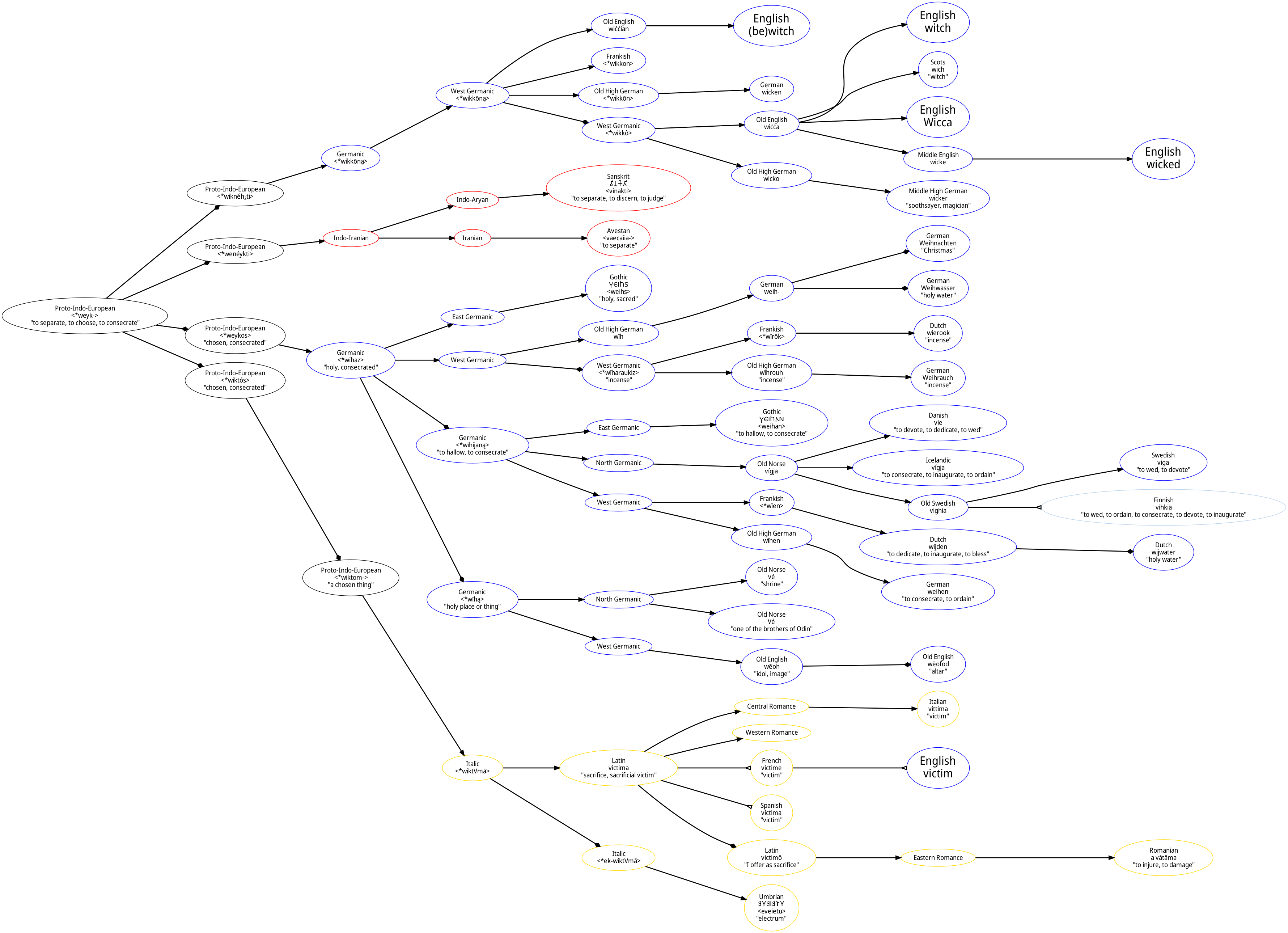
Proto-Indo-European *weyk- to separate, to choose, to consecrate
-
Proto-Indo-European *wiknéh₂ti
-
Germanic *wikkōną to divine, to cast auguries
-
West Germanic *wikkōn to practice sorcery
-
Old English wiċċian to practice witchcraft
- Middle English wicchen to practice witchcraft, to bewitch
- English witch / bewitch
- Frankish *wikkon
-
Old High German *wikkōn
-
Middle High German wicken
- German wicken
-
-
Old Saxon *wikkōn
-
Middle Low German wicken
-
Low German wicken to divine, to practice sorcery
-
Low German Wicker wizard
- Low German Wickersche witch
-
-
-
-
West Germanic *wikkō sorcerer, wizard, witch
-
Old English wiċċa wizard, druid, necromancer
-
Middle English wicche witch, sorcerer, heretic, pagan
- English witch
- Scots wich / witch / wech witch
- English Wicca learned reborrowing
-
Middle English wicke / wikke evil, sinful, malicious adjectival use
- English wicked
- Scots wick wicked, naughty, a naughty child
-
-
Old High German wicko
- Middle High German wicker soothsayer, magician
-
-
-
-
-
Proto-Indo-European *wenéykti transitive imperfective
-
Indo-Iranian
-
Indo-Aryan
- Sanskrit 𑀯𑀺𑀦𑀓𑁆𑀢𑀺 vinakti to separate, to discern, to judge
-
Iranian
- Avestan vaēcaiia- to separate, to sort out
-
-
-
Proto-Indo-European *wéykos chosen, consecrated
-
Germanic *wīhaz holy, consecrated
-
East Germanic
- Gothic 𐍅𐌴𐌹𐌷𐍃 weihs holy, sacred
-
West Germanic
-
Old High German wīh
-
Middle High German wīch
-
Middle High German wīchenahten Christmas
- German Weihnachten Christmas lit. "Holy Night"
-
Middle High German wīchwazzer
- German Weihwasser holy water
-
-
-
West Germanic *wīharaukiz incense
-
Frankish *wīrōk
- Dutch wierook incense
-
Old High German wīhrouh incense
-
Middle High German wīhrouch
- German Weihrauch incense
-
-
-
-
Germanic *wīhijaną to hallow, to consecrate
-
East Germanic
- Gothic 𐍅𐌴𐌹𐌷𐌰𐌽 weihan to hallow, to consecrate
-
North Germanic
-
Old Norse vígja
-
Old East Norse
- Danish vie to devote, to dedicate, to wed
-
Old Swedish vighia
- Swedish viga to wed, to devote
- Finnish vihkiä to wed, to ordain, to consecrate, to devote, to inaugurate
-
Old West Norse
- Icelandic vígja to consecrate, to inaugurate, to ordain
-
-
-
West Germanic *wīhijan to hallow, to consecrate
-
Frankish *wīen
-
Dutch wijden to dedicate, to inaugurate, to bless
- Dutch wijwater holy water
-
-
Old High German wīhen
-
Middle High German wīhen
- German weihen to consecrate, to ordain
-
-
-
-
Germanic *wīhą holy place or thing
-
North Germanic *wīha
- Old Norse vé shrine
- Old Norse Vé one of the brothers of Odin [1]
-
West Germanic *wīh
-
Old English wēoh idol, image
- Old English wēofod altar
-
-
-
-
-
Proto-Indo-European *wiktós chosen, consecrated
-
Proto-Indo-European *wiktom a chosen thing
-
Italic *wiktVmā
-
Latin victima sacrifice, sacrificial victim
-
Central Romance
- Italian vittima victim
-
Middle French victime
- French victime victim
- English victim
- Spanish víctima victim
-
Latin victimāre to offer as sacrifice
-
Eastern Romance
- Romanian vătăma to injure, to damage
-
-
-
Italic *ek-wiktVmā
- Umbrian 𐌄𐌖𐌄𐌉𐌄𐌕𐌖 eveietu electrum lit. ~"it will consecrate"
-
-
-
-
Visual
Collected English words
Sandwich Islands, Isidore of Seville, arcology, Louis, Louisiana, Louisa, Lewis, Luigi, Luis, Aloysius, Clovis, Ludwig, pro, Seville, home economics, Vis and Ramin, metic, economy, economics, home ec, ecology, diocese, ecumenic, ecumenical, vicinity, villa, -ville, village, villain, villein, Reykjavík, viking, Bewick, Buick, York, New York, Ipswich, Sandwich, sandwich, -wich, Warwick, bailiwick, Melville, Melvin, vanquish, convict, convince, evince, victor, Provence, province, Provençal, provincial, witch, witch, Wicca, wicked, victim
Footnotes
-
^
In the Old Norse triad Óðinn, Vili, and Vé, originally all three alliterated, instead of just the two. They correspond to Common Germanic *Wōdinaz, *Wiljô, and *Wīhą or Proto-Norse *Wōdinaʀ, *Wiljo, and *Wīha. The /w/ in *Wōdin was absorbed by the rounded vowel.
*Wōdinaʀ, *Wiljo, and *Wiha represent three divine aspects of mind: ecstasy (transcendent inspiration), will (thought leading to action), and spiritual power, respectively.