Introduction
I've been doing Word Families for 5 years! In that time, I have made 150 families! So this week is *pénkʷe: "five".
The *p-kʷ sequence in *pénkʷe leads to a set highly divergent forms. *kʷ is a highly variable sound on its own, becoming /kw/, /w/, /ʍ/, /k/, /t͡ʃ/, /s/, /p/, or /t/ in various descendants; in many cases with multiple branches arriving at the same sound independently at different times.
On top of that, the *p-kʷ assimilates in Germanic (progressively), Celtic, and Italic (both regressively). The regressive assimilation *p-kʷ to *kʷ-kʷ is a regular change also seen in Celtic and Italic descendants of *pekʷ-: "to cook" and *pérkʷu-s: "oak". (The Germanic assimilation is not consistent; *pérkʷu-s becomes *ferhuz with no assimilation.)
This is complicated by the fact that some branches in both Celtic and Italic change *kʷ to /p/ (a merger in Italic, but following deletion of *p in Celtic). And then, Vulgar Latin changed its mind about the assimilation and regressively dissimilates to /k-kʷ/. That then allows palatalization on the /k/ leading to /t͡ʃ/ (and later /ts/, /ʃ/, or /s/ in various descendants).
Some of these specifics are discussed in more detail in the footnotes.
I've included another root, Proto-Indo-European *pewǵ-: "to punch, to fist-fight". This is not so much to claim the roots are related, as that they are close enough in both sound and meaning that there are words that can't be assigned clearly to one or the other; particularly West Germanic *fūsti: "fist". The similarity also does allow for them to be potentially related, possibly with *penkʷ- coming from a re-analysis of a nasal infix form *pewǵ-, such as the one attested in Latin pungō.
Finally, as I've said before, there are reason to believe that many of the Proto-Indo-European numbers numbers are relatively recent, with only the numbers 1-3 being clearly established in Archaic PIE/Indo-Anatolian. The numbers 5-10 all have reasonably likely derivations, either as borrowings or as morphological derivations from other PIE words.
Teaser
finger, five, punch, Ponzi scheme, Pentecost, poignant, punch, point, punctuate, pygmy, pugnacious
Full Text
-
Proto-Indo-European *penkʷ- fist?, hand?, to hold in hand?
-
Proto-Indo-European *pn̥kʷstis
-
Balto-Slavic *punkstis *punstis *kunstis
-
Baltic
-
East Baltic
- Lithuanian kumštis a fist
-
West Baltic
- Old Prussian kuntis a fist
-
-
Slavic *pę̑stь
-
East Slavic
-
Russian пясть pjastʹ wristbone
- Russian запястье zapjastʹje wrist
- Ukrainian п'ясть pʺjastʹ a fist
-
-
South Slavic
-
Serbo-Croatian пест / pest a fist regional
- Serbo-Croatian песница pesnica a fist regional
-
-
West Slavic
- Czech pěst a fist
- Polish pięść a fist
-
-
-
Germanic *funkstiz? *funhwstiz? *funstiz [1]
-
West Germanic *fūsti a fist
-
Old English fȳst a fist
-
Middle English fist a fist
- English fist
- Yola hist a fist
-
-
Frankish *fūst
-
Middle Dutch vuust
- Dutch vuist a fist
-
-
Old High German fūst a fist
-
Middle High German fūst / voust
-
German Faust a fist [2]
- English Faust
- Yiddish פֿויסט foyst a fist
-
-
-
Old Saxon fūst
-
Middle Low German vûst
- Low German Fuust a fist
-
-
-
-
-
Proto-Indo-European *penkʷrós
-
Germanic *fingraz finger [1]
-
East Germanic
- Gothic 𐍆𐌹𐌲𐌲𐍂𐍃 figgrs finger
-
North Germanic *fingraʀ
-
Old Norse fingr finger
-
Old East Norse
- Danish finger finger
-
Old West Norse
- Icelandic fingur finger
- Old Norse þumalfingr thumb
-
-
-
West Germanic *fingr finger
-
Old English finger finger
-
Middle English finger / fynger finger
- English finger
-
-
Frankish *fingar
- Dutch vinger finger
-
Old High German fingar
- German Finger finger
- Yiddish פֿינגער finger finger, toe
-
-
Germanic *fingragulþą (golden) finger ring
-
East Germanic
- Gothic 𐍆𐌹𐌲𐌲𐍂𐌰𐌲𐌿𐌻𐌸 figgragulþ finger ring
-
North Germanic
-
Old Norse fingrgull
-
Old West Norse
- Faroese fingurgull golden (finger) ring
- Icelandic fingurgull finger ring
-
-
-
-
-
-
Proto-Indo-European *pénkʷe five
-
Pre-Albanian *penče
- Albanian pesë five
-
Old Armenian հինգ hing five
- Armenian հինգ hing five
-
Balto-Slavic *pénki five
-
Baltic
-
East Baltic
- Latvian pieci five
- Lithuanian penki five
-
West Baltic
-
Old Prussian *pentʲ five
- Old Prussian pentninx Friday likely literally "fifth"
- Sudovian pank five
-
-
- Slavic *pętь five
-
-
Pre-Germanic *pémpe
-
Germanic *fimf five
-
East Germanic
- Gothic 𐍆𐌹𐌼𐍆 fimf five
- Crimean Gothic fyuf five
-
North Germanic
-
Old Norse ᚠᛁᛘ / fimm five
-
Dalecarlian
- Övdalian fem five
-
Old East Norse
- Danish fem five
- Swedish fem five
-
Old West Norse
- Faroese fimm five
- Icelandic fimm five
-
-
-
West Germanic *fimf
-
Old English fīf five
-
Middle English five / vif / fif five
- English five
- Scots five five
- Yola veeve five
-
-
Frankish *finf *fīf
-
Middle Dutch viif
- Dutch vijf five
-
-
Old High German fimf five
-
Middle High German vinf / vünf
- German fünf five
- Yiddish פֿינף finf five
-
-
Old Saxon fīf five
-
Middle Low German vîf
- Low German fief five
-
-
-
Germanic *fimf-tigiwiz five group-of-tens, fifty
-
East Germanic
- Gothic 𐍆𐌹𐌼𐍆 𐍄𐌹𐌲𐌾𐌿𐍃 / 𐍆𐌹𐌼 𐍄𐌹𐌲𐌾𐌿𐍃 fimf tigjus fim tigjus fifty
-
North Germanic
-
Old Norse fimm tigir / fimmtigi fifty
-
Old East Norse
- Swedish femtio fifty
-
Old West Norse
- Faroese fimmti fifty
- Icelandic fimmtíu fifty
-
-
-
West Germanic *fimftigiwi fifty
-
Old English fīftiġ fifty
-
Middle English fifty / fifftiȝ fifty
- English fifty
- Scots fifty fifty
-
-
Frankish *fīftig
-
Middle Dutch vijftich fifty
- Dutch vijftig fifty
-
-
Old High German fimfzug fifty
-
Middle High German vünfzic fifty
- German fünfzig fifty
- Yiddish פֿופֿציק fifty
-
-
Old Saxon fīftich fifty
-
Middle Low German viftig fifty
- Low German föfftig fifty
-
-
-
-
Germanic *fimftehun five-ten, fifteen
-
East Germanic
- Gothic 𐍆𐌹𐌼𐍆𐍄𐌰𐌹𐌷𐌿𐌽𐌹𐌼 fimftaihunim fifteen attested only dative
-
North Germanic
-
Old Norse fimmtán / fimtán fifteen
-
Old East Norse
-
Danish femten fifteen
-
Danish femto- SI prefix for 10 to the -15
- English femto-
-
-
-
-
-
West Germanic
-
Old English fīftīene / fīftȳne / fȳftȳne fifteen
-
Middle English fiftene / fiften / fyftene fifteen
- English fifteen
- Yola vifteen fifteen
-
-
-
-
-
-
Hellenic *pénkʷe
- Aeolic Greek πέμπε pémpe five
-
Classical Greek πέντε pénte five
-
Classical Greek πεντάγραμμος pentágrammos
- English pentagram
- Greek πέντε pénte five
- English penta-
-
Classical Greek πένταθλον péntathlon contest of five exercises, pentathlon
-
English pentathlon
-
English -athlon
- English triathlon
-
-
-
Classical Greek πεντάγωνος pentágōnos five-angled, pentagonal, pentagon
-
Classical Greek πεντάγωνον pentágōnon pentagon
-
Latin pentagōnum pentagon
-
English pentagon
- English Pentagon
-
-
-
-
-
Indo-Iranian *pánča
-
Indo-Aryan *pánća
-
Mitanni Aryan *panća
-
Mitanni Aryan *panća-vartana for five laps Kikkuli
-
Hurrian
- Hittite pa-an-za-wa-ar-ta-an-na for five laps Kikkuli
-
-
-
Sanskrit 𑀧𑀜𑁆𑀘𑀦𑁆 páñcan five
-
Elu
- Dhivehi ފަހެއް fahek five
- Sinhala පහ paha five
-
Magadhi 𑀧𑀁𑀘 paṃca five
- Bengali পাঁচ pãcô five
- Rohingya 𐴉𐴝𐴣𐴏 fañs five
-
Maharashtri 𑀧𑀁𑀘 paṃca five
- Marathi पाच pāċ five
-
Pali pañca five
- Malay panca five
-
Sauraseni 𑀧𑀁𑀘 paṃca five
-
Hindustani
- Hindi पाँच pā̃c five
- English punch drink with five ingredients
-
Northwestern Sauraseni
- Kashmiri پانٛژھ pānċh five
- Punjabi ਪੰਜ pañj five
-
Western Sauraseni
-
Romani panʒ five
- Romani panʒvardeś fifty
-
-
-
Sanskrit 𑀧𑀜𑁆𑀘𑀯𑀺𑀁𑀰𑀢𑀺 páñcaviṃśati twenty-five
-
Sauraseni
-
Hindustani
- Hindi पच्चीस paccīs twenty-five
-
English pachisi
- English Parcheesi
-
-
-
-
-
Iranian *pánča
- Avestan 𐬞𐬀𐬧𐬗𐬀 paṇca five
-
Scythian
-
Alanian
- Ossetian фондз fonʒ five
-
-
Sogdo-Bactrian
- Bactrian πανζο panzo five
- Sogdian 𐫛𐫗𐫝 panč five
- Pashto پنځه pinźë́ five
-
Western Iranian
-
Northwestern Iranian
- Kurdish pênc five
-
Old Persian
-
Persian پنج panj five
-
Persian پنجاب panjâb Punjab (lit. five rivers)
-
Punjabi ਪੰਜਾਬ pañjāb Punjab
- English Punjab
-
-
Persian پنجه panja paw
- Hindi पंजा pañjā paw, claw, hand, group of 5
-
Ottoman Turkish پنچه pençe hand, paw, claw, signature
- Turkish pençe paw, claw
- Romanian pingea sole (bottom of shoe)
- Serbo-Croatian панџа pandža claw
-
-
-
-
-
Italo-Celtic *kʷenkʷe assimilation
-
Italic *kʷenkʷe five
-
Latin quīnque five
-
Vulgar Latin *cīnque five [4]
-
Central Romance
- Italian cinque five
-
Eastern Romance
- Romanian cinci five
-
Insular Romance
-
Sardinian
- Campidanese cincu
- Logudorese chimbi five
-
-
Western Romance
-
French cinq five
- Haitian Creole senk five
-
Spanish cinco five
- Tagalog singko five
-
Spanish Cinco de Mayo
- English Cinco de Mayo
-
-
-
Latin quīndecim fifteen
-
Vulgar Latin *quindece [4]
-
Insular Romance
-
Sardinian
- Logudorese bindighi fifteen
-
-
Western Romance
- French quinze fifteen
-
-
-
Latin quīncūnx five-twelfths, the five on a die
- English quincunx
-
-
Oscan 𐌐𐌖𐌌𐌐𐌄 pumpe five
-
Oscan *Pumpeis? "of five"
-
Latin Pompeiī
- English Pompeii
-
-
Latin Pompeius
- English Pompey
-
- Umbrian 𐌐𐌖𐌌𐌐𐌄 pumpe
-
- Messapian ΠΕΝΚΑΗΕΗ penkaheh five
- Phrygian ΠΙΝΚΕ pinke five
-
Tocharian *p'äñś
- Arshian päñ five
- Kushean piś five
-
Proto-Indo-European *penkʷtós fifth
- Albanian pestë fifth
-
Balto-Slavic *pénktas fifth (ordinal)
-
Baltic
-
East Baltic
-
Lithuanian penktas fifth (ordinal)
- Lithuanian penktadienis Friday
-
-
West Baltic
- Old Prussian penckts fifth
-
-
Slavic *pętъ fifth (ordinal)
-
East Slavic пѧтъ pętŭ
- Russian пятый pjatyj fifth (ordinal)
- Ukrainian п'ятий pʺjatyj fifth (ordinal)
-
South Slavic
- Old Church Slavonic ⱂⱔⱅⱏ / пѧтъ pętŭ fifth (ordinal)
- Serbo-Croatian пети / peti fifth (ordinal)
-
West Slavic
- Czech pátý fifth (ordinal)
- Polish piąty fifth (ordinal)
-
Slavic *pętъkъ Friday
-
East Slavic
- Russian пятница pjatnica Friday
- Ukrainian п'я́тниця pʺjátnycja Friday
-
South Slavic
- Old Church Slavonic ⱂⱔⱅⱏⰽⱏ / пѧтъкъ pętŭkŭ Friday
- Bulgarian петък petǎk Friday
- Serbo-Croatian петак petak Friday
-
West Slavic
- Czech pátek Friday
- Polish piątek Friday
-
-
Slavic *pętь five backformed?
-
East Slavic
- Russian пять pjatʹ five
- Ukrainian п'ять pʺjatʹ five
-
South Slavic
- Old Church Slavonic ⱂⱔⱅⱐ / пѧть pętĭ five
- Bulgarian пет / пен pet pen five
- Serbo-Croatian пет pet five
-
West Slavic
- Czech pět five
- Polish pięć five
-
-
-
-
Germanic *fimftô fifth
-
East Germanic
-
Gothic *fimfta
- Gothic 𐍆𐌹𐌼𐍆𐍄𐌰𐍄𐌰𐌹𐌷𐌿𐌽𐌳𐌰 fimftataihunda the fifteenth
-
-
North Germanic
-
Old Norse fimti fifth (ordinal)
- Danish femte fifth
- Icelandic fimmti fifth (ordinal)
-
-
West Germanic *fimftō fifth
-
Old English fīfta fifth (ordinal)
-
Middle English fifte / fifthe fifth (ordinal)
- English fifth
-
-
Frankish *fīfto
- Dutch vijfde fifth (ordinal)
-
Old High German fimfto
- German fünfte fifth (ordinal)
- Yiddish פֿינפֿט finft fifth (ordinal)
-
-
Germanic *halbaz fimftô four and a half
-
North Germanic
-
Old Norse halfr fimmti four and a half
-
Old East Norse
-
Danish halvfemte four and a half
-
Danish halvfemsindstyve ninety
- Danish halvfems ninety
-
-
-
-
-
-
-
Hellenic *pénkʷtos
-
Classical Greek πέμπτος pémptos fifth (ordinal)
-
Greek πέμπτος pémptos fifth (ordinal)
- Greek Πέμπτη Pémpti Fifth (day), Thursday
-
-
-
Italo-Celtic *kʷenkʷtos fifth
-
Celtic *kʷenkʷetos fifth
-
Brythonic *pɨmped fifth
- Welsh pumed fifth (ordinal)
- Gaulish pinpetos fifth
-
Old Irish cóiced fifth (ordinal), fifth (fraction), province (a fifth of Ireland)
- Irish cúigiú fifth (ordinal)
- Irish cúige province
-
-
Italic *kʷenkʷtos fifth
- Faliscan 𐌂𐌖𐌉𐌂𐌕𐌏 fifth, personal name: Fifth
-
Old Latin quīnctus fifth
-
Latin quīntus fifth (ordinal)
-
Latin Quīntus personal name: Fifth
-
Central Romance
- Italian Quinto
- Classical Greek Κόϊντος Kóïntos
-
Latin Quīntīnus diminutive
-
Central Romance
- Italian Quintino
-
Western Romance
-
Old French
-
Middle French
- French Quentin
-
Middle English
- English Quentin
- Spanish Quintín
-
-
-
-
-
Latin Quīntīlis / quīntīlis July before it was renamed after Julius Caesar
- Latin Quīnctīlius family name: of July
-
-
-
Oscan 𐌐𐌏𐌌𐌐𐌕𐌖𐌔 pomptus fifth
-
Latin Pontius personal name: Fifth?
-
Central Romance
-
Italian Ponzio
-
Italian Ponzi
- English Ponzi scheme
-
-
-
Western Romance
-
Old French
-
Middle French Ponce
- French Ponce
-
-
- English Pontius
-
-
-
-
Tocharian
- Arshian pänt fifth
- Kushean piṅkte fifth
-
Proto-Indo-European *pénkʷedḱomt fifty
-
Old Armenian յիսուն yisun fifty
- Armenian հիսուն hisun fifty
-
Hellenic
-
Classical Greek πεντήκοντα pentḗkonta fifty
- Greek πενήντα penínta fifty
-
Classical Greek πεντηκοστή pentēkostḗ fiftieth, Pentecost
-
Latin Pentēcostē Pentecost
- English Pentecost
-
-
-
Indo-Iranian *pančaHćát
-
Indo-Aryan
-
Sanskrit 𑀧𑀜𑁆𑀘𑀸𑀰𑀢𑁆 pañcāśát fifty
-
Elu
- Dhivehi ފަންސާސް fan̊sās fifty
- Sinhala පනහ panaha fifty
-
Magadhi
- Bengali পঞ্চাশ pôncash fifty
- Pali 𑀧𑀜𑁆𑀜𑀸𑀲 paññāsa fifty
-
Sauraseni
-
Hindustani
- Hindi पचास pacās fifty
-
-
-
-
Iranian
- Avestan 𐬞𐬀𐬧𐬗𐬁𐬯𐬀𐬙 paṇcāsat fifty
-
Western Iranian
-
Northwestern Iranian
- Kurdish pêncî fifty
-
Old Persian
- Persian پنجاه panjâh fifty
-
-
-
Italic *kʷenkʷekentā
-
Latin quīnquāgintā fifty
-
Vulgar Latin *cīnquāgintā fifty
-
Central Romance
- Italian cinquanta fifty
-
Insular Romance
- Sardinian chimbanta fifty
-
Western Romance
-
Old French cinquante / chinquante
-
Middle French
- French cinquante fifty
-
- Spanish cincuenta fifty
-
-
-
-
-
Tocharian
- Kushean piśāka fifty
-
-
-
-
Proto-Indo-European *pewǵ- to punch, to fist-fight
-
Proto-Indo-European *punéǵti -n- imperfective
-
Italic *pungezi
-
Latin pungere to puncture
-
Central Romance
- Italian pungere to prick, to sting, to prickle
-
Western Romance
-
Old French puindre / poindre
-
Middle French
- French poindre to prick, to sting, to begin
- Middle English poynen
-
-
-
Latin pungēns puncturing, stinging
-
Central Romance
- Italian pungente prickly, biting, pungent
-
Western Romance
-
Old French poignant pointed, pointy
- French poignant
- English poignant
-
- English pungent
-
-
Latin pūnctiō a puncture
-
Central Romance
- Italian punzone stamp
-
Western Romance
-
Old French ponchon / pounceon / ponson puncheon
-
Middle French poinchon / poinçon
- French poinçon stamp, awl, punch
-
Middle English punchoun
- English puncheon
-
Old French ponchonner to stamp, to punch
-
Middle English punchen
- English punch
-
-
- Spanish punzón awl
-
-
-
Latin *impungere
-
Eastern Romance
- Romanian împunge to prod, to goad, to prick
-
-
Latin expungere strike out, erase
- English expunge
-
Latin pūnctus punctured, stippled, marked with points
-
Central Romance
- Italian punto point
-
Western Romance
-
Old French point
-
Middle French poinct
- French point point
-
Middle English poynt
- English point
-
- Spanish punto point
-
- German bunt spotted, speckled, variegated
-
Vulgar Latin punctus
-
Vulgar Latin *punctiāre
-
Central Romance
- Italian ponzàre
-
-
-
Medieval Latin pūnctus
-
Medieval Latin pūnctuō
- English punctuate
- French punctuer
-
-
Latin pūnctūra a puncture
- English puncture
-
-
-
-
-
Proto-Indo-European *pugnéh₂ti
-
Germanic *fukkōną to strike, to fuck
-
North Germanic
-
Old Norse *fukka
-
Old East Norse
- Swedish fokka to fuck, to thrust, to push
-
Old West Norse
- Faroese fukka to fuck
-
-
-
West Germanic *fukkōn
-
Old English *fuccian
-
Middle English *fukken
- English fuck
- Scots fuck / fuk
-
-
-
-
-
Proto-Indo-European *puǵlis
-
Italic
-
Latin pugil boxer, pugilist
- English pugilism
-
-
-
Proto-Indo-European *puǵméh
-
Hellenic *pugmá
-
Classical Greek πυγμή pugmḗ fist, fistfight, distance from elbow to knuckles
-
Classical Greek πυγμαῖος pugmaîos pygmy
-
Latin pygmaeus pygmy
- English pygmy
-
-
-
-
-
Proto-Indo-European *puǵnós
-
Italic
-
Latin pugnus a fistful, a handful, a fist
-
Central Romance
-
Italian pugno a fist, a punch, a handful
- Greek μπουνιά bouniá a fist, a punch
-
-
Eastern Romance
- Romanian pumn a fist, a punch, a handful
-
Western Romance
-
Old French poing a fist
-
Middle French poing a fist
- French poing a fist
-
- Spanish puño a fist, a handful, wristband, handle
-
-
Latin pugnāre to fight, to oppose, to struggle
-
Central Romance
- Italian pugnàre to fight
-
Western Romance
- Spanish puñar to fight, to attack
-
Latin impugnāre to attack, to assail
- English impugn
-
Latin repugnāre to fight against, to resist, to struggle
-
Latin repugnāns / repugnantem
- English repugnant
-
-
Latin pugnāx / pugnācem tending to fight, combative, aggressive
- Italian pugnace pugnacious
-
French pugnace pugnacious
- English pugnacious
- Spanish pugnaz pugnacious
-
-
-
Latin *pugnālem
-
Central Romance
- Italian pugnale dagger
-
Western Romance
-
Old French poignal / poignel
-
Middle French
- French poignard dagger
- English poniard
-
-
-
-
-
-
Proto-Indo-European *punǵstis
-
Germanic *funkstiz? *funhwstiz? *funstiz [1]
-
West Germanic *fūsti a fist
-
Old English fȳst a fist
-
Middle English fist a fist
- English fist
- Yola hist a fist
-
-
Frankish *fūst
-
Middle Dutch vuust
- Dutch vuist a fist
-
-
Old High German fūst a fist
-
Middle High German fūst / voust
-
German Faust a fist [2]
- English Faust
- Yiddish פֿויסט foyst a fist
-
-
-
Old Saxon fūst
-
Middle Low German vûst
- Low German Fuust a fist
-
-
-
-
Balto-Slavic
-
Slavic *pę̑stь
-
East Slavic
-
Russian пясть pjastʹ wristbone
- Russian запястье zapjastʹje wrist
- Ukrainian п'ясть pʺjastʹ a fist
-
-
South Slavic
-
Serbo-Croatian пест / pest a fist regional
- Serbo-Croatian песница pesnica a fist regional
-
-
West Slavic
- Czech pěst a fist
- Polish pięść a fist
-
-
-
-
Visual
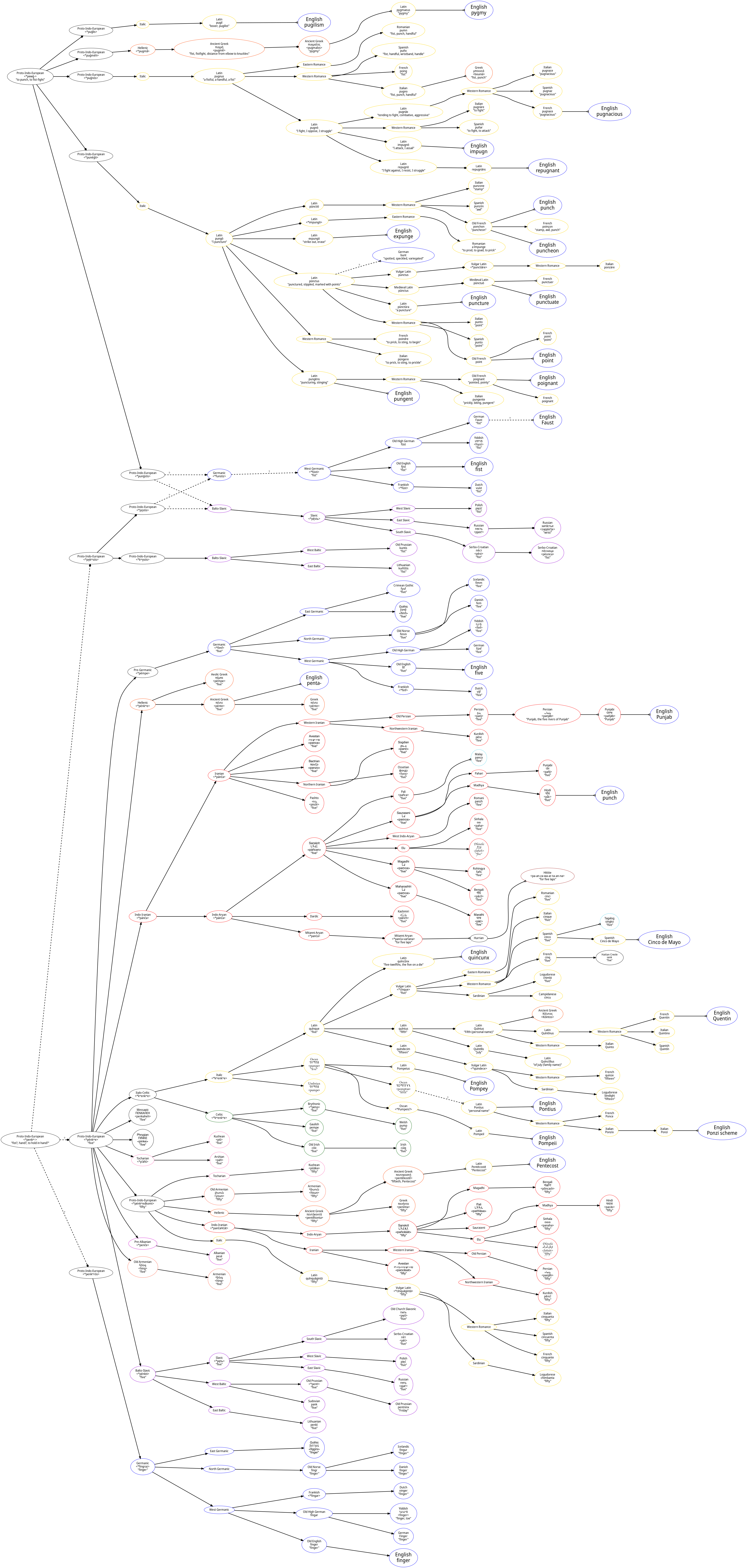
Collected English words
fist, Faust, finger, five, fifty, femto-, fifteen, penta-, punch, pachisi, Parcheesi, Punjab, Cinco de Mayo, quincunx, Pompeii, Pompey, fifth, Quentin, Ponzi scheme, Pontius, Pentecost, poignant, pungent, puncheon, punch, expunge, point, punctuate, puncture, fuck, pugilism, pygmy, impugn, repugnant, pugnacious, poniard, pentagon, Pentagon, triathlon, pentathlon, -athlon, pentagram
Footnotes
-
^
Oddly, Germanic seems to maintain several hand-related words apparently lost in most or all other branches, except in number words derived from them: hand from otherwise unattested *ḱomt, which apparently forms the basis of *déḱm̥: "ten" and *(d)ḱm̥tóm: "hundred", as well as this fist and finger from same root as *pénkʷe: "five". *pn̥kʷstis: "fist" is also attested in Balto-Slavic, but *penkʷrós: "finger" and *ḱomt: "hand" are only in Germanic.
-
^
The legendary German figure "Faust", after historical figure Johann Georg Faust, is generally derived from Latin faustus: "fortunate", used in Latin as a cognomen and the name of several early Christian martyrs and bishops. It's not clear what if any influence there is from German Faust: "fist". There is evidence of the German surname previously being spelled as "Fust" and then changing to "Faust", which is the same change as the word for "fist".
-
^
Note that Welsh pump (and Gaulish pempe) cannot come from the unassimalated *pénkʷe. In Proto-Celtic, all IE *p become Celtic *ɸ, and then lost in all surviving descendants. A Welsh form from *pénkʷe would look something like *emp instead. So even even though they start with p-, they are from *kʷénkʷe, with a re-emergence of the p from the regular *kʷ -> *p change in the "p-Celtic" languages such as Welsh and Gaulish.
Oscan and Umbrian forms with p could be from either *pénkʷe or *kʷénkʷe, since they have the same *kʷ -> *p, but in their case that merges *kʷ with inherited *p. But in this case it appears to be more parsimonious to assume *p -> *kʷ -> *p, than to assume an unchanged *p, so they are assumed to come from the same Italic *kʷénkʷe as Latin quīnque.
-
^
In Vulgar Latin decides it no longer likes the assimilated quīnque, and _dissimilates_ to *cinque. But in the Latin quīndecim: "fifteen", there is no second qu, and no dissimilation occurs, leaving Vulgar Latin *quindece. This leads to the phenomenon that in most Romance languages, the words for "five" and "fifteen" start with different sounds, e.g. French cinq (/sɛ̃k/) vs. quinze (/kɛ̃z/) or Logudorese Sardinian chimbe (/kim.bɛ/) vs. bindighi (/bin.di.ɡi/). (The Sardinian shows another one of those kw- to p- type changes).
In Eastern Romance languages, "fifteen" is re-derived from "five" as a calque of Old Church Slavonic пѧть на десѧте pętĭ na desęte: "five on (top of) ten", and so "five" and "fifteen" do match initial sounds: Aromanian tsintsi/tsisprã-dzatsi or Romanian cinci/cincisprezece.
The derivation for "fifty": Latin quīnquāgintā keeps the second qu, so it dissimilates to *cīnquāgintā like "five".