Teaser
work, work, energy, George, liturgy, surgeon, organic
Full Text
-
Proto-Indo-European *werǵ- to make
-
Proto-Indo-European *wérǵeti makes
- Albanian argëtój I entertain, I amuse
-
Celtic *wregeti does, makes
-
Brythonic *gwrėɣɨd
- Breton gran I make suppletive with ober borrowed from Latin
- Cornish gwrav I make
-
Middle Welsh gwneuthur
- Welsh gwneud doing, making
- Pictish ᚒᚏᚏᚐᚉᚈ urract he made
- Old Irish fairged they made
-
-
Proto-Indo-European *wr̥ǵti
-
Indo-Iranian *wr̥šti voicing assimilation from *wr̥ȷ́ti
-
Indo-Iranian *swawr̥šti
-
Indo-Aryan
- Sanskrit 𑀲𑁆𑀯𑀯𑀾𑀱𑁆𑀝𑀺 svávṛṣṭi epithet of Indra
-
-
-
-
Proto-Indo-European *wr̥ǵyéti makes intransitive/deponent imperfective?
-
Germanic *wurkijaną to work, to make
-
East Germanic
- Gothic 𐍅𐌰𐌿𐍂𐌺𐌾𐌰𐌽 waurkjan to work, to make
- Crimean Gothic warthata made
-
North Germanic ᚹᛟᚱᚨᚺᛏᛟ worahto I made Tune Stone
-
Old Norse yrkja to work, to compose
-
Old West Norse
- Icelandic yrkja to cultivate, to till
-
Middle English irken
- English irk
-
Old Norse orka work, strength
-
Old East Norse
- Danish orke
-
Old West Norse
- Icelandic orka strength, power, energy
-
-
-
-
West Germanic
-
Old English wyrċan to make, to work, to do
-
Middle English werken
- English work
- Scots wark / wirk work
- Yola woorkt worked
-
-
-
Finnic *pürkidäk to strive for, to tend to (do)
- Finnish pyrkiä to strive to, to pursue, to aspire to be, to tend to (do)
-
Samic *përkëtēk to work
-
Northern Sámi bargat to do, to work
- Northern Sámi bargu work, job
-
-
-
Hellenic *wreďďō
- Classical Greek ῥέζω rhézō I do, I make, I act
-
Indo-Iranian *wr̥ȷ́yáti
-
Indo-Aryan
- Sanskrit 𑀯𑀾𑀚𑁆𑀬𑀢𑁂 vṛjyáte to be turned, to be twisted
-
Iranian
- Avestan 𐬬𐬆𐬭𐬆𐬰𐬌𐬌𐬈𐬌𐬙𐬌 vərəziieiti does, works
-
-
-
Proto-Indo-European *wérǵyeti transitive imperfective?
- Albanian vërdhoj
-
Germanic *wirkijaną to make, to make happen
-
North Germanic
-
Old Norse virkja
-
Old East Norse
-
Danish virke to work, to function, to affect, to seem
- Icelandic virka to work, to function
-
-
Old West Norse
- Icelandic virkja to make work, to harness, to exploit
-
-
-
West Germanic *wirkijan
-
Old English wyrċan to make, to work, to do
-
Middle English werken
- English work
- Scots wark / wirk work
- Yola woorkt worked
-
-
Frankish *wirken
-
Middle Dutch werken
- Dutch werken to work
-
-
Old High German wirken
-
Middle High German wirken
- German wirken to work, to function, to seem, to take effect
-
-
-
-
Hellenic *wérďō
- Mycenaean Greek 𐀺𐀽𐀁 wo-ze-e to work
- Classical Greek ἔρδω érdō to act, to do, to perform
-
Proto-Indo-European *wr̥ǵtós worked, made adjective
-
Germanic *wurhtaz done, made, happened /past participle of *wurkijaną
-
West Germanic
-
Old English worht / ġeworht
-
Middle English wroghte
- English wrought
-
-
-
Germanic *wurhtijō worker, workman, maker
-
West Germanic
-
Old English wyrhta worker, maker
-
Middle English wrighte / wurhte
- English wright
-
-
Frankish *wurhto
- Dutch wrecht worker, builder, wright
-
-
-
-
Indo-Iranian
-
Iranian
- Avestan 𐬬𐬀𐬭𐬱𐬙𐬀 varšta done, complete, worked
-
-
-
Proto-Indo-European *wérǵom a work, a making
-
Old Armenian գործ gorc work, deed, action, business, effect
- Armenian գործ gorc work, job, business
-
Germanic *werką work (noun)
-
North Germanic
-
Old Norse verk work
-
Old East Norse
- Danish værk work, creation
-
Old West Norse
- Icelandic verk work, chore, creation
- Old Norse Bǫlverkr Bale-Worker, Evil-Doer (pseudonym of Odin)
-
-
-
West Germanic
-
Old English weorc
-
Old English Nīewe Weorc place name: New Work
-
Middle English
- English Newark
-
-
Middle English werk / wirk / work
- English work
- Scots wark
- Yola woork
-
-
Frankish *werk
- Dutch werk task, job, chore, creation
-
Old High German werc
-
Middle High German wërc
- German Werk creation, achievement, factory
-
-
Old Saxon
-
Middle High German werk
-
Middle High German bolwerk bulwark, stronghold
-
Dutch bolwerk
- English bulwark
-
French boulevard
- English boulevard
-
-
-
-
-
-
Hellenic *wérgon
-
Classical Greek ἔργον érgon work, labor, task, deed, result of work, creation
- Greek έργο work, project, creation
-
Classical Greek ἐργαλεῖον ergaleîon tool
-
Greek εργαλείο ergaleío tool
- Greek εργαλειοθήκη ergaleiothíki toolbox
-
-
Classical Greek ἐργάτης ergátēs worker, laborer, capstan, winch
- Greek εργάτης ergátis worker, laborer, servant, capstan, winch
-
Ottoman Turkish ارغات ırgat
- Turkish ırgat laborer (archaic), capstan, winch
- Albanian argat laborer
- Serbo-Croatian аргат argat laborer, peasant
-
English ergo-
- English ergonomic
-
-
Indo-Iranian *wárȷ́am
-
Indo-Aryan
- Sanskrit 𑀯𑀭𑁆𑀚 várja
-
Iranian
- Avestan 𐬬𐬀𐬭𐬆𐬰𐬆𐬨 varəzəm
-
-
Tocharian
- Arshian wark wickerwork, basketry
-
-
Proto-Indo-European *wérǵos working, a work
-
Celtic *wergos active
-
Brythonic
- Welsh gwery
-
Gaulish uercobretos chief magistrate of the Aedui
- Latin vergobretus chief magistrate of the Aedui
-
-
Hellenic
-
Classical Greek εργός ergós working, active, complete
-
German Allergie allergy learned construction "other-work", based on Energie
- English allergy
-
Classical Greek πανοῦργος panoûrgos all-working, willing to do anything, treacherous, sly
- French Panurge roguish character from Gargantua and Pantagruel
- English panurgy
-
Classical Greek ἐνεργός energós at work, active
-
Classical Greek ἐνέργεια enérgeia activity, vigor, workmanship, cosmic force
-
Latin energia
- English energy
- German Energie
-
-
-
Classical Greek άεργος / ἀεργός aergós not working, idle, lazy, incomplete
-
Classical Greek ἀργός argós not working, idle, lazy, incomplete contraction
-
New Latin argon
- Translingual Ar
- English argon
-
Classical Greek λήθαργος lḗthargos forgetful, lethargic
-
Classical Greek ληθαργία lēthargía
- English lethargy
-
-
-
-
-
-
Indo-Iranian
-
Indo-Aryan
- Sanskrit 𑀊𑀭𑁆𑀚𑁆 ū́rj vigor, strength, sap
-
Iranian
- Avestan 𐬬𐬀𐬭𐬆𐬰 varǝz strength, performance, work, activity
-
-
-
Proto-Indo-European *worǵós worker, maker
-
Hellenic *-worgós used in compounds
-
Mycenaean Greek -𐀺𐀒 -wo-ko
- Mycenaean Greek 𐀂𐀋𐀫𐀺𐀒 i-je-ro-wo-ko priest
- Mycenaean Greek 𐀆𐀓𐀶𐀺𐀒 de-ku-to-wo-ko net-maker
- Mycenaean Greek 𐀓𐀬𐀰𐀺𐀒 ku-ru-so-wo-ko goldsmith
-
Classical Greek -ουργός -ourgós
-
Classical Greek γεωργός geōrgós tilling the ground, farmer "earth-work"
-
Classical Greek Γεώργιος Geṓrgios personal name: Farmer
-
Latin Geōrgius
-
English George
-
English Prince George Land
- Russian Земля Георга Zemlya Georga place name: George Land
-
-
Low German Jürgen
- German Jürgen
- Danish Jørgen
-
-
-
-
Classical Greek χειρουργός kheirourgós craftsman, surgeon "hand-worker"
- Latin chīrūrgus surgeon
-
Classical Greek χειρουργία kheirourgíā handiwork, handicraft, surgery
-
Latin chīrūrgia surgery
-
Western Romance
-
Old French surgie
- English surgery
-
-
Latin *chīrurgiānus
-
Western Romance
-
Old French cerorgien / surgien / cirurgiien
-
Middle French chirurgien
- French chirurgien
-
Middle Dutch cirurgijn
- Dutch chirurgijn
-
Middle English surgien / cirurgien
- English surgeon / chirurgeon
-
-
-
-
-
-
Classical Greek Λῠκοῦργος Lukoûrgos personal name: Wolf-Worker
-
Latin Lycurgus
- English Lycurgus
-
-
Classical Greek λειτουργός leitourgós public servant "townhall worker"
-
Classical Greek λειτουργία leitourgíā public service, ministration
- Greek λειτουργία leitourgía function, service, liturgy, Mass
-
Latin lītūrgia liturgy
- English liturgy
-
-
Classical Greek μεταλλουργός metallourgós miner, metal-worker
-
French métallurgie
- English metallurgy
-
-
-
-
-
Proto-Indo-European *wérǵih₂
-
Celtic *wergā anger
-
Old Irish ferg anger, wrath
- Irish fearg anger
-
-
-
Proto-Indo-European *worǵéh₂
-
Hellenic *worgā́
-
Classical Greek ὀργή orgḗ temper, passion, anger, temperament
- Greek οργή orgí rage, anger
-
Classical Greek ὀργάω orgáō I am eager, I am excited, I ripen, I am aroused
-
Classical Greek ὀργασμός orgasmós eagerness, arousal, orgasm
- Greek οργασμός orgasmós
-
French orgasme
- English orgasm
-
-
Classical Greek ὀργίζω orgízō I anger, I irritate, I become angry
- Greek οργίζω orgízo I anger, I enrage
-
Classical Greek ὄργια órgia secret rituals, cultic practices
-
Latin orgia secret revel, festival of Bacchus, orgy
-
French orgie
- English orgy
-
-
-
-
-
Proto-Indo-European *worǵnom tool for work
-
Hellenic *worganon
-
Classical Greek ὄργανον órganon tool, instrument, musical instrument, sense organ
- Greek όργανο órgano body organ, musical instrument, appliance, equipment
- Aramaic 𐡀𐡅𐡓𐡂𐡍𐡅𐡍 ʾōrganōn instrument, tool, vessel, body organ
-
Old Armenian երգիոն ergion (pipe) organ
- Armenian երգեհոն ergehon (pipe) organ
-
Latin organum implement, tool, musical instrument
-
French organe organ
- English organ
-
French orgue (pipe) organ
- English orgue
- Persian ارگ org (pipe) organ
-
Latin organicus
-
French organique
- English organic
-
-
Medieval Latin organismus organism
-
English organism
- English cyborg
-
-
Medieval Latin organizāre to organize
-
Middle French organiser
- French organiser to organize
-
Middle English organizen
- English organize
-
Medieval Latin organizātiō / organizātiōnem
-
Middle French organisation
- French organisation
- English organisation / organization
-
-
-
- Persian ارغنون arğanun (pipe) organ
-
-
-
Visual
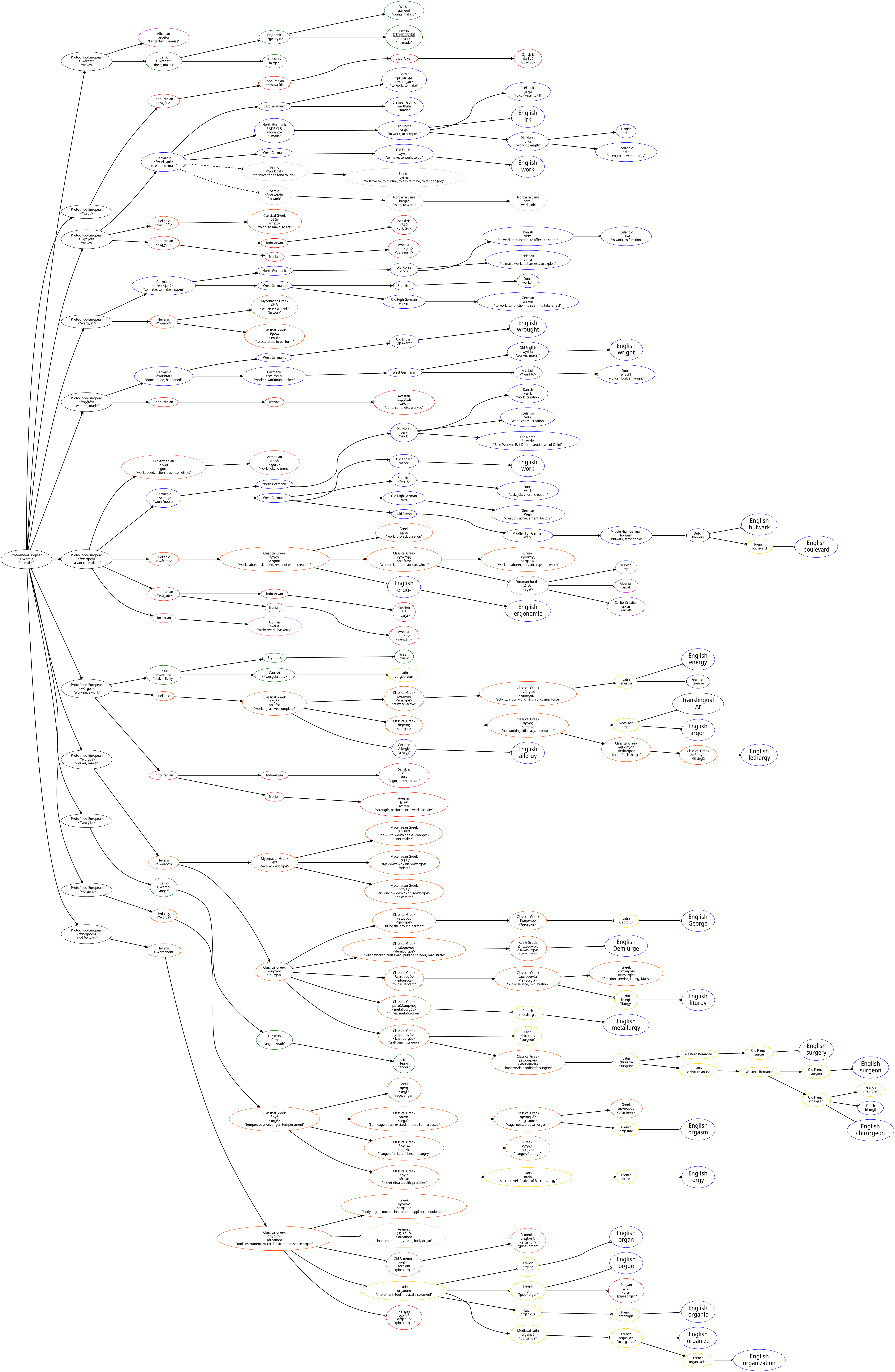
Collected English words
cyborg, Prince George Land, George, Newark, surgery, surgeon, bulwark, boulevard, Lycurgus, irk, work, wrought, wright, work, ergo-, ergonomic, energy, Ar, argon, lethargy, panurgy, allergy, Demiurge, liturgy, metallurgy, orgasm, orgy, organ, orgue, organic, organism, organize, organisation
Footnotes
-
^
I've always associated the Gnostic Demiurge with demigod, and assumed it was demi-: "half". But that's a Latin prefix. Demiurge actually has the demi- meaning "people, public" as in democracy or demographic instead. So a dēmiourgós was a public craftsman, often an engineer of public works.