Introduction
One neat discovery in this family is that English has words from three different compoundings of *h₃ekʷ- with *h₂énti: "opposite, near, in front" three different times: compounded in Proto-Indo-European *h₂énti-h₃kʷós goes through Latin antiquus to give antique and antic; compounded again in Late Latin as *anteocularis it goes through Old French antoillier to give antler; and finally compounded in scientific English of Greek roots as anti-optic.
Teaser
eye, daisy, window, antique, antler, binocular, person
Full Text
-
Proto-Indo-European *h₃ekʷ- to see, eye, to eye
-
Proto-Indo-European *h₃ókʷs eye
-
Proto-Indo-European *h₂nḗr-h₃ókʷs?? man-seeming??
-
Hellenic *ǝntʰrokʷos person, human
- Mycenaean Greek 𐀀𐀵𐀫𐀦 a-to-ro-qo person, human
- Arcadocypriot 𐠀𐠰𐠦𐠡𐠩 a-to-ro-po-se men
-
Classical Greek ἄνθρωπος ánthrōpos person, human, mankind
- Greek άνθρωπος ánthropos person, human
-
Classical Greek μισάνθρωπος misánthrōpos misanthropic, human-hating
-
Classical Greek μισανθρωπία misanthrōpía misanthropy, human-hatred
-
English misanthropy
- English misanthrope
-
-
-
Classical Greek λῠκάνθρωπος lukánthrōpos werewolf, wolf-man, lycanthrope
- Greek λυκάνθρωπος lykánthropos
- English lycanthrope
-
Classical Syriac ܩܢܛܪܘܦܘܣ qanṭropos werewolf, lycanthrope
- Arabic قطرب quṭrub werewolf, lycanthrope
-
Classical Greek ἄνθρωπολόγος anthrōpologos discussion of a human, discussion of humanity
-
New Latin anthropologia
-
French anthropologie
- English anthropology
-
-
-
English anthropo-
- English anthropomorphic
- English Anthropocene
-
-
Balto-Slavic *aks
-
Baltic
-
East Baltic
- Lithuanian akìs eye
-
West Baltic
- Old Prussian ackis eye
-
-
Slavic *ȍko
-
East Slavic
- Ukrainian око oko eye
-
South Slavic
- Old Church Slavonic ⱁⰽⱁ / око oko eye, sight
- Serbo-Croatian око / oko eye
-
West Slavic
- Czech oko eye
- Polish oko eye, sight
-
Slavic *okъnò window
-
East Slavic окно okno
- Russian окно okno window
- Ukrainian вікно vikno window
-
South Slavic
-
Old Church Slavonic окно okno
- Romanian ocnă mine, prison
- Serbo-Croatian окно / okno pane, shaft, pit
-
-
West Slavic
- Czech okno window
- Polish okno window, shaft
-
Finnic *akkuna window
- Estonian aken window
- Finnish akkuna window dialectic
-
Finnic *ikkuna window variant
- Finnish ikkuna window
- Hungarian akna window
-
-
-
-
Celtic *okʷs eye
-
Gaulish ops eye
-
Gaulish exops eyeless, blind
-
Latin ab oculīs blind
-
Western Romance
-
Old French avogle / aveule blind, blind person
-
Middle French avegule
-
French aveugle
- Haitian Creole aveg blind
-
-
-
-
-
- Gaulish *sacrap- evil eye
- Gaulish Cenopillus
-
-
-
Pre-Germanic *agz?
-
Germanic *augô eye modified by association with *ausô: "ear" from *h₂ṓws
-
East Germanic
- Gothic 𐌰𐌿𐌲𐍉 augō eye
- Crimean Gothic oeghene eyes only attested in plural
-
North Germanic
-
Old Norse auga eye
-
Dalecarlian
- Övdalian oga eye
-
Old East Norse
- Danish øje eye
- Swedish öga eye
-
Old West Norse
- Faroese eyga eye, view
- Icelandic auga eye
-
Old Norse vindauga window
- Danish vindue window
- Swedish vindöga window (archaic)
-
English window
- English windowpane
- Irish fuinneog window
-
Old Norse augasteinn pupil (of the eye)
-
Old East Norse
- Danish øjesten apple of one's eye
- Swedish ögonsten apple of one's eye
-
Old West Norse
- Icelandic augasteinn pupil, lens
-
-
-
-
West Germanic *augā
-
Old English ēage eye
-
Old English dæġes ēage daisy lit. "day's eye"
-
Middle English dayesye daisy
- English daisy
-
-
Middle English eyȝe / eie / eye eye
- English eye
- Scots ee eye
- Yola iee eye
- Old English ēagþyrel window lit "eye-hole"
-
-
Frankish *oga
-
Middle Dutch oge eye, gaze
- Dutch oog eye
-
-
Old High German ouga eye
-
Middle High German ouge eye
- German Auge eye
- Yiddish אויג oyg eye
-
-
West Germanic *augāhlid eyelid
-
Old English *ēaghlid
-
Middle English
- English eyelid
-
-
Frankish *ogahlid
-
Middle Dutch
- Dutch ooglid eyelid
-
-
Old High German *ougenhlit
-
Middle High German
- German Augenlid eyelid
-
-
-
-
Germanic *augjaz eyed, having eyes (of a certain type)
-
North Germanic
-
Proto-Norse augiʀ
- Proto-Norse ᚷᛚᛇᚨᚢᚷᛁᛉ glïaugiʀ gleaming? eyed
- Old Norse eygr
-
-
-
Germanic *augijaną to show, to cause to see
-
East Germanic
- Gothic 𐌰𐌿𐌲𐌾𐌰𐌽 augjan to show
-
North Germanic
-
Old Norse eygja to eye
-
Old West Norse
- Icelandic eygja
-
-
-
West Germanic
- Old English īewan to show, to appear
-
Old Saxon ōgian
-
Low German ögen
-
Low German ögelen frequentive
- English ogle
-
-
-
-
-
-
Hellenic *ókʷs
-
Hellenic *áitʰ-ókʷs "eye-burning"
- Classical Greek αἶθοψ aîthops gleaming, sparkling, blazing
-
Hellenic *áitʰiókʷs
- Mycenaean Greek 𐀀𐀂𐀴𐀍𐀦 a-i-ti-jo-qo Ethiopian
-
Classical Greek Αἰθίοψ Aithíops Ethiopian
-
Classical Greek Αἰθιοπία Ethiopia
-
Latin Aethiopia Ethiopia
-
English Ethiopia
- Hawaiʻian ʻAikiopa Ethiopia
-
- Amharic ኢትዮጵያ ʾityop̣p̣ya Ethiopia
-
-
-
Classical Greek κώνωψ kṓnōps gnat, mosquito
-
Classical Greek κωνώπιον kōnṓpion diminutive
-
Greek κουνούπι kounoúpi mosquito
- Aromanian cunupi mosquito
-
-
Classical Greek κωνωπεῖον kōnōpeîon an Egyptian couch with mosquito netting
-
Latin cōnōpēum / canōpēum / canāpēum mosquito net, canopy, seat with a canopy
-
Western Romance
-
Old French conope / canope
-
Middle French
-
French canapé sofa, hors d’oeuvre, canapé
- English canapé
- Greek καναπές kanapés sofa, settee
-
-
Middle English canape / canapy / canope canopy
-
English canopy
- French canopée (forest) canopy
- Spanish canopy / canopi (canopy) zipline
-
-
-
-
-
-
-
Classical Greek ὄψ / ὤψ óps ṓps eye, face
-
Translingual Camelops a taxonomic genus of extinct camels
- Translingual Camelops hesternus species name: Yesterday's Camel
-
Translingual Ceratops an obsolete taxonomic genus of ornithiscian dinosaurs
- Translingual Ceratopsia the Ceratopsians, a taxonomic suborder of ornithiscian dinosaurs
- Translingual Triceratops a taxonomic genus of Ceratopsians lit. "three horn face"
-
-
Classical Greek ὀφθαλμός ophthalmós
- Greek οφθαλμός ofthalmós eye, bud
- English ophthalmo-
-
-
Indo-Iranian *Hákš eye
-
Indo-Aryan *Hákṣ
-
Indo-Aryan *anHákṣ
- Vedic Sanskrit 𑀅𑀦𑀓𑁆 अनक् anák blind
-
-
-
Tocharian *ëk
- Arshian ak eye
- Kushean ek eye
-
Tocharian *tärrek blind [1]
- Arshian trak blind
- Kushean tärrek blind
-
Tocharian *tāpāki- mirror
- Arshian tāpaki mirror
- Kushean tapākye mirror
-
Proto-Indo-European *h₃ókʷih₁ eyes (dual)
-
Pre-Albanian *asī
- Albanian sy eye
- Old Armenian աչք ačʻkʻ eyes, sight
-
Hellenic *óťťe
- Classical Greek ὄσσε ósse eyes
-
Indo-Iranian *HáčiH
-
Indo-Iranian *Hákši eye
-
Indo-Aryan *Hákṣi
-
Sanskrit 𑀅𑀓𑁆𑀱𑀺 ákṣi eye
-
Elu
- Dhivehi ލޮަ loa eye
- Sinhala ඇස æsa eye
-
Magadhi
- Bengali আঁখ ãkh eye
-
Sauraseni 𑀅𑀓𑁆𑀔𑀺 akkhi
-
Madhya Sauraseni
- Hindi आँख ā̃kh eye, sight
-
Northwestern Sauraseni
- Kashmiri أچھ ạch eye
- Punjabi ਅੱਖ akkh eye, sight
-
Western Sauraseni
- Romani jakh eye
-
- Telugu அக்கு akku eye
-
-
-
Iranian *Háxši *Háši
- Avestan 𐬀𐬱𐬌 aši eyes
-
Western Iranian
-
Old Persian
-
Middle Persian 𐭠𐭱 āš
- Persian اش aš -eye
-
-
-
-
-
Nuristani
- Ashkun aćī́ eye
- Kamviri ačé eye
-
Proto-Indo-European *h₁én-h₃ókʷih₁ in the (two) eyes, seen
-
Tocharian
-
Kushean yneś obvious, real
- Kushean yneśaññe the present, the current time
-
-
-
-
Proto-Indo-European *h₃ekʷō *h₃kʷn-
-
Old Armenian ակն akn eye
- Armenian ակն akn eye
-
-
Proto-Indo-European *-h₃kʷos combining form
-
Proto-Indo-European *h₂époh₃kʷos looking back
-
Balto-Slavic
-
East Baltic
- Lithuanian apúokas eagle owl for being able to turn their head around and look backward
-
Slavic *opakъ
-
South Slavic
- Serbo-Croatian опак opak wicked, spiteful, severe
-
-
-
Germanic *abuhaz backwards, inverted, wicked
-
East Germanic
- Gothic 𐌹𐌱𐌿𐌺𐍃 ibuks backward, back
-
North Germanic
-
Old Norse ǫfugr / afigr backward, unkind, harsh
-
Old East Norse
- Danish avet backward
-
Old West Norse
- Icelandic öfugur backward, inverted, wrong, inside out, queer
-
Middle English awke
- English awk
-
Middle English aukeward in the wrong direction
- English awkward
-
-
-
West Germanic
-
Old English *afuh
- Old English afuhlic perverse, evil
-
Old High German abuh
-
Middle High German ebich
- German äbich inside out
-
-
-
-
-
Indo-Iranian
-
Indo-Aryan
- Sanskrit 𑀅𑀧𑀸𑀜𑁆𑀘𑁆 apāñc facing backward, behind, western
-
-
Proto-Indo-European *h₁éni-h₃kʷos face lit. "in-eye"
-
Celtic *enīkʷom face
-
Brythonic *eneb face
- Breton eneb face, honor, opposite
- Cornish enep face, surface
- Old Welsh enep surface, page
-
Primitive Irish *ineqa-
- Primitive Irish ᚔᚅᚓᚊᚐᚌᚂᚐᚄ ineqaglas personal name: Green/Blue/Grey-Face
-
Old Irish enech face, front, honor
-
Middle Irish enech / einech / ainech
- Irish oineach honor, honorary
-
-
Celtic *eɸi-enīkʷom
-
Brythonic *eieneb
- Welsh wyneb face
-
-
-
Hellenic *enōkʷā́
- Classical Greek ἐνωπή enōpḗ face
-
Indo-Iranian *HániHkas
-
Indo-Aryan
- Sanskrit 𑀅𑀦𑀻𑀓 ánīka face, appearance, front
-
-
-
Proto-Indo-European *h₂énti-h₃kʷos in front of the eye, before the eye, across from the eye
-
Indo-Iranian
-
Indo-Aryan
- Sanskrit 𑀅𑀦𑁆𑀢𑀺𑀓 antiká near, close by, across from
-
-
Italic *antīkʷos
-
Latin antīquus former, earlier, old
-
Central Romance
-
Italian antico old, ancient
- English antic
-
-
Old French antic
-
Middle French
-
French antique
- English antique
-
-
-
-
-
-
Proto-Indo-European *h₂eh₁tro-h₃kʷs fire-sight, seeming like a fire
-
Italic *ātrōks
-
Latin atrox terrible, frightening, fierce, cruel
-
Central Romance
- Italian atroce atrocious, dreadful, ghastly
-
Western Romance
- Spanish atroz atrocious, horrible, appalling
-
Latin atrocitas atrocity, suffering, disaster
- English atrocity
-
-
-
- Proto-Indo-European *ni-h₃kʷos below the eye, looking downward
-
Proto-Indo-European *préti-h₃kʷos in front of the eye, towards the eye
-
Hellenic
-
Archaic Ionic Greek *protiōpon
- Classical Greek πρόσωπον prósōpon
-
Etruscan 𐌘𐌄𐌓𐌔𐌖 φersu mask, masked actor
-
Etruscan *φersuna
-
Latin persōna mask, character, role, personality, grammatical person
-
Central Romance
- Italian persona person, someone, anyone
-
Western Romance
-
Old French persone person, individual, rector of a parish, someone
-
Middle French
- French personne / persoun person, grammatical person, no one, anyone
-
Middle English persoun / personne
- English person
- English parson
-
-
-
English persona
- Japanese ペルソナ perusona persona
-
Latin persōnālis
- English personal
-
French personnel
- English personnel
-
-
-
-
-
Indo-Iranian
-
Indo-Aryan
- Sanskrit 𑀧𑁆𑀭𑀢𑀻𑀓 prátīka surface, form, appearance, image
-
-
Tocharian
- Kushean pratsāko chest, breast
-
- Proto-Indo-European *h₂nḗroh₃ókʷs?? man-seeming??
-
Proto-Indo-European *h₁n̥dʰéreh₃kʷós?? seen below?? earthly??
-
Hellenic *ǝntʰrokʷos person, human
- Mycenaean Greek 𐀀𐀵𐀫𐀦 a-to-ro-qo person, human
- Arcadocypriot 𐠀𐠰𐠦𐠡𐠩 a-to-ro-po-se men
-
Classical Greek ἄνθρωπος ánthrōpos person, human, mankind
- Greek άνθρωπος ánthropos person, human
-
Classical Greek μισάνθρωπος misánthrōpos misanthropic, human-hating
-
Classical Greek μισανθρωπία misanthrōpía misanthropy, human-hatred
-
English misanthropy
- English misanthrope
-
-
-
Classical Greek λῠκάνθρωπος lukánthrōpos werewolf, wolf-man, lycanthrope
- Greek λυκάνθρωπος lykánthropos
- English lycanthrope
-
Classical Syriac ܩܢܛܪܘܦܘܣ qanṭropos werewolf, lycanthrope
- Arabic قطرب quṭrub werewolf, lycanthrope
-
Classical Greek ἄνθρωπολόγος anthrōpologos discussion of a human, discussion of humanity
-
New Latin anthropologia
-
French anthropologie
- English anthropology
-
-
-
English anthropo-
- English anthropomorphic
- English Anthropocene
-
-
-
Proto-Indo-European *h₃ekʷelos
-
Italic *okʷelos eye
-
Latin oculus / oclus eye, sight
-
Latin ab oculīs blind
-
Western Romance
-
Old French avogle / aveule blind, blind person
-
Middle French avegule
-
French aveugle
- Haitian Creole aveg blind
-
-
-
-
-
Central Romance
- Dalmatian uaclo eye
- Italian occhio eye
-
Eastern Romance
- Aromanian oclju eye
- Romanian ochi eye
-
Insular Romance
- Sardinian ogru eye
-
Western Romance
- Catalan ull eye
-
Old French ol / oil / ueil eye
-
Middle French œil eye
-
French œil eye
-
French trompe-l’œil
- English trompe l’oeil
-
-
-
- Spanish ojo eye
- English oculus
-
Latin ocularis
-
French oculaire
-
French binoculaire
- English binocular
-
-
-
Latin inoculare to graft (an eye or bud) of one tree into another, to implant
- English inoculate
-
Latin *anteocularis in front of the eyes
-
Western Romance
-
Old French antoillier antler, horn [2]
- French andouiller tine of an antler
-
Middle English
- English antler
-
-
-
-
-
-
-
Proto-Indo-European *h₃ékʷmn̥ a seeing, a look action/result noun
-
Hellenic *ókʷmə
-
Archaic Greek *ópma
- Aeolic Greek ὄππα
-
Ionic Greek
-
Classical Greek ὄμμα eye, light, face oblique stem ὄμματ- ómmat-
-
Classical Greek ὀμμάτιον diminutive
-
Byzantine Greek μάτιν matin
- Greek μάτι máti eye
-
- Translingual Ommata taxonomic genus of longhorn beetles
-
-
-
-
-
Proto-Indo-European *h₃kʷtós seen, visible
-
Hellenic
-
Classical Greek ὀπτός optós seen, visible
-
Classical Greek ὀπτικός optikós visual, optical
-
Latin opticus
-
English optic
- English anti-optic
-
-
-
-
-
-
Proto-Indo-European *h₃ékʷtis
-
Classical Greek ὄψις ópsis view, sight, countenance
-
Greek όψη ópsi appearance, aspect
-
Classical Greek σύνοψις súnopsis seeing all together, general view, synopsis, estimate
-
Latin synopsis list, synopsis, overview
- English synopsis
-
-
-
-
-
Proto-Indo-European *?-h₃ókʷo-
-
Anatolian *sṓgʷos eye
- Hittite 𒃲𒄭𒀀𒅖 šakawiš eye
-
Luwic
- Cuneiform Luwian 𒁕𒀀𒌋𒄿𒅖 tāwīš eye
- Hieroglyphic Luwian 𔑰𔗬 ta-wa- eye
-
Lycian 𐊗𐊁𐊇𐊁 tewe eyes
- Lycian 𐊑𐊗𐊁𐊇𐊚 ñtewẽ facing, opposite, towards
-
-
Visual
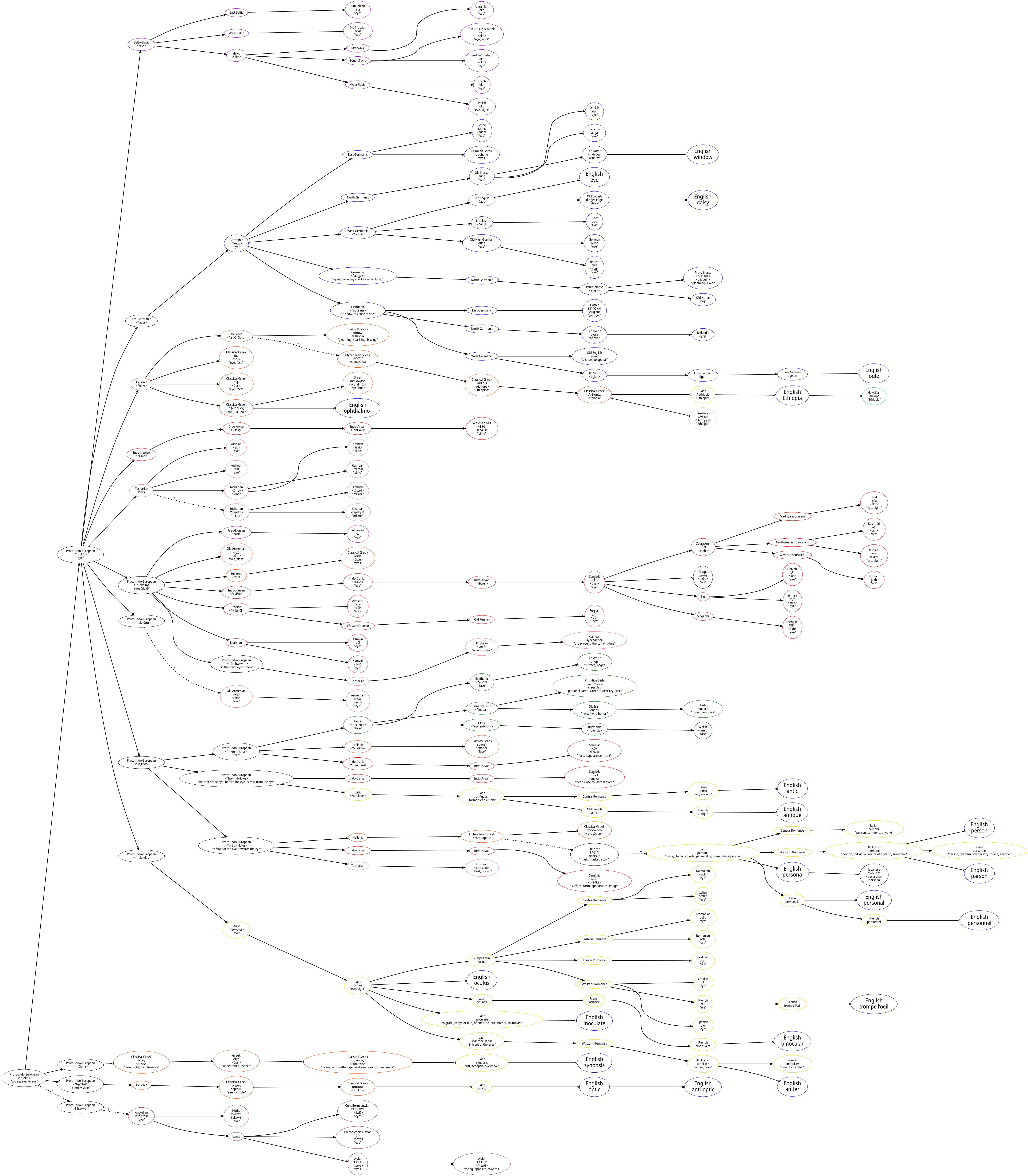
Collected English words
daisy, misanthropy, misanthrope, anthropology, anthropo-, anthropomorphic, Anthropocene, eye, eyelid, ogle, Ceratops, ophthalmo-, awk, awkward, antic, antique, person, parson, persona, personal, personnel, trompe l’oeil, oculus, binocular, inoculate, antler, Ommata, optic, anti-optic, synopsis, Ceratopsia, Triceratops, windowpane, atrocity, window, lycanthrope, Camelops, Camelops hesternus, Ethiopia, canapé, canopy
Footnotes
-
^
In Tocharian *tärrek: "blind, blind person", the second element is ek: "eye", while the the first element is probably cognate to "stare". Compare West Germanic *stareblind: "completely blind", which gives Dutch staarblind, Old English stæreblind, and German Star-deu-Latn: "cataract (eye disease)".
-
^
Latin *anteocularis: "in front of the eyes"—Old French antoillier: "antler, horn", English antler—effectively re-creates Proto-Indo-European *h₂énti-h₃kʷos: "in front of the eye"—whence Latin antiquus, antique.