Indo-European Ninety-Nines
In the coming week, it will be September 9th, 9-9! And this particular September 9th would also be my grandfather's 99th birthday. The corresponding Word Family also came out this week.
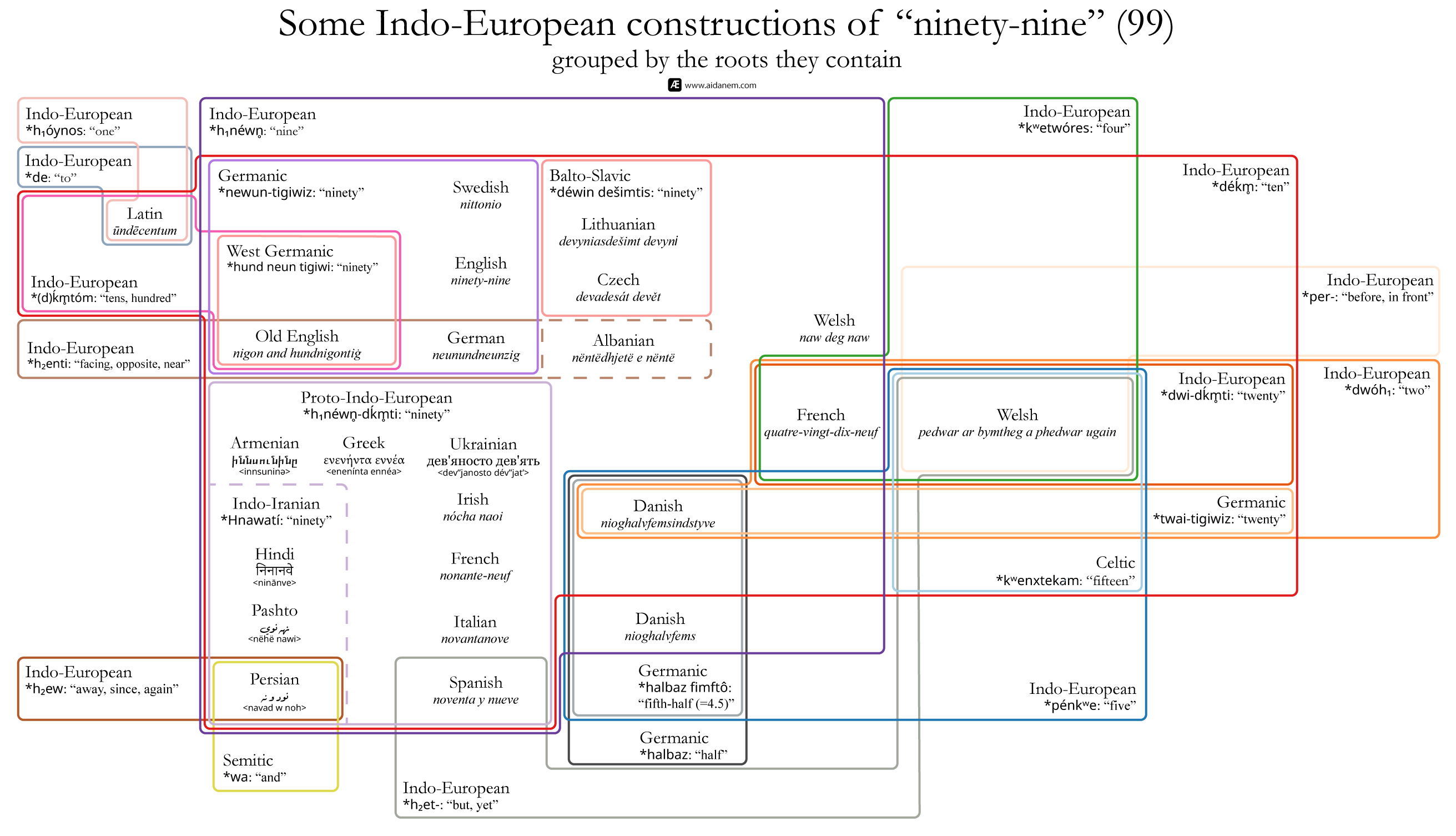
Notes
Four-score
As different as they may look, French quatre-vingt and Welsh phedwar ugain are exact cognates, reflecting Proto-Indo-European *kʷetwóres (d)wi-(d)ḱm̥ti ("four twice-tens") for 80.
Welsh pedwar ar bymtheg a phedwar ugain, "four past fifteen and four twenties", stands out as one of only two of the words for 99 on this chart that do not contain the root *h₁néwn̥: "nine"
The other is the Latin ūndēcentum, "one to hundred", a variant used primarily by Pliny the Elder in contrast to the more usual nonaginta novem or novem et nonaginta that are represented in Italian novantonove and Spanish noventa y nueve.
Welsh a ("and") in pedwar ar bymtheg a phedwar ugain is derived from the same PIE as Latin et and Spanish y.
Four-and-a-half-score
The Danish nioghalvfems, "nine-half-fifth", on the other hand, stands out as the only one on the chart that does not contain the root *déḱm̥.
Though it is a contraction of a form that does contain *déḱm̥: nioghalvfemsindstyve, "nine half-fifth times twenty", i.e. nine plus 4.5 × 2 × 10. "half-fifth" for 4.5 continues an old Germanic system for talking about halves in which the "first half" is the one between 0 and 1, the "second half" is the one between 1 and 2, etc.
And and And
In addition to the "and"s used in Latin and Welsh, from Proto-Indo-European *(h₁)éti: "beyond, over, and"; there are some other "and" words on the chart. Old English and German use Germanic *andi: "after that, furthermore, and", from PIE *h₂enti: "facing, opposite, near". Albanian e: "and" is shortened from older ende and likely also reflects *h₂enti.
Fascinatingly, Persian has two different words for "and" with different etymologies and different pronunciations, but the same spelling! و u ("and") is from Indo-European *h₂ew ("away, since, again"); but و wa (also "and") is borrowed from Arabic and comes from Semitic *wa ("and").
Classical Greek would also have used an "and", καί kaí, in 99, ἑπτα καὶ ἐνενήκοντα, but modern Greek does not in ενενήντα εννέα.
The Indo-Iranian 90
Indo-Iranian *Hnawatí, likely continues the same Indo-European *h₁néwn̥-dḱm̥ti> as seen in Armenian, Greek, East Slavic, Irish, and the Romance languages, but it is irregular so it is not certain. The expected form would be **Hnawaćatí.
Slavic and East Baltic 9 and 90
per WFF-Nine's footnotes:
Balto-Slavic *néwin/*déwin: "nine" and*newintas/*dewintas: "ninth" come in both the expected *n forms, attested in West Baltic†, and irregular *d forms, in East Baltic and Slavic.
It is unclear exactly why it became *d; some possibilities include change by analogy to *déśimt: "ten"; articulatory dissimilation from the second <*n>; a blending of the features of [n] and [ʔ] (the likely value of *h₁) into [d]; or maybe even some sort of reverse Kortlandt effect (the Kortlandt effect usually dissimilates *d into *h₁ when followed by a dental).
† Or rather, in Old Prussian. No other West Baltic language is preserved well enough to attest these words. The Narew glossary of an apparent West Baltic language (probably Sudovian) contains the numbers one through eight, but then stops just before nine—arguably the most interesting number to record in a West Baltic language!